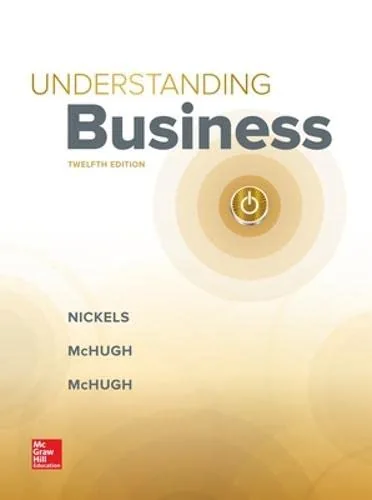
Understanding Business, twelfth edition, introduces the major functions and settings of business for undergraduate students and readers beginning business study. It brings together ownership, entrepreneurship, management, marketing, finance, and human resources, with attention to global trade, ethical choices, and the relationships among everyday organizational decisions.
Inside this title
Business ownership, entrepreneurship, management, and organizational leadership
Current listed price $13.99Regular price $25.00Digital ebook
A business operates through connected decisions about people, products, money, and markets. This introductory text surveys those connections, beginning with forms of ownership and the environment in which organizations compete. Entrepreneurship, management responsibilities, leadership, and human resource practices establish the organizational side of the subject.
Marketing coverage introduces product, price, distribution, and promotion, including digital marketing. Financial topics address statements, cash flow, and investment decisions, while international business brings in trade barriers, exchange rates, and market entry. Ethics and social responsibility appear alongside these functional areas. The twelfth edition provides a broad course framework for students comparing business disciplines and developing the vocabulary to study them further.
Study guide included
Inside Understanding Business, 12th Edition.
A first course in business usually arrives as separate subjects. This twelfth edition keeps them attached to one question: how does a firm turn what customers value into work that can be paid for? Financing, staffing, distribution, and reporting appear as parts of that answer rather than as isolated chapters.
The book opens with risk, economic systems, trade, and the obligations a company owes to people beyond its owners. From there it works through ownership forms, the planning cycle, operations, and employment, then builds the marketing mix and closes on accounting, securities, and banking. The sequence matters: an income statement, a staffing choice, and a distribution deal are treated as evidence about the same enterprise. Readers are pushed to ask which condition is actually causing a weak result before they change a price, a schedule, or a campaign. The edition line is 12th edition, McGraw-Hill Education, 2019.
External conditions and responsible decisions
Founders put money and time at risk before demand is proven, so the surrounding economy belongs in the analysis. Productivity, joblessness, inflation, and the cycle all shift what buyers can do. Microeconomics looks inside a single market; macroeconomics looks at the aggregate. Comparative advantage explains why trade can pay even for a strong producer, while ethics asks who bears the cost of a choice.
Separate market demand from economy-wide pressure
Weigh delivery, currency, and labor risk
Test whether a decision can be defended publicly
Ch. 1–4 · Environment, economics, trade, ethics
Ownership, authority, and management cycle
Proprietorship, partnership, and corporation divide control, liability, funding access, and continuity in different ways. Franchising supplies a proven system plus operating conditions; an independent founder must invent the system. Whatever the form, the plan should state what is sold, which resources are required, and how the operation supports the financing chosen. Management then cycles through planning, organizing, leading, and controlling, and structure decides where expertise sits and how fast a problem escalates.
Match ownership form to liability and funding needs
Operations management lines up people, materials, equipment, and information so the promise made to buyers can be kept. Site choice, suppliers, stock levels, scheduling, and process design all set capacity. Lean thinking targets waste; quality work means preventing repeat defects and coordinating with suppliers early. On the people side, recruiting, training, appraisal, and pay shape performance, and a manager should find out whether a shortfall comes from skill, unclear expectations, scarce resources, or perceived unfairness.
The marketing concept starts with what a buyer needs and then coordinates product, service, and price around it. Research and environmental scanning test assumptions; segmentation gathers buyers whose similarities matter for the decision. Consumer and business markets differ in criteria and routine. Relationship marketing adds repeat satisfaction to the acquisition count, which changes the measures a firm watches. Price is judged against the whole bundle: the item, brand, service, packaging, convenience, and expected support.
Group buyers by what changes their choice
Price the bundle, not just the item
Track repeat business alongside new accounts
Ch. 13–14 · Marketing, goods and services, pricing
Channel design and coordinated promotion
Intermediaries perform transport, storage, information, assortment, and service work; a direct channel keeps control but pushes those tasks inside the firm. The right comparison asks how an arrangement handles the buyer's purchase and the firm's inventory and service obligations. On communication, advertising builds recognition, selling answers complicated questions, public relations shapes awareness, and promotion prompts a timely response. Match the mix to audience and purpose, then pick a measure that can detect the intended response.
Compare channel cost against channel work
Set the goal before the media
Measure the response the message sought
Ch. 15–16 · Distribution and promotion
Statements, budgets, and financing choices
The balance sheet lists resources, obligations, and owner claims at a moment; the income statement tracks revenue and expense across a period; the cash flow statement explains movement in cash. Ratios turn those figures into questions about profitability, liquidity, and leverage, read beside industry and period peers. Budgets separate cash, capital, and operating commitments. Short-term financing covers timing gaps, longer investments need repayment and ownership decisions, and securities markets plus banking set what funding costs.
Marketing and Developing Goods and ServicesCh. 13–14
Distribution and promotionsCh. 15–16
Accounting and financial managementCh. 17–18
Securities markets, money, and bankingCh. 19–20
Key takeaways
Trace a weak result to demand, capacity, or an overpromise before adjusting price or staffing.
Give every promotion a measure that can show whether the intended response occurred.
Chart payment and collection dates before expanding a service whose costs arrive early.
Undergraduate students in an introductory business course, and self-taught founders who want one map of ownership, operations, marketing, and finance rather than a stack of disconnected tutorials.
Topics covered
business fundamentals
introductory business course
business functions overview
ownership structures
operations management basics
marketing mix
financial statements
small business planning
Other editions of this title.
Compare editions, prices, and book details before you choose.
Edition, audience, and study-guide details at a glance.
What is Understanding Business, 12th Edition about?
Understanding Business, twelfth edition, introduces the major functions and settings of business for undergraduate students and readers beginning business study. It brings together ownership, entrepreneurship, management, marketing, finance, and human resources, with attention to global trade, ethical choices, and the relationships among everyday organizational decisions.
Which edition of Understanding Business, 12th Edition is this?
This listing is for the 12th edition. Check the title, ISBN, and book details above before ordering, especially if your course or reading list names a specific edition.
Who is Understanding Business, 12th Edition for?
Undergraduate students in an introductory business course, and self-taught founders who want one map of ownership, operations, marketing, and finance rather than a stack of disconnected tutorials.
Does this page include a study guide?
Yes. This page includes an original study guide with six thematic sections, key takeaways, and a chapter and section map for structured reading.