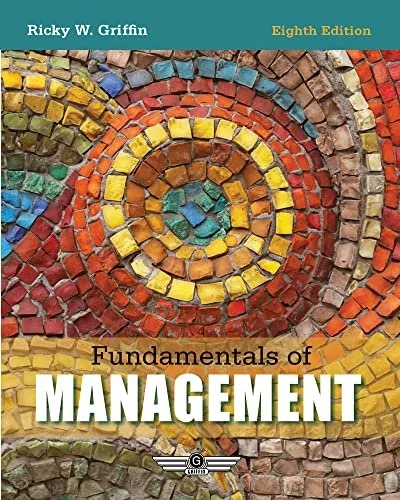
Ricky W. Griffin's Fundamentals of Management, 8th Edition, introduces planning, organizing, leading, and controlling for students beginning management studies. Examples and a skills-based approach connect organizational structure, strategy, motivation, human resources, and performance control with ethical decisions, diversity, globalization, and the use of technology.
Inside this title
Planning, organizing, leading, and controlling management functions
Current listed price $29.99Regular price $85.00Digital ebook
The four management functions provide the organizing framework for this introductory textbook. Planning covers goals and strategy; organizing examines authority, departmentalization, and coordination. Leadership and motivation explain how managers work with people, while control systems address the measurement and adjustment of organizational performance.
Griffin connects these topics with examples of managerial activity and opportunities to apply concepts through coursework. Human resource management adds recruitment, training, and appraisal to the discussion. Ethical responsibilities, workforce diversity, globalization, and technology place everyday decisions in their broader organizational setting. The eighth edition is suited to introductory business courses and readers seeking a structured foundation in how organizations are managed.
Study guide included
Inside Fundamentals of Management, 8th Edition.
An introductory management study guide organised around planning, organising, leading, and controlling, connecting strategy, structure, motivation, human resources, and performance measurement with ethics, diversity, global operations, and the practical skills expected of people entering management for the very first time.
The four management functions organise this introductory text. Planning covers goals and strategy; organising examines authority, departmentalisation, and coordination. Leadership and motivation explain how managers work through people, while control systems address measurement and adjustment of performance. Griffin links each topic to examples of managerial activity and to coursework that asks readers to apply the concepts. Human resource management adds recruitment, training, and appraisal. Ethical responsibility, workforce diversity, globalisation, and technology place routine decisions in a wider organisational setting. The eighth edition suits introductory business courses and independent readers who want a structured foundation in how organisations are managed.
Planning, goals, and strategy
Planning sets direction before action. The guide covers how goals are formed, how strategy connects an organisation to its environment, and how plans translate intention into decisions others can follow. It treats planning as a process with trade-offs, not a document produced once, and links the topic to the later functions that carry a plan into structure and behaviour.
Form goals that guide later decisions
Connect strategy to the environment
Treat planning as an ongoing process
Begin here; organising, leading, and controlling each respond to a plan.
Organizing authority and structure
Organising turns plans into arrangements of work. The guide examines authority, departmentalisation, coordination, and the design choices that determine how tasks and people fit together. Structure is presented as a response to strategy and size rather than a fixed template, so readers can see why different organisations organise differently and what coordination costs accompany each choice.
Choose a basis for departmentalisation
Match structure to strategy and size
Recognise the cost of coordination
Read with the planning section open; structure should follow from stated goals.
Leading and motivating people
Leadership and motivation explain how managers work through others. The guide presents theories of motivation alongside the leadership behaviour that shapes effort and commitment, and it connects both to the workplace conditions that sustain performance. Readers are asked to consider how a manager's approach fits the people and task at hand rather than to adopt one universal style.
Match leadership approach to the situation
Connect motivation theory to workplace conditions
Consider people and task together
Read after structure, since leadership operates inside an organisational arrangement.
Control and performance measurement
Control closes the management cycle by measuring performance and adjusting activity. The guide covers the systems that gather information, the standards against which results are judged, and the corrective action that follows a gap. It presents control as a feedback process that can help or distort behaviour, depending on what is measured and how results are used.
Set standards for judging results
Gather information that supports correction
Watch for distortion caused by measurement
Read last among the four functions; control tests whether the earlier plan worked.
Human resource management and staffing
Human resource management adds the people processes that support organising: recruitment, training, and appraisal. The guide connects these to the wider management functions, showing how staffing decisions follow from structure and strategy and how appraisal feeds back into development and control. The theme treats HR as a managerial responsibility rather than a separate specialist domain.
Link recruitment to structure and strategy
Use training to build required capability
Connect appraisal to development and control
Read alongside organising and control, where staffing decisions have their clearest effects.
Ethics, diversity, global management
Management decisions carry ethical weight and are made in a workforce and market that are diverse and often global. The guide places ethical reasoning, diversity, and globalisation alongside technology as context that shapes routine choices. Readers see that these are not add-ons to the four functions but conditions under which planning, organising, leading, and controlling actually occur.
Apply ethical reasoning to routine decisions
Treat diversity as a management condition
Adapt practice to global settings
Reread after the four functions, when the context can be applied to real decisions.
Topic map
Planning, goals, and strategyTopic 1
Organizing and departmentalisationTopic 2
Authority, coordination, and structureTopic 3
Leadership and motivationTopic 4
Control and performance measurementTopic 5
Human resource managementTopic 6
Ethics and workforce diversityTopic 7
Globalisation and technology in managementTopic 8
Key takeaways
Planning, organising, leading, and controlling form a cycle rather than four separate subjects.
Structure should answer to strategy and size, not follow a single template.
Control measures behaviour as well as results, so what is measured matters.
Students beginning management studies in introductory business courses, and independent readers who want a structured foundation in how organisations are planned, organised, led, and controlled.
Topics covered
fundamentals of management
planning and strategy
organizational structure
leadership and motivation
performance control
human resource management
business ethics
global management
Questions about this ebook.
Edition, audience, and study-guide details at a glance.
What is Fundamentals of Management, 8th Edition about?
Ricky W. Griffin's Fundamentals of Management, 8th Edition, introduces planning, organizing, leading, and controlling for students beginning management studies. Examples and a skills-based approach connect organizational structure, strategy, motivation, human resources, and performance control with ethical decisions, diversity, globalization, and the use of technology.
Which edition of Fundamentals of Management, 8th Edition is this?
This listing is for the 8th edition. Check the title, ISBN, and book details above before ordering, especially if your course or reading list names a specific edition.
Who is Fundamentals of Management, 8th Edition for?
Students beginning management studies in introductory business courses, and independent readers who want a structured foundation in how organisations are planned, organised, led, and controlled.
Does this page include a study guide?
Yes. This page includes an original study guide with six thematic sections, key takeaways, and a topic map for structured reading.