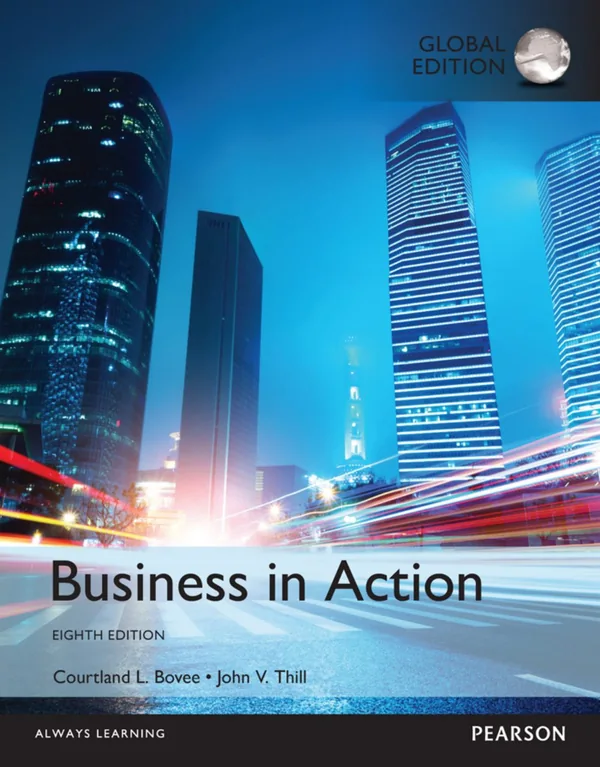
Business in Action, Eighth Global Edition, introduces the main functions and decisions involved in running a business. Courtland L. Bovée and John V. Thill cover management, marketing, finance, accounting, operations, human resources, entrepreneurship, and ethics, using concise explanations and business examples for introductory students and independent learners.
Inside this title
Introductory coverage spans management, marketing, finance, and operations
Current listed price $22.99Regular price $43.00Digital ebook
Business organization and stakeholder relationships provide a starting point for examining how companies operate. The text introduces marketing, accounting, financial management, operations, and human resources, showing the range of decisions that occur across an enterprise. Entrepreneurship and innovation add the perspective of creating and developing business opportunities.
Learning objectives and case-based examples organize the chapters around recognizable business situations. Leadership, motivation, supply chains, governance, ethics, and social responsibility place functional topics within a broader organizational setting. The eighth Global Edition is designed for introductory business study, offering students an overview that can support later, more specialized coursework in management, finance, marketing, or related fields.
Study guide included
Inside Business in Action, 8th Edition, Global Edition.
Bovée and Thill assemble the introductory business course into one narrative about a firm that must attract customers, organize work, move goods and fund itself. The global eighth edition keeps the prose short and the examples concrete, so a reader can see how a pricing decision, a channel choice and a cash forecast press on each other.
Six parts trace a company from its surroundings to its balance sheet. Economics, global trade and stakeholder obligations set the frame, since a market entrant inherits both opportunity and constraint. Ownership forms and entrepreneurship follow, weighing control against capital and continuity. Management, teamwork, operations and quality carry plans into delivered work. Human resources and labor relations consider who does that work and on what terms. Marketing, pricing, channels and logistics convert promises into purchases. Accounting statements, securities and banking show where money comes from and when it must be repaid.
Contexts that shape opportunity
The opening part asks what a firm is for and what surrounds it. Value comes from combining resources under uncertainty, and a professional learns to ask who pays, who bears cost and who benefits. Supply, demand, cycles, inflation and unemployment alter both customer willingness and the terms of hiring. International activity adds exchange rates, institutions and culture, while exporting, licensing and direct investment trade commitment against control.
Ask who bears costs outside the transaction
Entry modes trade control for commitment
Currency shifts change a deal's economics
Part 1 · pp. 47–142
Ownership and entrepreneurial choice
Sole proprietorships, partnerships and corporations distribute authority, liability and access to capital in different ways, and the choice should follow what the venture intends to do. Continuity when an owner departs belongs in the comparison. Entrepreneurship adds a plan: evidence of customer need, a revenue logic and a realistic cost base. Franchising supplies a recognized brand and proven routines in exchange for fees and limits on independence.
Ownership defines who decides and who pays
A plan needs a customer, not only a product
Franchise support comes with restrictions
Part 2 · pp. 143–190
Managing people and production
Management appears as four linked activities: setting goals, allocating work, supporting people and comparing results with the plan. Structure makes authority visible, yet teams still need defined roles and a route for resolving disagreement across departmental lines. Operations connect suppliers, stock, process and service, and a value chain shows where each step adds something a customer notices. Capacity and inventory policy balance cost against reliability.
Structure should make responsibility legible
Trace parts from receiving to delivery
Quality depends on process and feedback
Part 3 · pp. 191–268
Workforce systems and relations
Motivation theory points at rewards, expectations, learning and job design rather than a single lever. Goals help when employees have resources to act on them, and incentives can quietly damage quality or cooperation. Recruitment, training, appraisal and pay build capability over time. Labor relations adds collective representation and negotiation over wages, conditions and security. Turnover often traces to scheduling and supervision before it traces to starting pay.
Check workload before blaming motivation
Incentives can reward the wrong behavior
Predictable schedules aid retention
Part 4 · pp. 269–340
Marketing and the route to buyers
Research identifies customer groups and the needs an offer could meet. Product design, branding and life-cycle stage shape expectations, while price signals value and moves margin and demand together. Channels distribute the work of reaching buyers among wholesalers and retailers, and forecasting, ordering, warehousing and transport decide whether service promises hold. Promotion must match what distribution can actually deliver at volume.
Set price against cost, rivals and response
A channel decides what service is possible
Align advertising with fulfillment capacity
Part 5 · pp. 341–440; Costco case · p. 394
Statements, cash and institutions
The finance part reads three reports as one story. A balance sheet freezes resources and claims at a date, an income statement covers a period, and a cash flow statement records actual movement. Timing explains why a profitable credit sale can leave a firm short. Planning weighs borrowing against issuing ownership claims, and securities differ in risk and rights. Credit conditions can squeeze a company whose sales are steady.
Profit and available cash are not the same
Read the three statements as a sequence
Stress repayment against slower receipts
Part 6 · pp. 441–537
Chapter and section map
Developing a Business Mindsetp. 48
The Global Marketplacep. 95
Forms of Ownershipp. 144
Production Systemsp. 244
Labor Relationsp. 319
Distribution and Marketing Logisticsp. 394
Financial Information and Accounting Conceptsp. 442
The Money Supply and Banking Systemsp. 515
Key takeaways
Judge an entry mode by the control, cost and local access it actually buys.
Make channel, inventory and advertising choices that support one consistent customer promise.
Read earnings, cash movement and debt obligations together before calling a growing firm healthy.
Students in introductory business or management programs, career changers preparing for an MBA, and small-business owners who want a structured overview of functions they handle informally.
Topics covered
business fundamentals
global business
forms of ownership
operations management
marketing channels
human resources
financial statements
entrepreneurship basics
Questions about this ebook.
Edition, audience, and study-guide details at a glance.
What is Business in Action, 8th Edition, Global Edition about?
Business in Action, Eighth Global Edition, introduces the main functions and decisions involved in running a business. Courtland L. Bovée and John V. Thill cover management, marketing, finance, accounting, operations, human resources, entrepreneurship, and ethics, using concise explanations and business examples for introductory students and independent learners.
Which edition of Business in Action, 8th Edition, Global Edition is this?
This listing is for the 8th edition. Check the title, ISBN, and book details above before ordering, especially if your course or reading list names a specific edition.
Who is Business in Action, 8th Edition, Global Edition for?
Students in introductory business or management programs, career changers preparing for an MBA, and small-business owners who want a structured overview of functions they handle informally.
Does this page include a study guide?
Yes. This page includes an original study guide with six thematic sections, key takeaways, and a chapter and section map for structured reading.