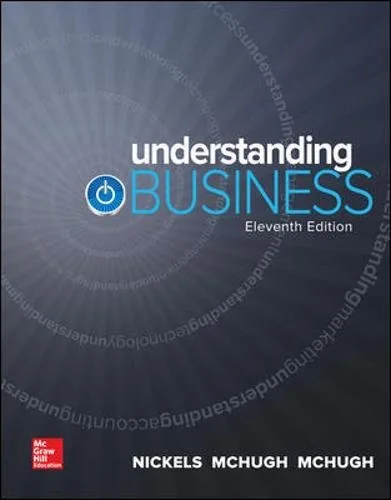
Understanding Business, eleventh edition, surveys business disciplines through explanations, examples, and cases for introductory college courses. Students encounter economics, management, marketing, accounting, finance, and operations, alongside the legal environment, international markets, and technology. The breadth helps readers see how separate business functions contribute to organizational activity.
Inside this title
Economic systems, management responsibilities, and core business functions
Current listed price $9.99Regular price $18.00Digital ebook
The eleventh edition develops a general foundation for business study by relating economic conditions to organizational decisions. Supply and demand, market structures, and government involvement establish context for chapters on management, leadership, and operations. Marketing topics extend from research and segmentation to product development and promotion.
Accounting and finance sections introduce financial statements, budgeting, capital management, and the time value of money. The text also considers contracts, liability, intellectual property, ethics, and international business. Cases and examples give students situations in which to discuss these ideas. Technology and e-commerce connect the functional survey to changes in business models and communication within the edition’s coverage.
Study guide included
Inside Understanding Business, 11th Edition.
The eleventh edition surveys the business curriculum for students meeting it for the first time. Economics, ethics, ownership, management, marketing, and finance are presented as linked decisions, and cases from medical travel to the banking crisis show how private choices depend on institutions that no single firm controls.
Chapters move from risk and economic conditions into global trade, ethical responsibility, and the legal forms a business can take. Management, motivation, and production follow, then goods and services, pricing, channels, and promotion. The final stretch covers accounting, finance, securities, and banking. Two extended cases anchor the abstractions: a medical-tourism profile about comparing treatment across countries, and a banking-crisis discussion about credit conditions. Throughout, the emphasis falls on separating a genuine shift in a market from customers simply moving to a rival. Edition: 11th, McGraw-Hill Education, 2016.
Conditions, markets, and cross-border exchange
A founder commits labor and capital while returns stay unknown, and the surrounding economy sets part of the odds. Demand and supply explain opportunity in a particular market; output, prices, employment, and productivity describe the whole. Trade follows comparative advantage, yet exchange rates, policy, standards, and local expectations shape access. The medical-tourism case makes the point: a price comparison across countries leaves out follow-up, coverage, and patient protection.
Tell a shrinking market from a lost account
Read trade exposure through more than price
Check access and follow-up abroad
Ch. 1–3 · Risk, economics, global markets
Responsibility, formation, and the founder's plan
A company leans on employees, suppliers, buyers, lenders, and its community. The ethics chapter separates what is legal from what people can fairly expect, asking who gains, who carries risk, and who must hear the explanation. Ownership divides authority, liability, funds, and continuity: proprietorship for direct control, partnership for pooled resources, corporation and franchise for other terms. The plan then converts the idea into testable assumptions about customers, costs, work, and money.
Ask who gains and who carries risk
Match entity type to control and liability
Turn the concept into assumptions you can test
Ch. 4–6 · Ethics, formation, entrepreneurship
Management, structure, and work flow
Planning names the target, organizing assigns people and resources, leading turns them toward the target, and controlling compares results with intent. Structure decides who can settle a problem and how fast other teams learn of it. Operations tie facilities, process, inventory, schedule, and suppliers together. Productivity and quality numbers show whether requirements are met, and the way to improve flow is to locate the bottleneck and test a change there.
Name who owns each handoff
Fix the bottleneck, not the pace
Check what the quality measure actually counts
Ch. 7–9 · Leadership, structure, operations
Motivation, hiring, and labor relations
Work-method study, the Hawthorne findings, and later research point at social conditions, needs, incentives, and fairness. A manager can ask whether someone knows the standard, can meet it, and expects a valued result; each answer implies a different fix. Human resources begins with forecasting roles, recruiting, and selecting, then trains and appraises while pay frames the exchange. Collective bargaining adds employee voice to the terms of work, and clear feedback keeps disagreement from hardening.
Check understanding before adding incentives
Fix the shift before rewriting the bonus
Give employees a channel for concerns
Ch. 10–12 · Motivation, HR, labor relations
Marketing mix and channel readiness
Research and segmentation find buyers with distinct needs. The offer includes service, packaging, brand, and purchase experience, not just the object. Life-cycle thinking ties demand shifts to feature and price calls, while price must satisfy cost, perception, competitors, and position. Intermediaries add transport, storage, assortment, and access; direct selling returns those duties to the producer. Advertising, selling, public relations, and promotion serve different goals, and the mix works when buyers can receive it as promised.
The income statement reports earnings for a period, the balance sheet a position at a point, and the cash flow statement the movement of cash. Ratios raise questions about liquidity, debt, or profit. Budgets separate capital, operating, and cash commitments. Debt and equity differ in claims, obligations, and outcomes when results fall short. Banks and securities markets set access to funding, and the banking-crisis case shows terms tightening when a firm's plan has not changed.
Follow every cost and duty inside a channel deal before comparing the headline prices.
Sort demand, job design, and coordination issues apart before touching incentives.
Keep a cash calendar beside the margin forecast when payment arrives after delivery.
Students taking an introductory business survey course, plus owners of small firms who need a structured way to weigh a channel offer or a staffing change.
Topics covered
business survey course
business ethics
business ownership forms
operations bottleneck
channel economics
marketing mix
cash budgeting
credit conditions
Other editions of this title.
Compare editions, prices, and book details before you choose.
Edition, audience, and study-guide details at a glance.
What is Understanding Business, 11th Edition about?
Understanding Business, eleventh edition, surveys business disciplines through explanations, examples, and cases for introductory college courses. Students encounter economics, management, marketing, accounting, finance, and operations, alongside the legal environment, international markets, and technology. The breadth helps readers see how separate business functions contribute to organizational activity.
Which edition of Understanding Business, 11th Edition is this?
This listing is for the 11th edition. Check the title, ISBN, and book details above before ordering, especially if your course or reading list names a specific edition.
Who is Understanding Business, 11th Edition for?
Students taking an introductory business survey course, plus owners of small firms who need a structured way to weigh a channel offer or a staffing change.
Does this page include a study guide?
Yes. This page includes an original study guide with six thematic sections, key takeaways, and a chapter and section map for structured reading.