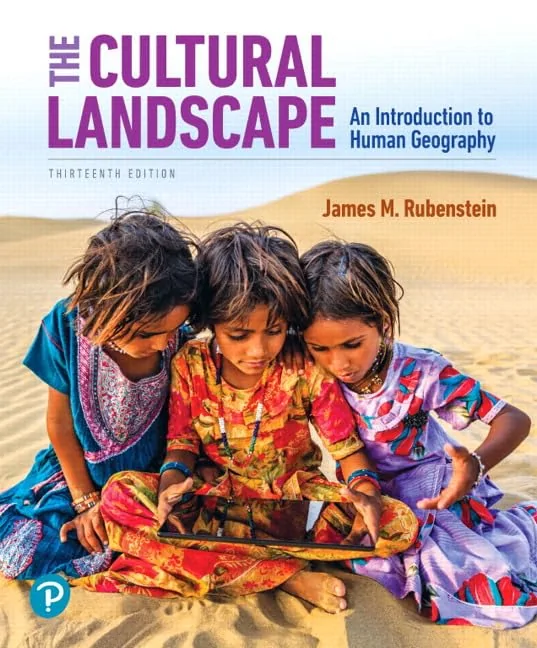
The Cultural Landscape: An Introduction to Human Geography, 13th Edition
By James M. Rubenstein
About this ebook
The Cultural Landscape, Thirteenth Edition, introduces human geography through the spatial relationships among culture, population, politics, economic activity, and environment. James M. Rubenstein examines migration, identity, development, agriculture, and urban land use for introductory students, using concepts such as place, scale, region, and diffusion to connect these subjects.
Inside this title
Place, region, scale, and diffusion as geographic concepts
Current listed price $14.00Regular price $23.00Digital ebook
Human geography asks where activities occur, why patterns develop, and how places influence one another. This text introduces the spatial concepts needed to examine those questions, then applies them to population change, migration, cultural identity, and political territory. Language, religion, ethnicity, borders, and states become subjects for geographic analysis.
Economic chapters consider agriculture, industry, services, and uneven development, while urban material examines city structure, growth, and land use. Human-environment relationships bring resource use and environmental constraints into the same framework. The thirteenth edition is intended for majors and non-majors taking introductory human geography, with coverage that connects social processes to the landscapes they produce.
Study guide included
Inside The Cultural Landscape: An Introduction to Human Geography, 13th Edition.
Human geography explains why things sit where they do. Rubenstein moves from maps and population to culture, politics, farming, industry, and cities, always asking which feature lies where, how it reached that spot, and which scale lets the answer hold. The result is a way of comparing places rather than a list of regional facts.
Opening chapters set out mapping, how people are distributed, how numbers change, and movement between places. The middle of the book turns to the spread of customs, speech, and faith, then to ethnicity and to how territory is ordered politically. Towards the end, Rubenstein follows farming, economic development, manufacturing, power, services, and city growth as forces that remake particular places. Throughout, readers practise comparing locations and asking whether an apparent arrangement comes from physical limits, institutions, mobility, or uneven access to resources. The thirteenth edition pairs diffusion with place, region, and scale, and it keeps asking who gains from a given arrangement of space.
Read maps as arguments
Place names the particular character of a location, while region groups places through a common trait, a relationship, or a felt belonging. Scale and space then show how features are arranged and which unit fits the explanation. Density, concentration, and pattern measure different things, and every map carries choices about which projection to use, where to draw boundaries, and how to classify.
Separate place, region, space, and scale
Check what each map actually counts
Compare equivalent units before drawing conclusions
Chapter 1, This Is Geography
Track people and movement
Arithmetic density divides the population by the whole land area; physiological density sets people against arable land, so a region can rank very differently depending on which one is used. The demographic transition model traces how fertility and mortality shift as conditions change. Migration then alters distribution independently of natural increase, and its effects must be traced at both the origin and the destination.
Compare density measures before ranking regions
Split growth into births, deaths, and moves
Trace consequences where people leave and arrive
Chapters 2–3, Population & Health and Migration
Trace how culture spreads
Culture takes in beliefs, customs, objects, and the shape of everyday social life. The book contrasts locally rooted traditions with popular forms carried by commerce and by media networks, noting that access and institutions decide who takes part. A practice can keep a recognisable shape while being reshaped for a different setting, and languages and religions travel in comparable ways.
Separate rooted traditions from popular forms
Follow who can access the network
Notice adaptation, not just spread
Chapters 4–7, Culture, Languages, Religions, and Ethnicities
Relate borders to wellbeing
A state holds a territory and exercises governing power, whereas a nation rests on a sense of shared identity. A border may cut through a nation or enclose several national groups, and colonial history, demands for separation, and cross-border cooperation all widen the gap between the two. Development is likewise read through health, schooling, and living standards, not output alone.
Keep state and nation distinct
Ask who the border includes and excludes
Look inside national averages for variation
Chapters 8 and 10, Political Geography and Development
Explain where production sits
Farming reflects climate, soil, labour, land ownership, transport links, and consumer demand, and subsistence and commercial systems differ in how output is used. Abundant harvests may sit beside water shortage where canals or rules move supply elsewhere. Industry weighs closeness to materials, buyers, labour, transport links, and capital, with each sector ranking them differently.
Link land, water, and market demand
Ask who controls land and supply
Weight location factors by industry type
Chapters 9 and 11, Food & Agriculture and Industry & Energy
Explain urban form and reach
Consumer services answer to households, business services to companies. Central place theory ties the reach of a service to how many customers it needs and how far people will go, which is why common services appear in small settlements and specialised ones cluster in fewer, larger centres. Urban models compare districts, housing, and transport, though geography and policy bend them.
Define the service and its market area
Compare travel time, not straight lines
Fix the city boundary before comparing density
Chapters 12–13, Services & Settlements and Urban Patterns
Chapter and section map
This Is GeographyCh. 1
Population & Health; MigrationChs. 2–3
Culture, Languages, Religions, and EthnicitiesChs. 4–7
Political GeographyCh. 8
Food & Agriculture; Development; Industry & EnergyChs. 9–11
Services & Settlements; Urban PatternsChs. 12–13
Key takeaways
Fix the scale and the unit of comparison before contrasting two places.
Break growth into births, deaths, and migration before you explain any shift.
Call distance access only after the thresholds, barriers, and travel routes are checked.
Introductory human-geography students, general readers curious about how space shapes society, and teachers who want a framework for comparing regions rather than memorising facts about places.
Topics covered
human geography
cultural landscape
population and migration
cultural diffusion
political geography
economic development
urban patterns
central place theory
Questions about this ebook.
Edition, audience, and study-guide details at a glance.
What is The Cultural Landscape: An Introduction to Human Geography, 13th Edition about?
The Cultural Landscape, Thirteenth Edition, introduces human geography through the spatial relationships among culture, population, politics, economic activity, and environment. James M. Rubenstein examines migration, identity, development, agriculture, and urban land use for introductory students, using concepts such as place, scale, region, and diffusion to connect these subjects.
Which edition of The Cultural Landscape: An Introduction to Human Geography, 13th Edition is this?
This listing is for the 13th edition. Check the title, ISBN, and book details above before ordering, especially if your course or reading list names a specific edition.
Who is The Cultural Landscape: An Introduction to Human Geography, 13th Edition for?
Introductory human-geography students, general readers curious about how space shapes society, and teachers who want a framework for comparing regions rather than memorising facts about places.
Does this page include a study guide?
Yes. This page includes an original study guide with six thematic sections, key takeaways, and a chapter and section map for structured reading.