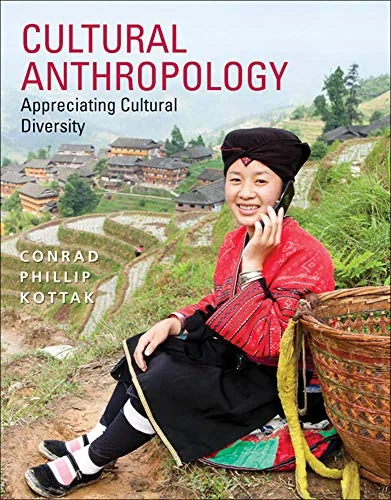
Cultural Anthropology: Appreciating Cultural Diversity, 16th Edition
By Conrad Phillip Kottak
About this ebook
Cultural Anthropology: Appreciating Cultural Diversity, Sixteenth Edition, introduces the study of human cultures through ethnographic examples and comparative analysis. Conrad Phillip Kottak examines fieldwork, language, economic and political systems, kinship, religion, and social change for undergraduate students, relating cultural variation to globalization, migration, and environmental questions.
Inside this title
Ethnographic fieldwork, participant observation, interviewing, and research ethics
Current listed price $15.99Regular price $31.00Digital ebook
Kottak places cultural anthropology within the wider anthropological study of humanity while focusing on the diversity of social life. Participant observation, interviewing, and research ethics introduce how ethnographic knowledge is produced. Language and communication then connect cultural identity with questions about thought, meaning, and relationships.
Comparisons of production, distribution, political authority, marriage, family, and religious practice show different ways societies organize experience. Applied anthropology, globalization, and cultural change extend those comparisons to problems that cross local boundaries. The sixteenth edition is suited to an introductory undergraduate course and to readers in related fields who want a structured account of cultural anthropology's methods and central topics, supported by examples of lived social practices.
Study guide included
Inside Cultural Anthropology: Appreciating Cultural Diversity, 16th Edition.
Kottak's survey teaches readers to study human communities through close fieldwork and systematic comparison. It introduces anthropology's subfields, then follows language, livelihood, kinship, belief and global interconnection, showing undergraduates how learned customs are shaped by history, institutions and unequal access to resources.
First comes the discipline's four-field structure, the idea of culture and the craft of participant observation. The middle of the book compares how people communicate, classify ethnicity and race, earn a living, organize authority, and arrange gender, marriage and descent. Later chapters turn to ritual and expressive life, then to colonialism and globalization. Readers practice moving between local accounts and larger structures, testing rival explanations and asking who benefits from research or policy. Review questions and ethnographic vignettes keep the abstract terms anchored in concrete communities.
Anthropology, culture and holistic comparison
The four subfields are presented as complementary sources of evidence about one question, and culture as learned, shared and often disputed. Relativism is a research stance: grasp the local setting before assessing effects. A meal example shows availability, trade, cooking skill, hospitality rules and beliefs about occasion converging in a single practice.
Four subfields supply complementary evidence
Culture is learned, shared and argued over
Understand a practice in local context first
Chs. 1–2, pp. 1 and 20
Fieldwork and applied practice
Sustained involvement in daily life, paired with careful notes, anchors ethnographic knowledge; interviews, life stories, surveys and household data widen the evidence. Insiders' categories and analysts' comparisons answer different questions. Applied projects in schooling, development or health raise issues of who defined the problem, whose voice counts in planning, and which barriers keep people from taking part.
Combine participation with disciplined recording
Distinguish participants' terms from analytic terms
Ask who defines the problem and who speaks
Chs. 3–4, pp. 39 and 63
Language, ethnicity and racial classification
Speech, gesture, style and speaker relationships all carry meaning, and people adjust register to audience, place and purpose. Variation may signal belonging or expose speakers to unequal judgment. The book then contrasts ethnic and racial classification across societies: labels have institutional histories and effects, yet human biological variation does not sort into the separate groups the labels presume.
Language use carries social information
Variation can mark affiliation or trigger bias
Racial categories are historical and institutional
Chs. 5–6, pp. 81 and 102
Livelihood, exchange and political authority
Livelihoods, from hunting and herding to farming and industry, depend on movement, labor, tools and access to land. Goods move through sharing, centralized collection and markets, and several modes can coexist. Authority may rest on reputation and persuasion or on office and law. The analysis asks how disputes are handled, decisions made, and inequality preserved or contested.
Subsistence links labor, land and mobility
Goods move through several exchange modes
Authority ranges from reputation to office
Chs. 7–8, pp. 129 and 151
Gender, kinship, marriage and household
Gender arrangements vary, and comparison works best when it looks at concrete tasks and who can use which resources. Descent determines membership, inheritance and duties; marriage creates ties between groups as well as individuals. Charts show named relations, while observation and interviews reveal the actual flow of care, property and decision-making.
Compare specific tasks, not blanket roles
Descent shapes inheritance and responsibility
Charts record names; practice reveals care
Chs. 9–11, pp. 174, 194 and 212
Ritual, expression and global entanglement
Ritual, art, sport and media mark transitions, create solidarity, address uncertainty and open debate about meaning. Why a performance matters, and who decides what counts as authentic, depends on local circumstances. The closing chapters connect colonialism, industrial growth and the world system to changing labor and politics, asking how communities interpret outside pressures and who captures the gains.
Ritual and art organize shared meaning
Local context explains a performance's significance
Global ties both enable and constrain choices
Chs. 12–15, pp. 231, 250, 273 and 295
Chapter and section map
What Is Anthropology?p. 1
Culturep. 20
Method and Theory in Cultural Anthropologyp. 39
Applying Anthropologyp. 63
Ethnicity and Racep. 102
Making a Livingp. 129
The World System and Colonialismp. 273
Anthropology’s Role in a Globalizing Worldp. 295
Key takeaways
Combine observation with participants' own interpretations before describing what a practice means locally.
Trace obligations, resource access and decision rights before predicting who gains from a proposed change.
Compare one activity across settings while accounting for different histories and available resources.
Undergraduate students in cultural anthropology and related social science courses, plus instructors seeking comparative ethnographic cases and general readers curious about how anthropologists study communities.
Topics covered
cultural anthropology
ethnographic fieldwork
cultural relativism
kinship and marriage
political organization
language and ethnicity
globalization and colonialism
applied anthropology
Questions about this ebook.
Edition, audience, and study-guide details at a glance.
What is Cultural Anthropology: Appreciating Cultural Diversity, 16th Edition about?
Cultural Anthropology: Appreciating Cultural Diversity, Sixteenth Edition, introduces the study of human cultures through ethnographic examples and comparative analysis. Conrad Phillip Kottak examines fieldwork, language, economic and political systems, kinship, religion, and social change for undergraduate students, relating cultural variation to globalization, migration, and environmental questions.
Which edition of Cultural Anthropology: Appreciating Cultural Diversity, 16th Edition is this?
This listing is for the 16th edition. Check the title, ISBN, and book details above before ordering, especially if your course or reading list names a specific edition.
Who is Cultural Anthropology: Appreciating Cultural Diversity, 16th Edition for?
Undergraduate students in cultural anthropology and related social science courses, plus instructors seeking comparative ethnographic cases and general readers curious about how anthropologists study communities.
Does this page include a study guide?
Yes. This page includes an original study guide with six thematic sections, key takeaways, and a chapter and section map for structured reading.