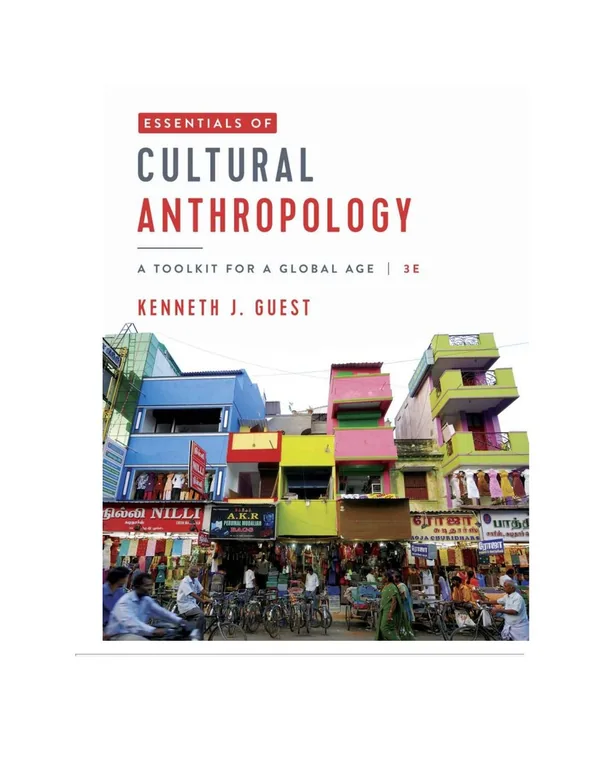
Essentials of Cultural Anthropology: A Toolkit for a Global Age, 3rd Edition
By Kenneth J. Guest
About this ebook
Essentials of Cultural Anthropology: A Toolkit for a Global Age, 3rd Edition introduces cultural analysis through concepts students can apply to global issues. Kenneth J. Guest examines fieldwork, language, race, ethnicity, gender, kinship, economy, politics, religion, and health. The textbook is designed for undergraduates learning to interpret cultural practices and social relationships.
Inside this title
Culture, fieldwork, and language as tools for social analysis
Current listed price $13.99Regular price $23.00Digital ebook
Guest presents cultural anthropology as a set of concepts and research methods for examining everyday life and global connections. Culture, fieldwork, and language establish ways to ask questions about social experience. Race, ethnicity, gender, and kinship then show how identities and relationships are shaped and understood.
Economic systems, environments, political life, religion, health, and art broaden the range of cultural questions. The chapter structure develops an analytical toolkit that readers can bring to real situations, rather than treating cultural examples as isolated facts. Undergraduates in introductory anthropology courses can use the third edition to consider how local practices connect with wider institutions, exchanges, and global processes.
Study guide included
Inside Essentials of Cultural Anthropology: A Toolkit for a Global Age, 3rd Edition.
An undergraduate introduction to cultural anthropology built around a portable analytical toolkit. Guest connects ethnography, language, kinship, economy, politics, religion and health to global flows of people, goods and ideas, helping students interpret local practices within wider systems of power.
Guest opens with the discipline's four fields, the idea of culture and the value of tracing connections across borders. Fieldwork and language chapters show how ethnography is produced and how a researcher's position shapes evidence. Later units examine race, ethnicity, nationalism, gender, sexuality, kinship, economy, environment, politics, religion, health and media. A recurring toolkit asks whose account is being heard, how a practice developed and which institutions give it force in everyday life. Each chapter returns to the same questions, so a reader can compare a market, a clinic, a border crossing or a news image using one consistent analytical vocabulary.
Culture inside global connections
Cultural patterns are learned, shared and debated rather than fixed, and they form within wider movements of capital, labour and information. Guest traces ordinary objects outward to reveal uneven relationships: some actors direct flows, while others absorb the costs of extraction, migration or displacement. Institutions help certain meanings endure through rules, resources and authority.
Trace a familiar object across its networks
Notice who benefits and who bears costs
Connect culture with institutional power
Chs. 1–2 · pp. 4, 32
Fieldwork, evidence and reflexivity
Ethnography builds a contextual account from participation, interviews, mapping and observation. Consent, confidentiality and attention to harm shape what can be published and who might be identified. Language does more than carry information: accent, style and word choice signal membership, and a reflexive account asks how the investigator's own status affects what people say.
Compare observation with official accounts
Protect participants through the whole project
Include how your position shapes the evidence
Chs. 3–4 · pp. 62, 92
Race, ethnicity and national belonging
Race is treated as a historical and political classification with material consequences, not a set of biological types. Institutions create and enforce categories through housing, citizenship and work. Ethnic identification can draw on shared history, language or exclusion, while states and movements mobilise narratives of national membership in law, ritual and conflict.
Trace when a category was created
Look for consequences in access and law
Compare claims of belonging with actual recognition
Chs. 5–6 · pp. 120, 154
Gender, sexuality and relatedness
Societies give meaning to bodies and organise gender and sexuality through expectations, work and family arrangements. Rules about who performs a task can shape income, authority and care. Kinship orders obligation and support through descent, marriage and other ties, and mapping those ties reveals how households respond to migration and economic change.
Observe what people do, not only what they say
Map care and money across households
Avoid assuming a single family form
Chs. 7–9 · pp. 180, 208, 236
Economy, environment and authority
Production and exchange rest on social relations as well as prices, and a commodity chain shows where work happens and how risk is distributed. Environmental disputes involve both ecological processes and the capacity to influence land and water. Political anthropology asks who participates in decisions, what counts as legitimate evidence and who can realistically refuse.
Follow labour through a commodity chain
Compare conservation goals with local costs
Identify who can actually refuse a plan
Chs. 10–12 · pp. 266, 308, 336
Ritual, illness and public representation
Religion includes practices and institutions as well as explanations of experience, and outwardly similar rituals can mean different things to different participants. Health is interpreted socially, through symptoms, explanations and access to care. Art and media decide which experiences become visible, so the book asks who produced an image and which conventions make it authoritative.
Interpret belief within its setting
Treat illness as experience and explanation
Ask who produced a representation and for whom
Chs. 13–15 · pp. 368, 400, 432
Chapter and section map
Anthropology in a Global Age and CultureChs. 1–2 · pp. 4, 32
Fieldwork and EthnographyCh. 3 · p. 62
LanguageCh. 4 · p. 92
Race, ethnicity, and nationalismChs. 5–6 · pp. 120, 154
Gender, sexuality, and kinshipChs. 7–9 · pp. 180, 208, 236
Global economy, environment, and politicsChs. 10–12 · pp. 266, 308, 336
Religion, health, and mediaChs. 13–15 · pp. 368, 400, 432
Key takeaways
Trace an everyday object across places and note who gains or absorbs costs at each stage.
Keep observation, participant statements and your own inference in clearly separate categories.
When an identity category matters, ask how institutions give it practical consequences.
Undergraduate students in introductory cultural anthropology and related social science courses, plus readers seeking an accessible framework for interpreting cultural difference in a globalised world.
Topics covered
ethnographic fieldwork
culture and power
race and ethnicity
kinship and gender
global commodity chains
political anthropology
religion and ritual
medical anthropology
Questions about this ebook.
Edition, audience, and study-guide details at a glance.
What is Essentials of Cultural Anthropology: A Toolkit for a Global Age, 3rd Edition about?
Essentials of Cultural Anthropology: A Toolkit for a Global Age, 3rd Edition introduces cultural analysis through concepts students can apply to global issues. Kenneth J. Guest examines fieldwork, language, race, ethnicity, gender, kinship, economy, politics, religion, and health. The textbook is designed for undergraduates learning to interpret cultural practices and social relationships.
Which edition of Essentials of Cultural Anthropology: A Toolkit for a Global Age, 3rd Edition is this?
This listing is for the 3rd edition. Check the title, ISBN, and book details above before ordering, especially if your course or reading list names a specific edition.
Who is Essentials of Cultural Anthropology: A Toolkit for a Global Age, 3rd Edition for?
Undergraduate students in introductory cultural anthropology and related social science courses, plus readers seeking an accessible framework for interpreting cultural difference in a globalised world.
Does this page include a study guide?
Yes. This page includes an original study guide with six thematic sections, key takeaways, and a chapter and section map for structured reading.