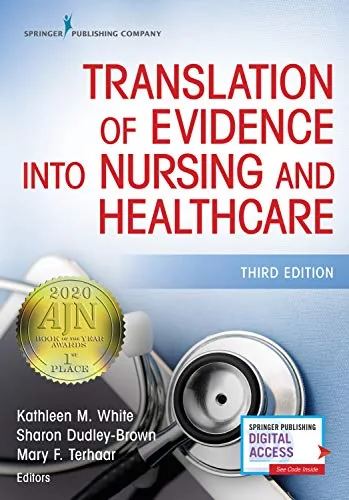
Translation of Evidence Into Nursing and Healthcare, 3rd Edition
By Kathleen M. White, Sharon Dudley-Brown, Mary F. Terhaar
About this ebook
Translation of Evidence Into Nursing and Healthcare, 3rd Edition examines how research findings become organized changes in practice. It covers translation frameworks, implementation strategies, organizational capacity, and outcome evaluation. Graduate nursing students, clinical leaders, and interprofessional teams can study the process through healthcare examples, discussion questions, and project-focused tools.
Inside this title
Translation science distinguished from research utilization and evidence-based practice
Current listed price $31.99Regular price $78.00Digital ebook
Moving evidence into practice requires attention to context, people, and evaluation. White, Dudley-Brown, and Terhaar distinguish translation science from research utilization and evidence-based practice, then examine frameworks for organizing translation projects. Needs assessment, stakeholder engagement, piloting, and sustaining change connect the conceptual discussion with implementation work.
Examples from acute care, primary care, community settings, and academic institutions illustrate how projects take shape. The third edition considers clinical, process, and financial outcomes as well as organizational structures that support inquiry and mentoring. Its combination of models, cases, and discussion questions suits graduate nursing coursework and interprofessional teams examining evidence translation in their own settings.
Study guide included
Inside Translation of Evidence Into Nursing and Healthcare, 3rd Edition.
Getting research into practice is not a single step but a project with context, people, and measurement. White, Dudley-Brown, and Terhaar separate translation science from research utilization and evidence-based practice, then follow frameworks through needs assessment, stakeholder engagement, implementation, evaluation, and the work of sustaining change.
The book treats evidence translation as organized change rather than simple dissemination. It distinguishes translation science from related concepts, then examines frameworks that structure projects from problem definition to outcome review. Needs assessment and stakeholder engagement come before implementation, and piloting is presented as a way to test a change before scaling it. Evaluation covers clinical, process, and financial outcomes, since a project can succeed on one measure and disappoint on another. Organizational capacity, mentoring, and support for inquiry determine whether a change survives after the project team moves on. Examples from acute care, primary care, community settings, and academic institutions show how the process looks in different environments.
Translation science and related terms
The book begins by separating ideas that are often used interchangeably. Translation science, research utilization, and evidence-based practice overlap but are not the same, and the distinctions matter for what a project is trying to accomplish. Readers are asked to use the terms precisely so that a plan matches the problem it addresses.
Distinguish translation from utilization
Use terms precisely in planning
Match the approach to the problem
Topic 1 · Translation Science
Selecting a translation framework
Frameworks give a project structure and a way to explain its logic. The section examines how a framework is chosen and what it organizes, from problem definition to outcome review. Readers are asked to see a framework as a decision aid rather than a guarantee, since a model still depends on the people and setting applying it.
Use frameworks to structure a project
See the model as an aid, not a guarantee
Connect framework choice to setting
Topic 2 · Frameworks
Needs assessment and stakeholders
Change begins with understanding the setting and the people in it. The section covers needs assessment and stakeholder engagement as preparatory work that shapes the rest of the project. Readers are asked to identify who is affected, who must agree, and what the current situation actually requires before proposing a solution.
Assess the setting before proposing change
Identify who is affected and who decides
Let findings shape the plan
Topic 3 · Needs and Stakeholders
Implementation and piloting
Implementation turns a plan into practice. The section examines how a change is introduced, tested, and adjusted, with piloting presented as a way to learn before scaling. Readers are asked to treat early implementation as evidence gathering rather than as proof that the original plan was right.
Introduce change in stages
Use pilots to learn before scaling
Treat early results as evidence, not proof
Topic 4 · Implementation and Piloting
Evaluating clinical, process, and financial outcomes
Evaluation asks whether a project achieved what it intended. The section covers clinical, process, and financial outcomes, showing that a project can succeed on one measure and fall short on another. Readers are asked to choose measures that match the project's aims rather than reporting only the most favorable result.
Measure clinical, process, and financial results
Expect measures to diverge
Match measures to stated aims
Topic 5 · Outcome Evaluation
Sustaining change and organizational capacity
A change that ends when the project team leaves has not been translated. The section examines organizational capacity, mentoring, and support for inquiry as conditions for durability. Readers are asked to plan for continuation from the start, since sustaining a practice depends on structures and people rather than on enthusiasm alone.
Plan for continuation from the start
Build organizational capacity and mentoring
Rely on structures, not enthusiasm alone
Topic 6 · Sustaining Change
Topic map
Translation Science and Related ConceptsTopic 1
Selecting a FrameworkTopic 2
Needs Assessment and Stakeholder EngagementTopic 3
Implementation PlanningTopic 4
Piloting and AdjustmentTopic 5
Clinical, Process, and Financial OutcomesTopic 6
Sustaining Change and Organizational CapacityTopic 7
Exemplars Across Care SettingsTopic 8
Key takeaways
Distinguish translation science from research utilization and evidence-based practice before planning a project.
Assess needs and engage stakeholders before implementing, and use pilots to learn rather than to confirm.
Plan for sustainability and measure clinical, process, and financial outcomes separately.
Graduate nursing students, clinical leaders, and interprofessional healthcare teams who want a structured approach to moving evidence into practice and evaluating the result.
Topics covered
evidence translation
implementation science
nursing practice change
evidence-based practice
stakeholder engagement
outcome evaluation
sustaining change
healthcare quality
Questions about this ebook.
Edition, audience, and study-guide details at a glance.
What is Translation of Evidence Into Nursing and Healthcare, 3rd Edition about?
Translation of Evidence Into Nursing and Healthcare, 3rd Edition examines how research findings become organized changes in practice. It covers translation frameworks, implementation strategies, organizational capacity, and outcome evaluation. Graduate nursing students, clinical leaders, and interprofessional teams can study the process through healthcare examples, discussion questions, and project-focused tools.
Which edition of Translation of Evidence Into Nursing and Healthcare, 3rd Edition is this?
This listing is for the 3rd edition. Check the title, ISBN, and book details above before ordering, especially if your course or reading list names a specific edition.
Who is Translation of Evidence Into Nursing and Healthcare, 3rd Edition for?
Graduate nursing students, clinical leaders, and interprofessional healthcare teams who want a structured approach to moving evidence into practice and evaluating the result.
Does this page include a study guide?
Yes. This page includes an original study guide with six thematic sections, key takeaways, and a topic map for structured reading.