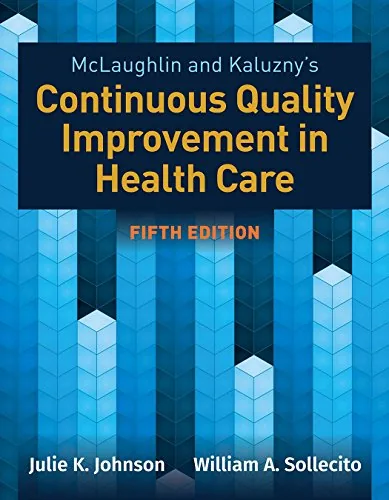
Continuous Quality Improvement in Health Care, 5th Edition
By William A. Sollecito, Julie K. Johnson
About this ebook
Continuous Quality Improvement in Health Care, Fifth Edition combines improvement methods with operations management, organizational behavior, and health services research. William A. Sollecito and Julie K. Johnson address PDSA cycles, statistical process control, teamwork, leadership, and sustaining change for health administration students, clinicians, managers, and quality improvement professionals.
Inside this title
Plan-Do-Study-Act cycles, systems thinking, and statistical process control
Current listed price $31.99Regular price $75.00Digital ebook
This textbook develops continuous quality improvement as both an approach to organizational learning and a set of analytical methods. Its historical account traces connections between manufacturing and healthcare, then considers how systems thinking, Plan-Do-Study-Act cycles, and statistical process control apply to health service processes. Measurement is linked with the design and interpretation of improvement work.
Organizational culture, leadership commitment, teams, and patient engagement receive attention because improvement depends on how people work together. The fifth edition also examines the spread of CQI and the evaluation and maintenance of changes over time. Students in health administration and public health, as well as practitioners responsible for quality initiatives, are its intended readers.
Study guide included
Inside Continuous Quality Improvement in Health Care, 5th Edition.
Sollecito and Johnson combine improvement methods with operations management, organisational behaviour and health services research. PDSA cycles, statistical process control, teamwork, leadership and sustained change are examined in healthcare settings for health administration students, clinicians, practising managers and quality improvement professionals.
The book develops continuous quality improvement as both an approach to organisational learning and a set of analytical methods. Its historical account traces links between manufacturing and healthcare, then considers how systems thinking, Plan-Do-Study-Act cycles and statistical process control apply to health service processes. Measurement is tied to the design and interpretation of improvement work. Culture, leadership commitment, teams and patient engagement receive attention because improvement depends on how people work together. The fifth edition also examines the spread of improvement and the evaluation and maintenance of changes over time.
From manufacturing to healthcare
The historical account shows how improvement ideas travelled from industrial settings into health services. Understanding that lineage helps readers see which assumptions carried over and which needed adaptation to clinical work.
Improvement methods have industrial origins
Assumptions require adaptation to healthcare
History clarifies current practice
Topic 1
Systems thinking and PDSA
Plan-Do-Study-Act cycles are presented within a systems view of care. Improvements are tested in small steps and studied before wider adoption, which turns change into learning rather than a single leap.
Processes are understood as systems
PDSA tests change in small steps
Study precedes wider adoption
Topic 2
Measurement and process control
Statistical process control provides a way to distinguish ordinary variation from signals of real change. The book links measurement to interpretation, since data without an understanding of variation can mislead improvement teams.
Variation has ordinary and special causes
Control methods separate signal from noise
Interpretation must accompany measurement
Topic 3
Leadership, culture and teams
Improvement depends on how people work together. Leadership commitment and culture determine whether teams can test changes, and collaboration across roles is treated as a condition for sustained progress rather than a soft extra.
Leadership commitment enables improvement
Culture shapes willingness to test change
Cross-role teams sustain progress
Topic 4
Patient engagement
Patients are included because care processes are experienced by them. Their perspective can reveal problems that internal measures miss, and engagement is presented as part of designing improvement rather than an afterthought.
Patients experience the care process
Their view can reveal hidden problems
Engagement informs improvement design
Topic 5
Spread, evaluation and maintenance
A successful test is not the same as a changed system. The book examines diffusion, evaluation and maintenance, asking how improvements are spread and how gains are held once attention moves elsewhere.
Successful tests must be spread
Evaluation judges durable effect
Maintenance protects gains over time
Topics 6–7
Topic map
Historical Development of Improvement MethodsTopic 1
Systems Thinking and Plan-Do-Study-Act CyclesTopic 2
Measurement and Statistical Process ControlTopic 3
Leadership, Organisational Culture and TeamworkTopic 4
Patient Engagement in ImprovementTopic 5
Diffusion and Spread of ChangeTopic 6
Evaluation and Maintenance of ImprovementsTopic 7
Key takeaways
PDSA works because it treats change as a small, studied experiment.
Statistical process control separates real change from ordinary variation.
A successful pilot must still be spread and maintained to count as improvement.
Health administration and public health students, clinicians, managers and quality improvement professionals responsible for change in care settings.
Topics covered
Continuous Quality Improvement in Health Care fifth edition
Sollecito Johnson quality improvement
PDSA cycles healthcare
statistical process control
healthcare teamwork and leadership
patient engagement
sustaining improvement
health services quality management
Questions about this ebook.
Edition, audience, and study-guide details at a glance.
What is Continuous Quality Improvement in Health Care, 5th Edition about?
Continuous Quality Improvement in Health Care, Fifth Edition combines improvement methods with operations management, organizational behavior, and health services research. William A. Sollecito and Julie K. Johnson address PDSA cycles, statistical process control, teamwork, leadership, and sustaining change for health administration students, clinicians, managers, and quality improvement professionals.
Which edition of Continuous Quality Improvement in Health Care, 5th Edition is this?
This listing is for the 5th edition. Check the title, ISBN, and book details above before ordering, especially if your course or reading list names a specific edition.
Who is Continuous Quality Improvement in Health Care, 5th Edition for?
Health administration and public health students, clinicians, managers and quality improvement professionals responsible for change in care settings.
Does this page include a study guide?
Yes. This page includes an original study guide with six thematic sections, key takeaways, and a topic map for structured reading.