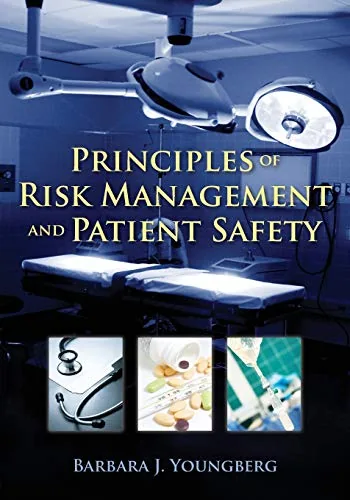
Cover of Principles of Risk Management and Patient Safety

Principles of Risk Management and Patient Safety

By Barbara J. Youngberg

About this ebook

Principles of Risk Management and Patient Safety examines the connection between healthcare risk programs, organizational leadership, and patient harm prevention. Barbara J. Youngberg addresses risk assessment, claims management, financing, proactive loss control, and safety culture for healthcare administrators, risk managers, quality professionals, and students studying the field's organizational foundations.

Inside this title
  • Clinical and operational risk identification, assessment, and monitoring
Current listed price $29.99Regular price $72.00Digital ebook
Review order preview

Digital ebook. No physical book.

Format
Digital ebook
ISBN
9781284214659
Last updated
2026-11-03

What this book covers.

This textbook places patient safety alongside the legal, financial, and organizational dimensions of healthcare risk. Its major sections consider the healthcare environment, risk management theory, claims, financing, and proactive loss control. The discussion connects identification of clinical and operational risks with the design and evaluation of an organization's response.

Topics include claims handling, commercial and alternative insurance arrangements, leadership responsibilities, and the development of a safety culture. Measurement and monitoring are considered as parts of an ongoing risk program. Published in 2011, the volume provides a period account of these principles for healthcare management education and for readers examining how risk management and quality improvement relate.

Study guide included

Inside Principles of Risk Management and Patient Safety.

Patient harm is rarely a single mistake. This textbook connects risk programs with leadership, money and daily operations, showing how healthcare organizations identify hazards, handle claims, finance exposure and build a culture that prevents harm before it reaches patients at all.

Youngberg organizes the field around the settings in which risk arises and the systems built to answer it. Early sections describe the healthcare environment and the theory behind risk management programs; later ones turn to claims handling, insurance and alternative financing, and proactive loss control. Leadership and culture run through the discussion, because a safety program depends on decisions made well above the ward. Measurement and monitoring are treated as continuing work rather than a one-time audit. Published in 2011, the book records the principles of its moment for administrators, risk managers, quality professionals and students learning how risk management and quality improvement fit together.

The healthcare risk environment

Risk in healthcare is set in a landscape of regulation, accreditation, clinical complexity and public expectation. The opening material explains why the field cannot be reduced to insurance or legal defense, and why organizational context determines which risks matter most.

  • Regulation and accreditation shape exposure
  • Clinical complexity creates operational risk
  • Context determines which risks matter
Topic 1

Program theory and design

A risk program needs a rationale before it needs a checklist. The text presents the conceptual basis for identifying, assessing and prioritizing risk, and shows how those choices feed into the structure of an organizational program.

  • Identification precedes assessment
  • Prioritization allocates limited attention
  • Program structure follows from purpose
Topic 2

Claims management

Claims handling is treated as both a legal and an organizational process. The discussion covers how incidents become claims, how responses are coordinated, and what a pattern of claims can reveal about underlying system weaknesses.

  • Incidents become claims through defined steps
  • Response requires coordination across functions
  • Claim patterns expose system weaknesses
Topic 3

Risk financing and insurance

Organizations must decide how to pay for the losses they cannot prevent. The book compares commercial insurance with alternative arrangements and explains the trade-offs between transferring risk, retaining it and funding it over time.

  • Insurance transfers some exposure
  • Alternatives shift cost and control
  • Financing choices reflect risk tolerance
Topic 4

Proactive loss control

The emphasis shifts from responding to preventing. Loss control means finding hazards before they cause harm, redesigning processes that invite error, and involving staff who see the work up close.

  • Prevention targets hazards before harm
  • Process design can reduce error
  • Frontline staff see risks others miss
Topic 5

Leadership, culture and measurement

Safety depends on what leaders reward and tolerate. The closing material links culture to governance, describes how measurement and monitoring sustain a program, and argues that patient safety is inseparable from how an organization makes decisions.

  • Leadership sets the tone for safety
  • Culture determines whether concerns are voiced
  • Measurement keeps improvement honest
Topics 6-7

Topic map

  • The Healthcare Environment and RiskTopic 1
  • Risk Management Theory and Program DesignTopic 2
  • Claims ManagementTopic 3
  • Risk Financing and InsuranceTopic 4
  • Proactive Loss ControlTopic 5
  • Leadership and Safety CultureTopic 6
  • Measurement and Program MonitoringTopic 7

Key takeaways

  • Risk management and patient safety are organizational problems, so clinical fixes alone will not hold.
  • Claims and insurance are part of the picture, but prevention and culture determine whether harm recurs.
  • Measurement turns a safety program from good intentions into something that can be checked.

Healthcare administrators, risk managers, quality and safety professionals, and students studying the organizational and financial foundations of patient safety.

Topics covered

  • Principles of Risk Management and Patient Safety
  • Barbara J. Youngberg
  • healthcare risk management textbook
  • patient safety culture
  • claims management
  • risk financing and insurance
  • proactive loss control
  • quality improvement in healthcare

Questions about this ebook.

Edition, audience, and study-guide details at a glance.

What is Principles of Risk Management and Patient Safety about?

Principles of Risk Management and Patient Safety examines the connection between healthcare risk programs, organizational leadership, and patient harm prevention. Barbara J. Youngberg addresses risk assessment, claims management, financing, proactive loss control, and safety culture for healthcare administrators, risk managers, quality professionals, and students studying the field's organizational foundations.

Who is Principles of Risk Management and Patient Safety for?

Healthcare administrators, risk managers, quality and safety professionals, and students studying the organizational and financial foundations of patient safety.

Does this page include a study guide?

Yes. This page includes an original study guide with six thematic sections, key takeaways, and a topic map for structured reading.

Keep your curiosity going.

More books from this subject area.

More medicine & health sciences ebooks