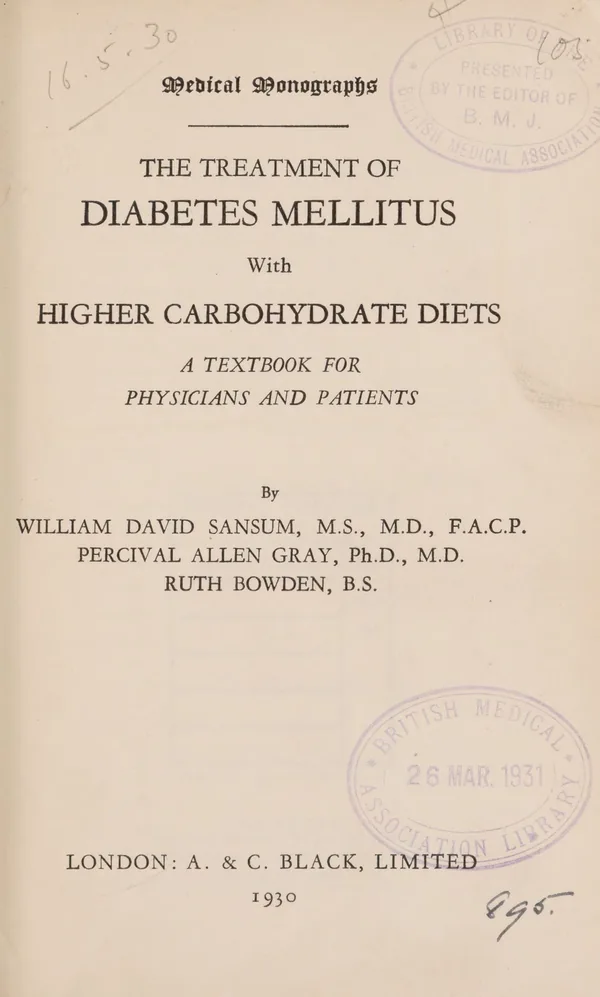
The Treatment of Diabetes Mellitus with Higher Carbohydrate Diets
By William David Sansum, Percival Allen Gray, Ruth Bowden
About this ebook
The Treatment of Diabetes Mellitus with Higher Carbohydrate Diets is a 1930 study of dietary approaches to diabetes. William David Sansum, Percival Allen Gray, and Ruth Bowden discuss energy needs, nutrient proportions, and food composition, offering medical historians and nutrition researchers a primary source on an earlier therapeutic debate.
Inside this title
Historical 1930 discussion of carbohydrate and fat in diabetes diets
Current listed price $23.99Regular price $39.00Digital ebook
This historical text examines the authors' proposal to increase dietary carbohydrate while reducing fat in the management of diabetes. Their discussion moves between principles of normal nutrition and the dietary arrangements they proposed for diabetic patients, placing the work within the nutritional thinking of 1930.
Caloric requirements, activity, body weight, and metabolic state shape the book's account of dietary planning. Protein, minerals, vitamins, and dietary bulk receive attention alongside carbohydrate-to-fat ratios. Written originally for physicians and patients, it now offers a source for studying changes in diabetes care, metabolic research, and patient education. Its treatment discussions represent the authors' period-specific approach to the subject.
Study guide included
Inside The Treatment of Diabetes Mellitus with Higher Carbohydrate Diets.
Dietary treatment of diabetes looked different in 1930, and this book records one position in that debate. Sansum, Gray and Bowden argue for raising carbohydrate while lowering fat, setting the proposal against energy needs, food composition and the nutritional knowledge of their time.
The text is a historical source rather than a current clinical manual. It opens with principles of normal nutrition, then develops the authors' case for a diet higher in carbohydrate and lower in fat for diabetic patients. Caloric requirements, activity level, body weight and metabolic state shape how the diet is planned, while protein, minerals, vitamins and dietary bulk receive their own attention. The authors write for physicians and patients, so the prose moves between rationale and practical arrangement. Read today, the book documents an earlier therapeutic argument and shows how diabetes care, metabolic research and patient education were understood at the time. Its recommendations belong to that period and are not presented as present-day guidance.
A position within a historical debate
The book is best understood as an argument, not a neutral survey. In 1930 the balance of carbohydrate and fat in diabetic diets was contested, and the authors take a side by proposing more carbohydrate and less fat. Reading their case alongside the period's assumptions shows how therapeutic disagreement was framed before later research changed the terms of the discussion.
The book argues for a specific dietary position
Carbohydrate and fat balance was contested
The argument reflects its period's assumptions
Topic 1
Principles of normal nutrition
Before discussing diabetes, the authors set out what they take normal nutrition to require. This baseline matters because their therapeutic proposal is defined against it: the diabetic diet is presented as a modification of ordinary eating rather than a separate system. The section also reveals which nutritional ideas the authors treat as settled and which they are still working out.
A normal-nutrition baseline precedes treatment
The diabetic diet is a modification of ordinary eating
The section shows what the authors take as settled
Topic 2
Energy requirements and activity
Caloric needs are related to body weight, activity and metabolic state rather than treated as a fixed number. The book explains how these factors enter dietary planning for a diabetic patient, so the diet is adjusted to the person rather than imposed uniformly. This attention to individual variation sits alongside the authors' general argument about carbohydrate and fat proportions.
Calorie needs vary with weight and activity
Metabolic state affects dietary planning
The diet is adjusted to the individual
Topic 3
Carbohydrate-to-fat proportions
The central proposal concerns the ratio between carbohydrate and fat. The authors present their reasoning for increasing carbohydrate while reducing fat, and they discuss the practical arrangements that follow. Because this is the book's distinctive claim, the section is where its therapeutic logic is most visible, and where a modern reader can see how the argument was constructed from the evidence then available.
The carbohydrate-to-fat ratio is the core claim
Practical arrangements follow from the proposal
The reasoning reflects the evidence then available
Topic 4
Protein, minerals, vitamins and bulk
Beyond the main macronutrient ratio, the book gives separate attention to protein, minerals, vitamins and dietary bulk. These topics show that the authors' dietary thinking was not limited to carbohydrate and fat; they were also concerned with adequacy and with the physical character of the diet. The detail helps a reader reconstruct what a complete dietary plan looked like in this period.
Protein needs are considered separately
Minerals and vitamins are part of adequacy
Dietary bulk affects the practical plan
Topic 5
Value as a primary source
The book's present-day interest lies in what it documents. It preserves an earlier therapeutic argument, the nutritional vocabulary used to make it, and the way physicians and patients were addressed. Historians of medicine and nutrition can read it as evidence of how diabetes care and metabolic thinking were presented in 1930, while remembering that its clinical recommendations are period-specific.
The text preserves an earlier therapeutic argument
Its vocabulary reflects the period
Clinical recommendations are period-specific
Topic 6
Topic map
The 1930 Dietary DebateTopic 1
Principles of Normal NutritionTopic 2
Caloric Needs and ActivityTopic 3
Carbohydrate and Fat ProportionsTopic 4
Protein, Minerals, Vitamins and BulkTopic 5
Reading the Book as a Historical SourceTopic 6
Key takeaways
Read the book as a primary source for a 1930 therapeutic argument, not as current clinical guidance.
Notice how the authors define their diabetic diet against a baseline of normal nutrition.
Treat the carbohydrate-to-fat proposal as historically situated reasoning rather than settled evidence.
Medical historians, nutrition researchers and students of diabetes care who want a primary source on earlier dietary thinking, along with readers interested in how therapeutic debates were argued in 1930.
Topics covered
diabetes mellitus history
higher carbohydrate diets
1930 diabetes treatment
historical nutrition research
dietary carbohydrate and fat
diabetes patient education
metabolic research history
primary source nutrition
Questions about this ebook.
Edition, audience, and study-guide details at a glance.
What is The Treatment of Diabetes Mellitus with Higher Carbohydrate Diets about?
The Treatment of Diabetes Mellitus with Higher Carbohydrate Diets is a 1930 study of dietary approaches to diabetes. William David Sansum, Percival Allen Gray, and Ruth Bowden discuss energy needs, nutrient proportions, and food composition, offering medical historians and nutrition researchers a primary source on an earlier therapeutic debate.
Who is The Treatment of Diabetes Mellitus with Higher Carbohydrate Diets for?
Medical historians, nutrition researchers and students of diabetes care who want a primary source on earlier dietary thinking, along with readers interested in how therapeutic debates were argued in 1930.
Does this page include a study guide?
Yes. This page includes an original study guide with six thematic sections, key takeaways, and a topic map for structured reading.