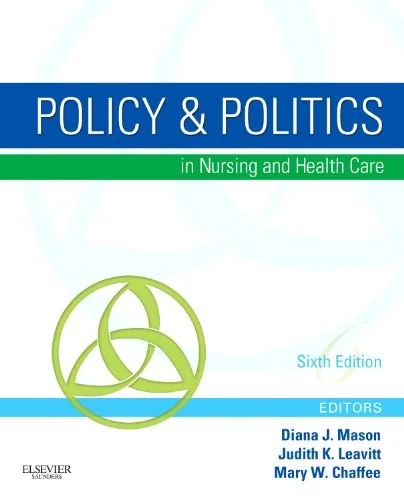
Policy & Politics in Nursing and Health Care, 6th Edition
Edited by Diana J. Mason, Judith K. Leavitt, Mary W. Chaffee
About this ebook
Policy & Politics in Nursing and Health Care, Sixth Edition, examines how nurses participate in health policy and political decision making. It combines policy frameworks with first-person accounts, covering advocacy, healthcare financing, organizational change, and communication with policymakers. Nursing students and professionals can study the relationships among clinical concerns, institutions, and public policy.
Inside this title
Political, economic, and ethical perspectives on healthcare issues
Current listed price $29.99Regular price $60.00Digital ebook
Edited by Diana J. Mason, Judith K. Leavitt, and Mary W. Chaffee, this volume treats nursing as a profession with a role in shaping healthcare decisions. Political, economic, and ethical perspectives are used to examine policy issues, while personal accounts from nurses and policy leaders illustrate how those issues unfold in practice.
The sixth edition considers advocacy at institutional, state, and federal levels, including communication with legislators, regulators, communities, and the media. Healthcare organization, financing, workforce concerns, patient safety, and health equity provide substantive contexts for that discussion. Published in 2012, the edition offers nursing learners a period-specific account of policy debates alongside broader concepts of professional political participation.
Study guide included
Inside Policy & Politics in Nursing and Health Care, 6th Edition.
Mason, Leavitt, and Chaffee treat policy as work nurses can learn rather than a distant arena. Practice observations become proposals once someone names the decision, the authority behind it, and the people affected. This guide follows the sixth edition through financing, evidence, government venues, associations, and community campaigns.
Early chapters make health central to four spheres: government, workplace, professional associations, and community. Political competence includes stakeholder mapping, communication, negotiation, media work, and timing. Delivery chapters separate payment, coverage, and actual access, using Medicare, children's programs, veterans' care, rural services, and international comparisons. Research chapters ask how evidence reaches decision makers and how staffing conditions shape care. Government material explains legislation, regulation, licensure, elections, and appointments. Later sections cover coalitions, competing interests, and community activism, closing with cases that cross jurisdictions. The edition describes U.S. arrangements as they stood around 2012.
Practice problems as policy questions
Repeated difficulties in care often trace back to a rule, a funding choice, or an organizational decision. The framework asks nurses to describe the pattern, identify who decides, and explain what a change would alter. Political competence is learnable: map stakeholders, find who gains and who bears costs, prepare the message, and watch for a moment when the venue can act.
Turn a recurring frustration into a named decision
Map gainers, losers, and decision authority
Wait for a venue ready to act
Ch. 1 to 12
Payment, coverage, and reachable care
Financing, coverage, and delivery are related but distinct questions. Programs for older adults, children, and veterans show how eligibility rules differ across groups. A covered service may still be out of reach because of staffing, distance, or transport. Reform chapters describe prevention, primary care, plus coverage gaps during early implementation, and comparisons with rural, long-term, and U.K. arrangements expose different constraints.
Separate who pays from who can reach care
Check eligibility against local capacity
Read reform claims in their publication period
Ch. 13 to 38
Evidence, staffing, and workplace politics
Research establishes how widespread a problem is, who experiences it, and whether an intervention could work. Research on service delivery links how care is organized to what it produces. Findings travel through organizations that hold their own priorities and incentives, so the politics of evidence matters. Workforce chapters connect ratios, schooling, migration, technology, and mistreatment to both employment and care quality. The right channel depends on whether an employer, regulator, or legislator holds authority.
Pair national research with local staffing data
Ask who sets the rule behind it
Present limits so a pilot has meaning
Ch. 39 to 62
Government venues and public argument
National, state, and local bodies carry different duties, and a single issue may pass through several. A legislature authorizes, an agency writes operating detail, and licensure boards handle practice and discipline. Advocates need the body that controls the relevant piece. Lobbying improves when the request is specific, evidence is clear, and effects on a named constituency are specific. Relationships help with procedure; voting, appointments, and elected office open other routes.
Identify the office that can grant the request
Explain consequences for a named constituency
Request one concrete next step
Ch. 63 to 80
Coalitions and shared influence
Associations contribute members, policy knowledge, and communication reach. Partners may add community trust or experience the profession lacks. A coalition works when participants agree on a limited objective, divide responsibilities, and keep separate agendas from blocking the joint message. Map allies and opponents before picking tactics. Pharmaceutical politics shows how resources shape what is debated, so campaigns need a plan for sustaining attention across several decision points.
Agree on one request before going public
Divide work and keep roles explicit
Anticipate well-resourced opposition early
Ch. 81 to 90
Communities and the conditions behind health
The community chapters locate policy where residents live and gather. Nurses contribute knowledge about health effects and available services; residents explain barriers and what change would mean. Activism depends on sustained contact and the skill at linking neighborhood experience with resource choices. Later cases reach global health, disease outbreaks, and trafficking, showing issues that cross professional and governmental boundaries. Local documentation can keep community knowledge visible as a proposal travels upward.
Let residents name the priority and the measure
Record the place and timing of complaints
Carry local experience into wider venues
Ch. 91 to 104
Chapter and section map
A Framework for Action in Policy and PoliticsCh. 1
The Policy Process and Political AnalysisCh. 7 and 8
Financing Health Care in the United StatesCh. 14
Research as a Political and Policy ToolCh. 40
Quality and Safety in Health CareCh. 48
An Overview of Legislation and RegulationCh. 65
CoalitionsCh. 86
An Introduction to Community ActivismCh. 92
Key takeaways
Name the body with authority over the specific change before selecting a tactic.
Join research with local observation so a proposal fits the setting it targets.
Agree early on the role affected groups play in defining and judging success.
Nursing students and practicing nurses who want a practical entry to health policy, plus educators using case discussions to connect clinical work with civic action.
Topics covered
health policy
nursing advocacy
political competence
healthcare financing
coalition building
community activism
legislative process
workforce policy
Questions about this ebook.
Edition, audience, and study-guide details at a glance.
What is Policy & Politics in Nursing and Health Care, 6th Edition about?
Policy & Politics in Nursing and Health Care, Sixth Edition, examines how nurses participate in health policy and political decision making. It combines policy frameworks with first-person accounts, covering advocacy, healthcare financing, organizational change, and communication with policymakers. Nursing students and professionals can study the relationships among clinical concerns, institutions, and public policy.
Which edition of Policy & Politics in Nursing and Health Care, 6th Edition is this?
This listing is for the 6th edition. Check the title, ISBN, and book details above before ordering, especially if your course or reading list names a specific edition.
Who is Policy & Politics in Nursing and Health Care, 6th Edition for?
Nursing students and practicing nurses who want a practical entry to health policy, plus educators using case discussions to connect clinical work with civic action.
Does this page include a study guide?
Yes. This page includes an original study guide with six thematic sections, key takeaways, and a chapter and section map for structured reading.