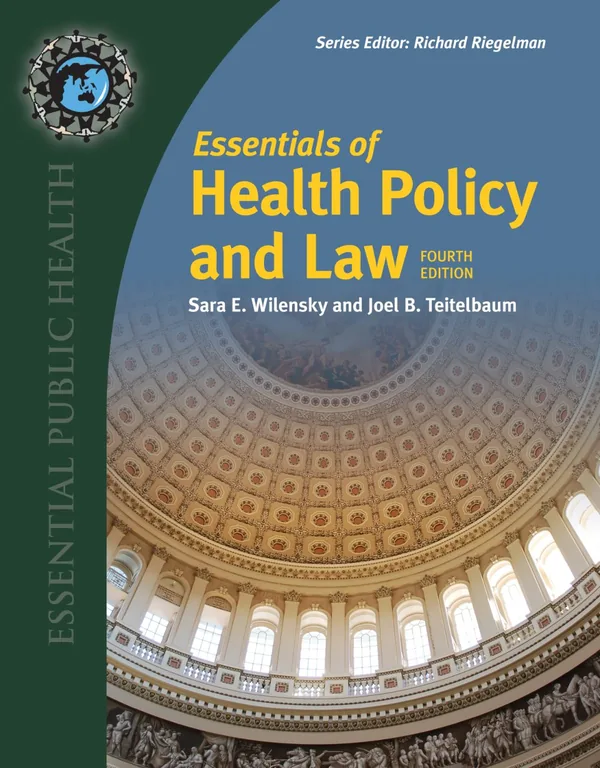
Essentials of Health Policy and Law, Fourth Edition introduces the policy and legal structures shaping American healthcare. Sara E. Wilensky and Joel B. Teitelbaum examine government roles, insurance, public health powers, reform, disparities, and ethical questions for students in public health, nursing, medicine, health administration, and related programs.
Inside this title
Federal and state roles in American healthcare policy
Current listed price $22.99Regular price $49.00Digital ebook
This introductory text connects the organization of U.S. healthcare with the processes that create its rules. Readers examine federal and state responsibilities, the development of legislation, and legal foundations of public health, then consider how these structures influence financing, access, and the delivery of services.
Coverage includes Medicare, Medicaid, private insurance, the Affordable Care Act, health disparities, and patient rights. Cases, examples, and discussion questions provide settings for thinking through privacy, liability, informed consent, and other policy dilemmas. The fourth edition supports coursework that asks students to understand the interaction of law, ethics, and health systems within the period addressed by the text.
Study guide included
Inside Essentials of Health Policy and Law, 4th Edition.
An orientation to the policy and legal machinery behind American healthcare, tracing how federal and state authority divides, how legislation becomes rules, and how those structures reach insurance, access, patient rights, and the ethical dilemmas practitioners meet in public health and clinical settings.
The fourth edition treats health policy and law as connected systems rather than separate subjects. Readers examine how federal and state responsibilities divide, how legislation is developed, and what legal foundations support public health action, then follow those structures into financing, access, and service delivery. Insurance material covers Medicare, Medicaid, private coverage, and the Affordable Care Act, while later discussion turns to health disparities and patient rights. Cases, examples, and discussion questions create room to work through privacy, liability, and informed consent. The text is written for students in public health, nursing, medicine, health administration, and related programmes who need to see how law, ethics, and health systems interact.
Federal and state authority
Responsibility for American healthcare is split between national and state government, and the book maps that division rather than assuming a single authority. Readers see how the split shapes what each level can do and how the two interact. Understanding who holds which power is treated as a precondition for understanding any later policy question.
Identify which level of government holds a given power
See where federal and state roles overlap or conflict
Connect authority to practical policy outcomes
Read first; later chapters on insurance and reform assume this division.
How policy and legislation are made
Policy is presented as a process with stages rather than a finished rule handed down. The text follows the development of legislation and the surrounding institutions that shape it. Readers are encouraged to trace a policy from proposal through enactment to implementation instead of treating statutes as static text.
Follow policy through its stages
Identify the institutions involved at each stage
Separate enactment from implementation
Use alongside a current example so the process stages have something concrete to attach to.
Legal foundations of public health action
Public health powers rest on legal grounds that define what agencies may require and where limits fall. The guide connects those foundations to the practical work of protecting population health. It presents law as the framework that both authorises and constrains public health measures.
Recognise the legal basis for public health measures
See where authority meets individual rights
Treat law as both permission and limit
Read before the chapters on rights and ethics, which test these limits.
Insurance, financing, and reform
Medicare, Medicaid, private insurance, and the Affordable Care Act are examined as mechanisms that determine how care is paid for and reached. The book connects financing arrangements to the access they produce. Reform is discussed within the period the edition covers rather than as an open-ended forecast.
Distinguish the major insurance programmes
Connect payment arrangements to access
Place reform within its historical moment
Read after the government-roles material so the programmes have an institutional home.
Disparities, access, and patient rights
The text turns from structures to consequences, asking who is served and who is not. Health disparities and patient rights are treated as outcomes of the policy and legal arrangements already described. Readers are asked to connect an observed inequity back to the rules and financing that help produce it.
Link disparities to structural causes
Identify the rights patients hold
Evaluate access as a policy result
Read after insurance and financing, which supply the explanatory background.
Privacy, liability, and informed consent
Ethical and legal dilemmas are worked through cases rather than resolved by a single rule. Privacy, liability, and informed consent each place professional duty against other interests. Discussion questions invite readers to reason toward a position and defend it, which is why the text pairs these topics with examples.
Apply principles to concrete dilemmas
Weigh competing duties in a case
Justify a position rather than recall a verdict
Use the cases as discussion prompts; they are designed for argument, not memorisation.
Topic map
Government roles in American healthcareTopic 1
Policy process and legislationTopic 2
Legal foundations of public healthTopic 3
Insurance and healthcare financingTopic 4
Health reform and the Affordable Care ActTopic 5
Disparities, access, and patient rightsTopic 6
Privacy, liability, and informed consentTopic 7
Law, ethics, and health systems togetherTopic 8
Key takeaways
American health policy is shaped by a division of authority between federal and state government that determines what each can do.
Insurance arrangements are not background detail; they set the conditions of access the rest of the system inherits.
Ethical dilemmas in healthcare are usually collisions between legitimate duties, which is why cases teach better than rules alone.
Students in public health, nursing, medicine, and health administration taking an introductory policy and law course, plus readers who want a structured account of how American healthcare is governed and financed.
Topics covered
health policy and law
US healthcare policy textbook
public health law
Medicare Medicaid private insurance
Affordable Care Act
health disparities and access
patient rights and informed consent
health ethics case studies
Questions about this ebook.
Edition, audience, and study-guide details at a glance.
What is Essentials of Health Policy and Law, 4th Edition about?
Essentials of Health Policy and Law, Fourth Edition introduces the policy and legal structures shaping American healthcare. Sara E. Wilensky and Joel B. Teitelbaum examine government roles, insurance, public health powers, reform, disparities, and ethical questions for students in public health, nursing, medicine, health administration, and related programs.
Which edition of Essentials of Health Policy and Law, 4th Edition is this?
This listing is for the 4th edition. Check the title, ISBN, and book details above before ordering, especially if your course or reading list names a specific edition.
Who is Essentials of Health Policy and Law, 4th Edition for?
Students in public health, nursing, medicine, and health administration taking an introductory policy and law course, plus readers who want a structured account of how American healthcare is governed and financed.
Does this page include a study guide?
Yes. This page includes an original study guide with six thematic sections, key takeaways, and a topic map for structured reading.