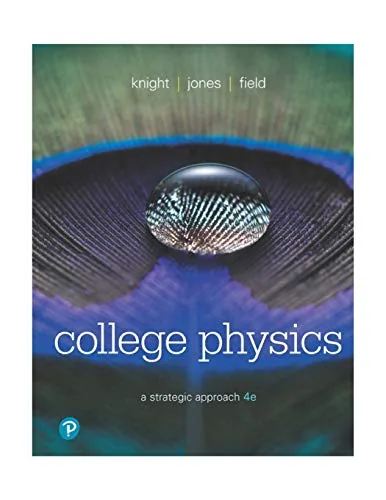
College Physics: A Strategic Approach, 4th Edition
By Randall D. Knight, Brian Jones, Stuart Field
About this ebook
College Physics: A Strategic Approach, Fourth Edition, presents algebra-based physics through structured problem solving and conceptual explanations. Knight, Jones, and Field cover mechanics, fluids, thermodynamics, electricity, magnetism, and optics for introductory college students, with examples that connect physical principles to everyday technology and the human body.
Inside this title
Algebra-based treatment of mechanics, energy, and momentum conservation
Current listed price $35.99Regular price $92.00Digital ebook
This text develops introductory physics without requiring calculus. Motion, forces, vectors, energy, and momentum establish the groundwork for studying rotations, oscillations, fluids, and waves. Later topics include heat transfer, gas behavior, electric circuits, magnetic fields, electromagnetic waves, and the behavior of light in lenses and optical instruments.
A recurring problem-solving strategy asks students to translate a situation, work through its solution, and check the result. Conceptual examples and Stop to Think questions direct attention to physical meaning as well as calculation. The approach supports students in an algebra-based college physics sequence, particularly those who benefit from seeing how a mathematical representation relates to an observable physical situation.
Study guide included
Inside College Physics: A Strategic Approach, 4th Edition.
College Physics: A Strategic Approach, fourth edition, presents algebra-based physics through structured problem solving and conceptual explanation. Knight, Jones, and Field cover mechanics, fluids, thermodynamics, electricity, magnetism, and optics for introductory students, with examples that connect physical principles to everyday technology and the human body.
Mechanics and conservation open the book, followed by matter and fluids, oscillations and sound, light, electricity and magnetism, and modern physics. Biological illustrations range from circulation and balance to nerve-cell signals and medical radiation. The same routine recurs: describe what is observed, state the simplifications in the model, and explain the answer in words as well as equations. Students are pushed to choose a representation deliberately, diagrams are treated as arguments, and the goal is physical judgment that survives an unfamiliar problem.
Motion diagrams, forces, and torque
Motion diagrams record position at equal time steps; the slope of a position-time graph gives velocity, and the signed area under a velocity-time graph gives displacement. Steady motion therefore means no acceleration, even though position changes. A diagram that isolates a single object and draws only the forces acting on it from outside makes the net force visible; torque depends on force and lever arm, so equilibrium requires both to balance.
Read the motion before reaching for an equation
Locate interactions and their lever arms
Remember that circular motion accelerates
Ch. 1–8
Momentum, work, and conservation
Momentum is a vector, and external impulse equals the change in momentum. In a brief collision the external impulse may be small enough to ignore even though the objects push hard on each other, so total momentum can be conserved while kinetic energy is not. Work changes a system's energy, power gives the rate, and potential energy stores capacity in particular interactions; friction turns mechanical energy into thermal energy.
Decide which quantity is conserved
Draw the boundary before calculating
Account for every energy transfer
Ch. 9–11
Gas behavior and fluid assumptions
The ideal-gas model connects pressure, volume, temperature, and amount to molecular motion, and a pressure change cannot be read without the other variables. Energy that raises temperature differs from energy absorbed during a phase change. Pressure grows with depth, buoyancy comes from displaced fluid, and steady flow of an incompressible fluid conserves volume through an unbranched tube, though viscosity adds resistance that ideal relations ignore.
Tie heat to the material's response
Check whether the fluid assumptions hold
Consider total area when vessels branch
Ch. 12–13
Waves, sound, and optical models
A restoring force can produce repeated motion, described by amplitude, period, and frequency. A traveling wave carries energy through a medium without carrying the medium along, and superposition explains standing waves, beats, and interference. Ray tracing predicts reflection, refraction, and image position when wave effects are negligible; wave optics accounts for diffraction and interference that rays cannot. Lenses and apertures must be judged for size, focus, and resolution.
Follow an oscillation into a wave
Choose the model of light that fits
Judge size, focus, and resolution separately
Ch. 14–19
Fields, circuits, and induced current
An electric field gives force per unit positive charge, electric potential gives potential energy per unit charge, and a potential difference across a component differs from the current through it. Kirchhoff's rules express charge and energy conservation in circuits. Moving charge and current create magnetic fields, which exert forces on moving charge or current; a changing flux through a loop induces an emf that opposes the change.
Keep field, potential, and current distinct
Trace current into its magnetic effect
Apply conservation to the circuit
Ch. 20–26
Relativity, spectra, and decay
Relativity enters through time and space measurements made by observers in relative motion, while ordinary mechanics remains accurate at everyday speeds. Quantum physics describes microscopic behavior differently, linking photon energy to frequency and treating matter as wavelike. Spectra reveal allowed energy states, nuclear physics separates electron behavior from changes inside nuclei, and radioactive decay is unpredictable for one nucleus but statistical for a large sample.
Notice where everyday approximations fail
Read spectra and decay as evidence
Use half-life only for large populations
Ch. 27–30
Chapter and section map
Representing MotionCh. 1 · p. 4
Forces and Newton’s Laws of MotionCh. 4 · p. 105
Energy and WorkCh. 10 · p. 309
FluidsCh. 13 · p. 441
Superposition and Standing WavesCh. 16 · p. 549
Wave OpticsCh. 17 · p. 586
CircuitsCh. 23 · p. 800
Atoms and MoleculesCh. 29 · p. 1019
Key takeaways
Use motion graphs and free-body diagrams to reveal assumptions an equation would hide.
Set the system boundary before applying conservation of momentum or of energy.
Pick a ray, wave, field, or particle model to fit what the observations must explain.
Students in algebra-based introductory college physics, including life-science and health-science majors, and instructors who want a strategic, diagram-centered approach with biological and everyday examples throughout.
Topics covered
algebra-based physics
Newton's laws
energy conservation
fluid mechanics
wave optics
electric circuits
magnetic induction
nuclear physics
Questions about this ebook.
Edition, audience, and study-guide details at a glance.
What is College Physics: A Strategic Approach, 4th Edition about?
College Physics: A Strategic Approach, Fourth Edition, presents algebra-based physics through structured problem solving and conceptual explanations. Knight, Jones, and Field cover mechanics, fluids, thermodynamics, electricity, magnetism, and optics for introductory college students, with examples that connect physical principles to everyday technology and the human body.
Which edition of College Physics: A Strategic Approach, 4th Edition is this?
This listing is for the 4th edition. Check the title, ISBN, and book details above before ordering, especially if your course or reading list names a specific edition.
Who is College Physics: A Strategic Approach, 4th Edition for?
Students in algebra-based introductory college physics, including life-science and health-science majors, and instructors who want a strategic, diagram-centered approach with biological and everyday examples throughout.
Does this page include a study guide?
Yes. This page includes an original study guide with six thematic sections, key takeaways, and a chapter and section map for structured reading.