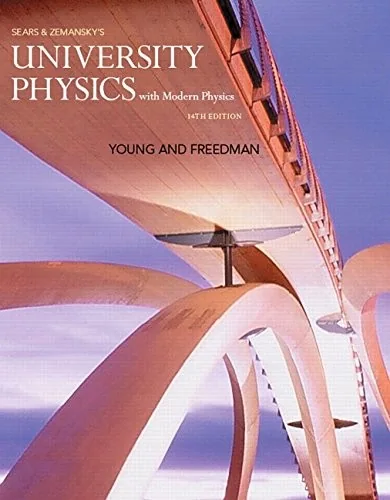
Sears and Zemansky's University Physics, Fourteenth Edition presents calculus-based introductory physics for engineering, physics, and other STEM students. Hugh D. Young and Roger A. Freedman cover mechanics, waves, thermodynamics, electromagnetism, optics, and modern physics through worked examples, visual explanations, and problems connecting concepts with mathematical analysis.
Inside this title
Calculus-based mechanics, waves, thermodynamics, electromagnetism, and optics coverage
Current listed price $9.00Regular price $16.00Digital ebook
Young and Freedman develop physical principles alongside the mathematical methods used to apply them. Mechanics begins with motion and forces before extending to energy, momentum, rotation, and gravitation. Waves, sound, and thermodynamics lead into electric and magnetic fields, circuits, electromagnetic waves, and optical phenomena.
Modern physics topics include relativity and quantum, atomic, and nuclear physics. Worked examples show approaches to analysis, while diagrams and problem sets connect visual representations with equations and physical interpretation. The fourteenth edition is aimed at a calculus-based introductory sequence for STEM undergraduates. Students can use its examples and exercises to study both conceptual questions and the multistep calculations encountered throughout university physics.
Study guide included
Inside Sears and Zemansky's University Physics, 14th Edition.
University Physics is a calculus-based introduction to physics for engineering and science students. Young and Freedman pair physical principles with the mathematical methods needed to apply them, moving from mechanics and thermodynamics through electromagnetism and optics to relativity and quantum physics, with worked examples and visual explanations throughout.
The fourteenth edition is organized as a sequence for a calculus-based introductory course. Mechanics comes first: motion and forces, then energy, momentum, rotation and gravitation. Waves and sound lead into thermodynamics. From there the text turns to electric and magnetic fields, circuits, electromagnetic waves and optical phenomena. The final stretch covers relativity together with quantum, atomic and nuclear physics. Each region of the book is developed through worked examples that model analysis, diagrams that connect visual representation with equations, and problem sets that range from conceptual checks to multistep calculations. Readers meet the mathematics as a working tool rather than an afterthought.
Mechanics: motion, force and the laws that connect them
The opening material builds mechanics from motion and forces before extending the same reasoning to energy, momentum, rotation and gravitation. The emphasis is on connecting a physical situation to an equation and then reading the result back in physical terms. Worked examples demonstrate the analysis step by step, while diagrams make the geometry of motion and force visible.
Motion and forces are the starting vocabulary
Energy, momentum and rotation extend the same framework
Gravitation is treated within the mechanical account
Topics 1–2
Waves, sound and thermodynamics
Waves and sound introduce periodic behavior and the transfer of disturbance through a medium. Thermodynamics then shifts scale, treating heat, work and the state of a system rather than a single moving object. The book keeps the visual and mathematical strands together, so wave representations and thermal quantities are interpreted through diagrams as well as equations.
Waves describe periodic disturbance and propagation
Sound applies wave ideas to a physical medium
Thermodynamics works at the level of systems and states
Topics 3–4
Electric and magnetic fields with circuits
Electric and magnetic fields are developed as the core of the electromagnetism portion. Circuits turn field ideas into practical networks of components, and the treatment keeps relating the abstract field picture to measurable quantities. The same pattern of worked example, diagram and problem carries the reader from field concepts toward circuit analysis.
Fields are the organizing idea for electricity and magnetism
Circuits connect field theory to components and measurements
Diagrams support the shift from concept to calculation
Topic 5
Electromagnetic waves and optics
Electromagnetic waves link the field chapters to optical phenomena, showing how the earlier electricity and magnetism material yields wave behavior. Optics then treats light through the phenomena the text describes, keeping visual explanation central. The sequence makes clear that optics is not an isolated subject but a continuation of the electromagnetic account.
Electromagnetic waves emerge from field theory
Optics applies wave reasoning to light
Visual explanation stays central to the optical material
Topic 6
Relativity and the quantum world
The modern physics section moves beyond classical mechanics into relativity and quantum concepts. These topics change the assumptions carried by earlier chapters, so the book presents them as a further stage rather than a contradiction. Atomic and nuclear physics follow, applying quantum ideas to structure at small scales and connecting the abstract to concrete physical systems.
Relativity revises classical assumptions about space and time
Quantum concepts introduce a different descriptive framework
Atomic and nuclear topics apply quantum reasoning
Topics 7–8
Method: examples, diagrams and graded problems
Across every section the book teaches physics through a consistent method. Worked examples show how an analysis is set up and carried through, diagrams connect a visual representation to the equations, and problem sets span conceptual questions and multistep calculations. This repeated structure is what makes the text usable for both study and practice in a calculus-based course.
Worked examples model the analysis process
Diagrams tie visual representation to equations
Problems range from conceptual checks to calculations
Topics 1–8
Topic map
Mechanics: Motion and ForcesTopic 1
Energy, Momentum, Rotation and GravitationTopic 2
Waves and SoundTopic 3
ThermodynamicsTopic 4
Electric and Magnetic Fields and CircuitsTopic 5
Electromagnetic Waves and OpticsTopic 6
Relativity and Quantum ConceptsTopic 7
Atomic and Nuclear PhysicsTopic 8
Key takeaways
The book is built for a calculus-based sequence, so the mathematics is part of the physics rather than a separate skill.
The topic order runs from mechanics through thermodynamics and electromagnetism to optics and modern physics, each stage reusing earlier ideas.
Worked examples, diagrams and graded problems form a repeating method you can follow when studying any section.
Undergraduates in engineering, physics and other STEM programs taking a calculus-based introductory physics course, plus students who want a structured reference for mechanics through modern physics.
Topics covered
Sears and Zemansky's University Physics 14th Edition
calculus based university physics
Young and Freedman University Physics
mechanics and thermodynamics
electromagnetism and optics
relativity and quantum physics
atomic and nuclear physics
university physics problem solving
STEM introductory physics
Questions about this ebook.
Edition, audience, and study-guide details at a glance.
What is Sears and Zemansky's University Physics, 14th Edition about?
Sears and Zemansky's University Physics, Fourteenth Edition presents calculus-based introductory physics for engineering, physics, and other STEM students. Hugh D. Young and Roger A. Freedman cover mechanics, waves, thermodynamics, electromagnetism, optics, and modern physics through worked examples, visual explanations, and problems connecting concepts with mathematical analysis.
Which edition of Sears and Zemansky's University Physics, 14th Edition is this?
This listing is for the 14th edition. Check the title, ISBN, and book details above before ordering, especially if your course or reading list names a specific edition.
Who is Sears and Zemansky's University Physics, 14th Edition for?
Undergraduates in engineering, physics and other STEM programs taking a calculus-based introductory physics course, plus students who want a structured reference for mechanics through modern physics.
Does this page include a study guide?
Yes. This page includes an original study guide with six thematic sections, key takeaways, and a topic map for structured reading.