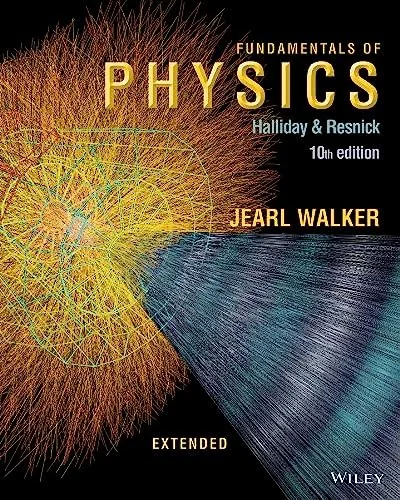
Halliday, Resnick, and Walker's Fundamentals of Physics, 10th Edition introduces classical and modern physics through conceptual explanations and mathematical problem solving. Written for university science and engineering students, it covers mechanics, thermodynamics, electromagnetism, optics, and quantum ideas, with worked approaches that connect principles to physical situations.
Inside this title
Mechanics, thermodynamics, electromagnetism, optics, and introductory quantum physics
Current listed price $26.99Regular price $65.00Digital ebook
The book builds physical reasoning across topics that begin with motion, force, energy, and momentum. Heat and entropy lead into electric fields, circuits, magnetic phenomena, and electromagnetic waves. The treatment of light includes reflection, refraction, interference, and diffraction, followed by introductory quantum concepts and atomic structure.
Explanations introduce concepts before developing their mathematical use, and step-by-step examples model approaches to calculation. Applications connect the abstract material with recognizable physical systems, from moving objects to optical devices. The tenth edition is intended for undergraduate introductory study and can also support review of connections among the core subjects before more specialized physics coursework.
Study guide included
Inside Fundamentals of Physics, 10th Edition.
Halliday, Resnick, and Walker build physics from careful measurement toward the modern picture of matter. Concepts come before equations, and worked problems show how to move from a described situation to a calculation. Mechanics, heat, electromagnetism, optics, and quantum ideas are arranged so that each stage prepares the next.
The tenth edition follows the arc of an introductory course. Measurement, vectors, and kinematics lead to Newton's laws and the analysis of forces. Conservation of energy, momentum, and angular momentum organize mechanics and extend to equilibrium, gravitation, and fluids. Oscillations and waves introduce periodic behavior, while thermodynamics treats heat, work, and entropy. Electricity and magnetism run from electrostatics through circuits, induction, and Maxwell's equations. Geometric and wave optics describe images and interference, and the final chapters take up relativity, photons, atomic structure, and the quantum description of matter. Examples and end-of-chapter problems reinforce each step.
From measurement to motion
The opening chapters establish the discipline of physics: choose coordinates, define quantities, and check units. Displacement, velocity, and acceleration are read from graphs and extended to more than one dimension with vectors. Newton's laws then connect changes in motion to net force.
Coordinates give signs and directions
Graphs describe motion
Free-body diagrams organize forces
Chapters 1–6
Energy, momentum, and rotation
Conservation laws answer questions that force analysis alone makes clumsy. Work changes kinetic energy, conservative forces allow potential energy, and momentum tracks collisions. Rotational inertia, torque, and angular momentum extend the same logic to distributed matter, equilibrium, gravitation, and fluids.
Work links force to energy
Momentum governs collisions
Rotation needs its own inertia and torque
Chapters 7–14
Oscillations, waves, and heat
A harmonic oscillator supplies a reference model for periodic motion, and waves carry that behavior across space. Superposition explains interference and standing patterns. Thermodynamics separates heat and work as energy transfers from internal energy, while entropy constrains which processes can occur.
Oscillators model periodic motion
Waves interfere and form standing patterns
Entropy limits feasible processes
Chapters 15–20
Electric and magnetic models
Electric fields and potentials describe interactions between charges, and Gauss's law simplifies problems with symmetry. Circuits track current and potential through junctions and loops. Magnetic fields act on moving charges and changing flux induces an emf, leading to inductance, AC, and Maxwell's equations.
Fields and potentials describe charge interactions
Symmetry makes Gauss's law useful
Changing flux induces current
Chapters 21–32
Light as rays and waves
Geometric optics treats light as rays when dimensions dwarf the wavelength, using reflection, refraction, and lenses to locate images. When interference matters, light is treated as a wave, and path difference determines whether signals reinforce or cancel. Diffraction links wavelength and aperture size to resolution.
Rays locate images in mirrors and lenses
Phase determines interference
Aperture and wavelength set resolution
Chapters 33–36
Relativity and the quantum scale
Special relativity relates time, length, momentum, and energy across inertial frames, forcing the observer and events to be stated explicitly. Quantum chapters introduce photons and matter waves, then build toward atoms, solids, nuclei, and particles. The final movement shows where classical models give way.
Relativity depends on the reference frame
Quantized states explain atomic behavior
Particle models extend to nuclei and solids
Chapters 37–44
Chapter and section map
Measurement, Motion, Vectors, and ForceCh. 1–6
Work, Energy, Momentum, and RotationCh. 7–11
Equilibrium, Gravitation, and FluidsCh. 12–14
Oscillations, Waves, and ThermodynamicsCh. 15–20
Electricity, Magnetism, and Maxwell’s EquationsCh. 21–32
Electromagnetic Waves and OpticsCh. 33–36
Relativity, Photons, and Matter WavesCh. 37–39
Atoms, Solids, Nuclei, and ParticlesCh. 40–44
Key takeaways
Draw the system, axes, and interactions before choosing equations.
Check the conditions for each conservation law separately; they do not always hold together.
Test a result against a limiting case or a second representation to confirm its meaning.
Undergraduate science and engineering students in calculus-based physics courses, and readers reviewing classical and modern physics.
Topics covered
university physics
Halliday Resnick Walker
mechanics
thermodynamics
electromagnetism
optics
relativity
quantum physics
physics problem solving
Questions about this ebook.
Edition, audience, and study-guide details at a glance.
What is Fundamentals of Physics, 10th Edition about?
Halliday, Resnick, and Walker's Fundamentals of Physics, 10th Edition introduces classical and modern physics through conceptual explanations and mathematical problem solving. Written for university science and engineering students, it covers mechanics, thermodynamics, electromagnetism, optics, and quantum ideas, with worked approaches that connect principles to physical situations.
Which edition of Fundamentals of Physics, 10th Edition is this?
This listing is for the 10th edition. Check the title, ISBN, and book details above before ordering, especially if your course or reading list names a specific edition.
Who is Fundamentals of Physics, 10th Edition for?
Undergraduate science and engineering students in calculus-based physics courses, and readers reviewing classical and modern physics.
Does this page include a study guide?
Yes. This page includes an original study guide with six thematic sections, key takeaways, and a chapter and section map for structured reading.