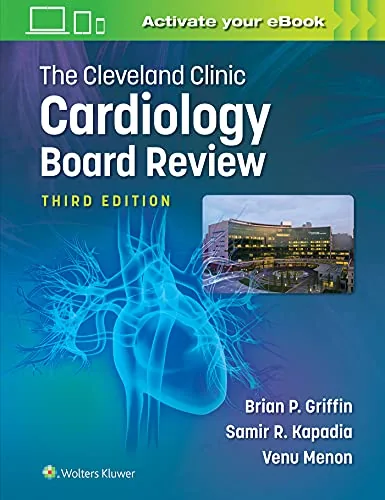
Edited by Brian P. Griffin, Samir R. Kapadia, Venu Menon
About this ebook
Cleveland Clinic Cardiology Board Review, 3rd Edition organizes cardiovascular medicine for focused review. Edited by Brian P. Griffin, Samir R. Kapadia, and Venu Menon, it covers examination, coronary disease, heart failure, valve disorders, arrhythmias, and imaging. Cardiology fellows and physicians can use the chapter format and review questions for structured study.
Inside this title
Coronary disease, heart failure, valve disorders, and cardiac arrhythmias
Current listed price $47.99Regular price $159.00Digital ebook
Clinical anatomy and physical examination introduce the foundations for reviewing cardiovascular disease. Subsequent topics include coronary artery disease, acute and chronic heart failure, valvular conditions, electrophysiology, ablation, and device therapy. Imaging discussion spans echocardiography, nuclear methods, CT, and MRI, connecting several ways of evaluating the heart.
The third edition uses a consistent chapter template with learning objectives, key points, tables, and review questions. Individual chapters can be consulted for a particular topic or studied as part of a broader review schedule. The clinically oriented presentation suits cardiology fellows preparing for certification-related study and practicing physicians revisiting the cardiovascular concepts and management discussions presented in this edition.
This review volume runs a consistent template through cardiovascular medicine: objectives, key points, tables and questions. Coronary disease, heart failure, valve disorders, arrhythmia, devices and imaging are each covered in a chapter that can be studied in sequence or consulted when a topic needs attention.
This review volume follows a single template: objectives, key points, tables and questions. Clinical anatomy and physical examination open the sequence, followed by coronary artery disease, acute and chronic heart failure, valvular disease, electrophysiology, ablation and device therapy. Imaging is covered across echocardiography, nuclear methods, CT and MRI, so that several ways of looking at the heart are set side by side. Chapters can be read in order for a review schedule or consulted individually when a topic needs attention, which is how most fellows will actually use it.
Examination and clinical anatomy
The review opens where clinical reasoning does: anatomy, physical examination and the findings that point toward a diagnosis. Cardiac auscultation, jugular venous assessment and other bedside signs are presented as evidence to be interpreted rather than maneuvers to be memorized. Later chapters assume this base, so a gap here shows up in every subsequent topic.
Bedside findings are evidence to interpret
Anatomy supports later clinical reasoning
Weak examination knowledge compounds
Topic 1
Coronary artery disease and revascularization
Coronary disease is covered from presentation through diagnosis and management. The chapter pattern connects risk assessment, ischemic evaluation and revascularization decisions with the evidence behind them. Review questions test whether the reader can move from a clinical scenario to a defensible choice, which is the skill the examination is designed to sample.
Presentation links to risk and testing
Revascularization decisions rest on evidence
Questions test scenario-to-choice reasoning
Topic 2
Heart failure and management
Acute and chronic heart failure are treated as distinct clinical problems sharing a pathophysiology. The review covers classification, evaluation and the sequence of therapy, with attention to what changes in the decompensated patient. Guideline-directed management is presented with the trials that support it, so that recommendations can be reconstructed rather than recalled.
Acute and chronic failure need different framing
Therapy follows a staged sequence
Recommendations trace back to trials
Topic 3
Valvular and structural disease
Valve disease is organized around lesion severity, symptoms and timing of intervention. The material connects auscultation and echocardiographic findings to decisions about repair or replacement, and it treats structural intervention as a choice with trade-offs rather than a default. Key points and tables gather the thresholds that are easy to confuse under examination conditions.
Severity and symptoms set intervention timing
Auscultation and echo are read together
Repair and replacement carry trade-offs
Topic 4
Arrhythmia, ablation and devices
Electrophysiology is built from mechanism outward. Rhythm diagnosis, the substrate for arrhythmia and the rationale for ablation are connected to device therapy and its indications. The review keeps the clinical question in front of the mechanism: what the patient has, what risk it carries, and which intervention the evidence supports at this point in the course.
Mechanism organizes rhythm diagnosis
Ablation targets a defined substrate
Device indications follow risk and evidence
Topics 5–6
Cardiac imaging across multiple modalities
Echocardiography, nuclear methods, CT and MRI are presented side by side so their relative strengths are visible. The review asks which modality answers which question, and where findings from one technique need confirmation from another. This comparative treatment is more useful for board review than learning each modality in isolation, because the examination often asks for the next appropriate test.
Each modality answers a different question
Findings may need confirmation elsewhere
Exams often ask for the next test
Topics 7–8
Topic map
Clinical Anatomy and ExaminationTopic 1
Coronary Artery DiseaseTopic 2
Acute and Chronic Heart FailureTopic 3
Valvular Heart DiseaseTopic 4
Electrophysiology and ArrhythmiaTopic 5
Ablation and Device TherapyTopic 6
Echocardiography and Nuclear ImagingTopic 7
Cardiac CT and MRITopic 8
Key takeaways
Study by organ system, then return to imaging to see how the same disease looks.
Use the review questions to find topics where recall is weaker than recognition.
Treat the tables and key points as a summary layer you revisit between chapters.
Cardiology fellows preparing for board examinations, practicing cardiologists returning to core material, and physicians who want a structured clinical review of cardiovascular medicine and imaging.
Topics covered
cardiology board review
cardiovascular medicine
coronary artery disease
heart failure review
cardiac imaging
arrhythmia review
Cleveland Clinic
board questions
Questions about this ebook.
Edition, audience, and study-guide details at a glance.
What is Cleveland Clinic Cardiology Board Review, 3rd Edition about?
Cleveland Clinic Cardiology Board Review, 3rd Edition organizes cardiovascular medicine for focused review. Edited by Brian P. Griffin, Samir R. Kapadia, and Venu Menon, it covers examination, coronary disease, heart failure, valve disorders, arrhythmias, and imaging. Cardiology fellows and physicians can use the chapter format and review questions for structured study.
Which edition of Cleveland Clinic Cardiology Board Review, 3rd Edition is this?
This listing is for the 3rd edition. Check the title, ISBN, and book details above before ordering, especially if your course or reading list names a specific edition.
Who is Cleveland Clinic Cardiology Board Review, 3rd Edition for?
Cardiology fellows preparing for board examinations, practicing cardiologists returning to core material, and physicians who want a structured clinical review of cardiovascular medicine and imaging.
Does this page include a study guide?
Yes. This page includes an original study guide with six thematic sections, key takeaways, and a topic map for structured reading.