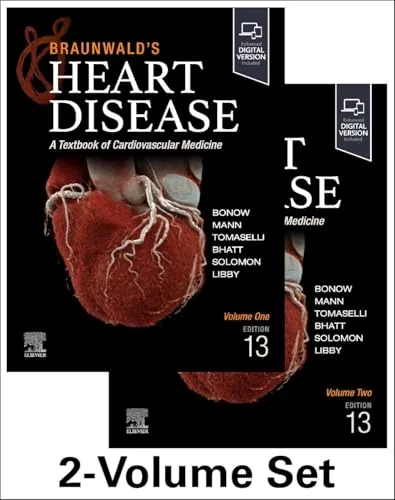
Braunwald's Heart Disease, Thirteenth Edition, is a two-volume cardiovascular medicine reference spanning disease biology, diagnosis, prevention, and treatment. Its coverage of imaging, coronary disease, heart failure, arrhythmias, valve disorders, and congenital disease serves cardiologists, fellows, researchers, and other clinicians studying the relationships between cardiovascular science and patient care.
Inside this title
Cardiovascular pathophysiology, clinical evaluation, diagnostic imaging, and prevention
Current listed price $67.99Regular price $219.00Digital ebook
This reference approaches cardiology from the underlying mechanisms of disease through clinical investigation and therapeutic options. Topics include atherosclerosis, heart failure, rhythm disorders, valvular disease, and congenital conditions, with cardiovascular imaging considered across echocardiography, MRI, CT, nuclear methods, and angiography.
Medical therapy sits alongside interventional procedures, electrophysiology, device treatment, and transplantation. Preventive cardiology chapters address risk assessment and the contribution of conditions such as hypertension, diabetes, and dyslipidemia. The two-volume structure accommodates both scientific explanations and specialty-level discussion, making it appropriate for sustained study during cardiology training and for topic-based consultation by physicians and other professionals working in cardiovascular care or research.
A two-volume reference that follows cardiovascular medicine from disease biology to bedside decisions. Bonow, Mann, Tomaselli, and colleagues connect pathophysiology, imaging, prevention, and therapy across coronary disease, heart failure, arrhythmias, valves, and congenital conditions, serving cardiology fellows, practicing clinicians, and researchers who need sustained, specialty-level depth in one place.
The thirteenth edition is organized so scientific explanation and clinical practice stay together. Early material establishes mechanisms of atherosclerosis and cardiovascular disease, then diagnostic evaluation moves through echocardiography, MRI, CT, nuclear imaging, and angiography. Therapeutic sections cover medical therapy, coronary intervention, electrophysiology, devices, surgery, and transplantation. Preventive chapters address risk assessment and conditions such as hypertension, diabetes, and dyslipidemia. The two-volume format supports both sequential study during training and targeted consultation when a specific question arises, which is why fellows and practicing specialists keep it within reach.
Disease Mechanisms and Vascular Biology
The reference starts from the biology that underlies clinical disease. Atherosclerosis, vascular function, and the molecular processes behind cardiovascular disorders are presented before diagnosis and treatment, so later recommendations can be read as consequences of mechanism rather than isolated rules.
Trace atherosclerosis development
Relate vascular biology to disease
Connect mechanism with clinical presentation
Topic 1
Clinical Evaluation and Multimodal Imaging
Diagnosis draws on history, examination, and several imaging methods. The text places echocardiography, MRI, CT, nuclear techniques, and angiography side by side, encouraging readers to match a modality to the question being asked rather than defaulting to one test.
Select imaging appropriate to a question
Compare modality strengths
Integrate findings into assessment
Topics 2–3
Coronary Disease and Intervention
Ischemic heart disease receives sustained coverage, from risk and presentation to catheter-based and surgical treatment. Medical management sits alongside revascularization, so procedural decisions are weighed within overall care rather than treated in isolation.
Assess coronary disease
Compare medical and interventional options
Interpret procedural indications
Topic 4
Heart Failure and Cardiomyopathy
Heart failure is examined across its presentations, mechanisms, and treatment pathways. Pharmacologic therapy, device support, and transplantation appear as parts of a continuum, and the text keeps attention on how choices change as the condition progresses.
Classify heart failure presentations
Follow treatment progression
Relate devices and transplant to care
Topic 5
Arrhythmias, Electrophysiology, and Devices
Rhythm disorders connect diagnosis with electrophysiology and device therapy. The book covers arrhythmia mechanisms, mapping and ablation, and implanted devices, presenting technical procedures alongside the clinical reasoning that leads to them.
Identify arrhythmia mechanisms
Understand electrophysiology study and ablation
Relate device therapy to indications
Topics 6–7
Valves, Congenital Disease, and Prevention
Structural and congenital conditions broaden the reference beyond acquired coronary disease, while preventive cardiology returns to risk assessment and modifiable factors. Together these sections show the range of cardiology from lifelong congenital care to population-level risk reduction.
Evaluate valvular disease
Approach congenital conditions
Apply risk assessment and prevention
Topic 8
Topic map
Cardiovascular pathophysiology and disease biologyTopic 1
Clinical assessment and echocardiographyTopic 2
MRI, CT, nuclear imaging, and angiographyTopic 3
Coronary artery disease and interventionTopic 4
Heart failure and transplantationTopic 5
Arrhythmias and electrophysiologyTopic 6
Device therapy and valvular diseaseTopic 7
Congenital disease, prevention, and risk factorsTopic 8
Key takeaways
Cardiovascular practice is best read as a chain from mechanism through diagnosis to therapy.
Imaging choices should follow the clinical question rather than habit.
Prevention and long-term structural disease belong within the same reference as acute coronary care.
Cardiology fellows and practicing cardiologists, internists and researchers in cardiovascular science, and clinicians who need a comprehensive specialty reference for training, board review, or topic-based consultation.
Topics covered
Braunwald's Heart Disease
cardiovascular medicine
cardiology reference
heart failure
coronary artery disease
cardiac imaging
arrhythmias
preventive cardiology
Questions about this ebook.
Edition, audience, and study-guide details at a glance.
What is Braunwald's Heart Disease, 13th Edition, Two-Volume Set about?
Braunwald's Heart Disease, Thirteenth Edition, is a two-volume cardiovascular medicine reference spanning disease biology, diagnosis, prevention, and treatment. Its coverage of imaging, coronary disease, heart failure, arrhythmias, valve disorders, and congenital disease serves cardiologists, fellows, researchers, and other clinicians studying the relationships between cardiovascular science and patient care.
Which edition of Braunwald's Heart Disease, 13th Edition, Two-Volume Set is this?
This listing is for the 13th edition. Check the title, ISBN, and book details above before ordering, especially if your course or reading list names a specific edition.
Who is Braunwald's Heart Disease, 13th Edition, Two-Volume Set for?
Cardiology fellows and practicing cardiologists, internists and researchers in cardiovascular science, and clinicians who need a comprehensive specialty reference for training, board review, or topic-based consultation.
Does this page include a study guide?
Yes. This page includes an original study guide with six thematic sections, key takeaways, and a topic map for structured reading.