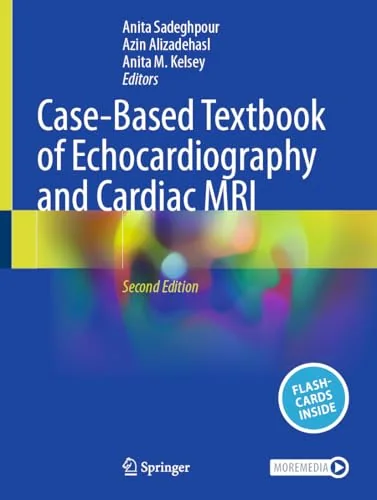
Cover of Case-Based Textbook of Echocardiography and Cardiac MRI, 2nd Edition

Case-Based Textbook of Echocardiography and Cardiac MRI, 2nd Edition

Edited by Anita Sadeghpour, Azin Alizadehasl, Anita M. Kelsey

About this ebook

Case-Based Textbook of Echocardiography and Cardiac MRI, 2nd Edition, uses clinical scenarios to teach cardiovascular imaging interpretation. It combines echocardiographic principles with cardiac magnetic resonance topics, including valve disease, cardiomyopathies, congenital conditions, and ischemia. Cardiology trainees and imaging professionals can study how findings from the two modalities inform case assessment.

Inside this title
  • Clinical cases linking imaging findings with interpretive reasoning
Current listed price $40.99Regular price $145.00Digital ebook
Review order preview

Digital ebook. No physical book.

Format
Digital ebook
ISBN
9783032022691
Last updated
2026-11-03

What this book covers.

Clinical cases organize this second edition's teaching of echocardiography and cardiovascular magnetic resonance. Scenarios progress through imaging findings, interpretation, and key learning points. Coverage includes transthoracic and transesophageal studies, Doppler assessment, chamber measurements, and CMR techniques such as late gadolinium enhancement and parametric mapping.

The disease-focused material considers valvular disorders, cardiomyopathies, adult congenital heart disease, ischemic disease, pericardial conditions, and cardiac masses. Bringing the modalities together allows readers to compare what each contributes to an imaging question. The textbook is intended for structured learning by cardiology trainees, echocardiographers, and other cardiovascular imaging professionals seeking a case-based account of the subjects addressed in this edition.

Study guide included

Inside Case-Based Textbook of Echocardiography and Cardiac MRI, 2nd Edition.

This second edition teaches cardiovascular imaging through clinical cases rather than isolated facts. Each scenario moves from echocardiographic or magnetic resonance findings to interpretation and stated learning points, so readers practice the reasoning that connects an image to a clinical question.

The volume is built around cases, and each one carries the teaching rather than serving as decoration. Ultrasound material covers transthoracic and transesophageal imaging, Doppler work and chamber measurement; magnetic resonance adds late gadolinium enhancement and parametric mapping. From there the scenarios move through valve problems, myocardial disease, adult congenital lesions, ischemic presentations, pericardial findings and masses. Seeing both modalities inside a single case lets readers ask what each adds to the same diagnostic problem. The stated readership is trainees in cardiology, practicing echocardiographers and related imaging staff who prefer structured case work to abstract description.

Cases drive the teaching

The organizing principle is the clinical scenario rather than the textbook chapter. A case presents findings first, then asks the reader to interpret them, and closes with key learning points. This sequence makes interpretation visible as a process, which suits trainees who must eventually reason from images they have not seen before.

  • Findings precede interpretation in each case
  • Learning points close the reasoning
  • Reasoning is practiced, not just described
  • Scenarios supply the structure for study
Topics 1–8

Echocardiography's technical and measurement base

Before disease-specific cases, the text establishes how ultrasound images are obtained and measured. Transthoracic and transesophageal approaches, Doppler assessment and chamber measurements are treated as the vocabulary a reader needs. Without that base, the later case interpretations would have nothing concrete and reliable to rest on.

  • Transthoracic and transesophageal windows differ
  • Doppler assesses velocity and flow
  • Chamber dimensions and volumes are measured
  • Measurement supports later interpretation
Topics 1–2

Cardiac MRI and tissue characterization

Cardiac magnetic resonance enters as a second imaging language. Late gadolinium enhancement and parametric mapping are presented as techniques for characterizing myocardium, not merely as attractive images. The cases show where tissue characterization answers a question that echocardiography raises but cannot settle on its own.

  • Late gadolinium enhancement marks abnormality
  • Parametric mapping quantifies tissue properties
  • CMR answers specific tissue questions
  • Technique is tied to interpretation
Topic 3

Valvular disease and cardiomyopathies

Valvular disorders and cardiomyopathies form the core disease territory of the cases. Readers compare what echocardiography shows about valve motion and chamber response with what magnetic resonance adds about myocardium. The pairing is meant to sharpen assessment rather than to rank one modality above the other.

  • Valve motion and severity are assessed
  • Chambers respond to loading conditions
  • Myocardium is characterized separately
  • Combined assessment sharpens judgment
Topics 4–5

Ischemia, congenital disease and masses

The case range extends to ischemic disease, adult congenital heart disease, pericardial conditions and cardiac masses. Each brings its own imaging questions, and the cases show how findings are weighed when the diagnosis is not obvious. The breadth keeps the book from becoming a single-disease manual.

  • Ischemic injury raises viability questions
  • Adult congenital anatomy requires care
  • Pericardial conditions have distinct signs
  • Masses need systematic assessment
Topics 6–8

Two modalities in one case

Bringing echocardiography and magnetic resonance together is the book's distinctive move. A case can show which modality first raises a question and which resolves it. Readers are encouraged to think in terms of complementary contributions, comparing strengths instead of memorizing parallel descriptions of the same disease.

  • Modalities answer different questions
  • One modality may confirm the other
  • Comparing the two modalities sharpens interpretation
  • Complementarity matters more than rivalry
Topics 1–8

Topic map

  • Echocardiographic Foundations and Image AcquisitionTopic 1
  • Doppler, Chamber Measurement and Hemodynamic AssessmentTopic 2
  • Cardiac MRI Techniques and Tissue CharacterizationTopic 3
  • Valvular Heart DiseaseTopic 4
  • Cardiomyopathies and Myocardial DiseaseTopic 5
  • Ischemic Heart Disease and ViabilityTopic 6
  • Adult Congenital Heart DiseaseTopic 7
  • Pericardial Conditions and Cardiac MassesTopic 8

Key takeaways

  • Work each case before reading its interpretation; the learning is in the attempt.
  • Treat echocardiography and CMR as two complementary answers to one imaging question.
  • Use the stated learning points to check whether the reasoning was understood.

Cardiology trainees, practicing echocardiographers and related cardiovascular imaging staff who want structured, practical, integrated case-based study that links ultrasound and magnetic resonance findings to diagnostic interpretation.

Topics covered

  • case-based cardiac imaging
  • echocardiography and cardiac MRI
  • valvular heart disease
  • cardiomyopathy imaging
  • late gadolinium enhancement
  • parametric mapping
  • adult congenital heart disease
  • multimodality imaging

Questions about this ebook.

Edition, audience, and study-guide details at a glance.

What is Case-Based Textbook of Echocardiography and Cardiac MRI, 2nd Edition about?

Case-Based Textbook of Echocardiography and Cardiac MRI, 2nd Edition, uses clinical scenarios to teach cardiovascular imaging interpretation. It combines echocardiographic principles with cardiac magnetic resonance topics, including valve disease, cardiomyopathies, congenital conditions, and ischemia. Cardiology trainees and imaging professionals can study how findings from the two modalities inform case assessment.

Which edition of Case-Based Textbook of Echocardiography and Cardiac MRI, 2nd Edition is this?

This listing is for the 2nd edition. Check the title, ISBN, and book details above before ordering, especially if your course or reading list names a specific edition.

Who is Case-Based Textbook of Echocardiography and Cardiac MRI, 2nd Edition for?

Cardiology trainees, practicing echocardiographers and related cardiovascular imaging staff who want structured, practical, integrated case-based study that links ultrasound and magnetic resonance findings to diagnostic interpretation.

Does this page include a study guide?

Yes. This page includes an original study guide with six thematic sections, key takeaways, and a topic map for structured reading.

Keep your curiosity going.

More books from this subject area.

More medicine & health sciences ebooks