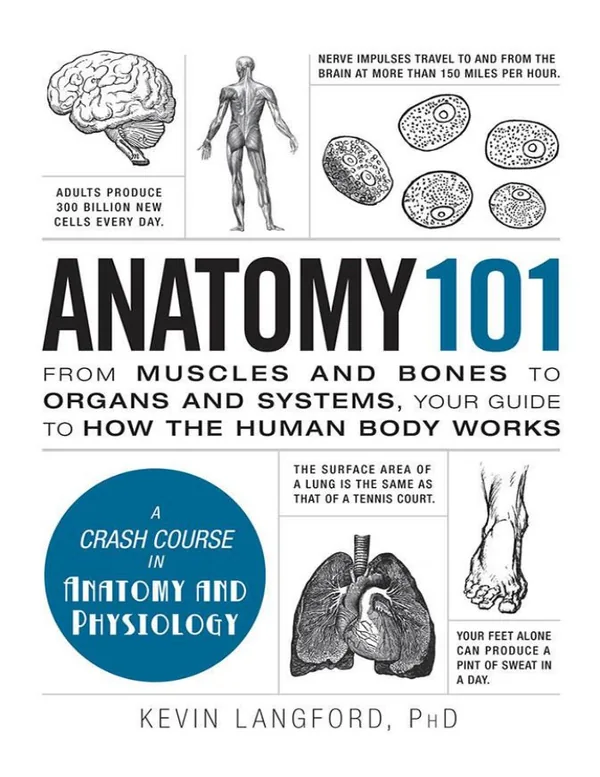
Anatomy 101 introduces human body structure and function for general readers and students seeking a supplementary overview. Kevin Langford moves from cells and tissues to bones, muscles, organs, and interacting systems, explaining movement, communication, circulation, digestion, and homeostasis in an approachable sequence suited to self-paced reading.
Inside this title
Progression from cells and tissues to interacting organ systems
Current listed price $3.99Regular price $8.00Digital ebook
Cells, tissues, and membranes provide the starting point for Langford's overview of the human body. The account develops from these building blocks to skeletal and muscular structures, major organs, and the systems that connect them. Explanations relate anatomical parts to what they do.
The nervous system's signaling, the partnership between circulation and respiration, and the roles of digestion and urinary function illustrate how body systems interact. Homeostasis and feedback connect those processes with the regulation of internal conditions. General science readers can explore the material independently, while high school, college, nursing, and fitness-related learners can use it as a supplementary introduction to human anatomy and physiology.
Study guide included
Inside Anatomy 101: Muscles, Bones, Organs, and Systems.
Anatomy is easier to hold onto when structure and function are learned together. Langford builds the body upward from cells and tissues, then shows how bones, muscles, organs, and systems depend on one another, keeping the vocabulary tied to what each part does.
The book follows an ascending order: cells, tissues, and membranes; the skeleton and joints; muscles and movement; the major organs; then the systems that coordinate them. Nervous signalling, the partnership of circulation and respiration, digestion, and urinary function are presented as interacting processes rather than separate piles of facts. Homeostasis and feedback give the account a unifying idea, showing why regulation matters to every other system. The tone stays introductory, aimed at readers who want a working map of the body rather than clinical detail.
Cells, tissues, and membranes
The body is introduced from its smallest working units outward. Cells, the four basic tissue types, and the membranes that line and cover surfaces are explained through the jobs they perform. This layer matters because tissue composition predicts what an organ can do, and because the vocabulary used later for organs is built from these terms.
Start with cell structure and function
Distinguish the four basic tissue types
Relate membrane structure to protection and exchange
Topic 1
Bones, joints, and the skeleton
The skeleton is treated as a working frame rather than a static scaffold. Bone tissue, the shapes of major bones, and the joints where they meet are connected to support, protection, and leverage. Joint type shapes the range and kind of movement available, so the section sets up the discussion of muscles that follows.
Read bone structure as support and leverage
Match joint types to movement
Connect the skeleton to protection of organs
Topic 2
Muscles, joints, and movement
Muscle groups are organised by the movements they produce at particular joints. Contraction, antagonistic pairs, and the way force transfers through tendons give the mechanical account. Naming muscles by region rather than as an undifferentiated list keeps the material usable, since each group is tied to an action a reader can picture.
Group muscles by joint action
Explain how antagonistic pairs work
Trace force from muscle through tendon
Topic 3
Nervous signalling and control
The nervous system is presented as the body's rapid communication network. Neurons, signalling pathways, and the split between sensory input and motor command explain how movement and sensation are coordinated. Placing this section after muscles makes the control relationship concrete: a muscle contracts because a signal reached it, not in isolation.
Describe how neurons carry signals
Separate sensory input from motor output
Link nerve supply to muscle control
Topic 4
Circulation and respiration together
The heart, blood vessels, and lungs are explained as a paired system for delivering oxygen and removing carbon dioxide. Gas exchange, the pathway of blood through the heart, and the mechanics of breathing are tied to the needs of tissues. Treating the two systems jointly shows why a problem in one quickly appears in the other.
Trace blood through the heart
Explain gas exchange in the lungs
Show why circulation and breathing are paired
Topic 5
Digestion, excretion, and balance
Digestion is followed from intake to absorption, with the organs and secretions involved at each stage. Urinary function is presented as the companion process that removes waste and adjusts fluid balance. Homeostasis and feedback then draw the systems together, explaining how the body corrects deviations rather than holding perfectly still.
Follow nutrients from intake to absorption
Explain waste removal and fluid balance
Use feedback to describe homeostasis
Topic 6-7
Topic map
Cells, Tissues, and MembranesTopic 1
Skeleton and JointsTopic 2
Muscles and MovementTopic 3
Nervous System SignallingTopic 4
Heart, Vessels, and LungsTopic 5
Digestion and Urinary FunctionTopic 6
Homeostasis and FeedbackTopic 7
Key takeaways
Learn each structure with the job it performs, because function is what makes anatomical names stick.
Systems are best understood in pairs: circulation with respiration, digestion with excretion, nerves with muscles.
Homeostasis is an active process of correction, not a fixed internal state.
General science readers, high school and college students, and nursing or fitness learners who want a readable supplementary introduction to human anatomy and physiology before a more technical course.
Topics covered
human anatomy
organ systems
skeletal system
muscle groups
nervous system
blood circulation
digestive system
homeostatic regulation
Questions about this ebook.
Edition, audience, and study-guide details at a glance.
What is Anatomy 101: Muscles, Bones, Organs, and Systems about?
Anatomy 101 introduces human body structure and function for general readers and students seeking a supplementary overview. Kevin Langford moves from cells and tissues to bones, muscles, organs, and interacting systems, explaining movement, communication, circulation, digestion, and homeostasis in an approachable sequence suited to self-paced reading.
Who is Anatomy 101: Muscles, Bones, Organs, and Systems for?
General science readers, high school and college students, and nursing or fitness learners who want a readable supplementary introduction to human anatomy and physiology before a more technical course.
Does this page include a study guide?
Yes. This page includes an original study guide with six thematic sections, key takeaways, and a topic map for structured reading.