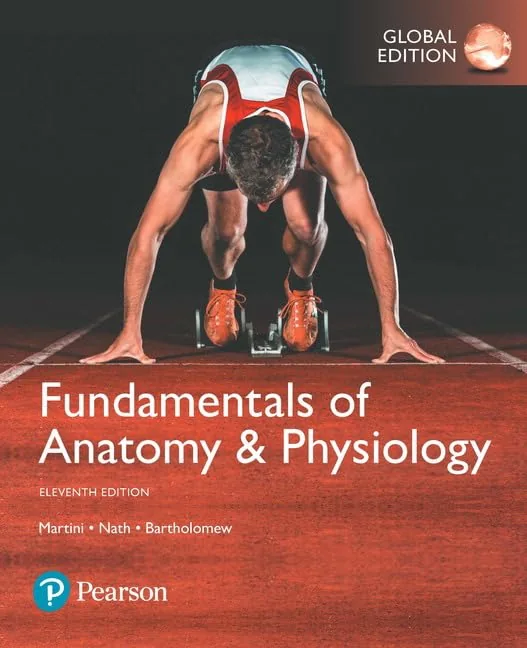
Fundamentals of Anatomy & Physiology, 11th Edition (Global Edition)
By Frederic H. Martini, Judi L. Nath, Edwin F. Bartholomew
About this ebook
Fundamentals of Anatomy & Physiology, eleventh edition, Global Edition, introduces human structure and function from cells and tissues to interacting organ systems. Martini, Nath, and Bartholomew use illustrated explanations to connect anatomical relationships with physiological processes. It is intended for students completing an anatomy and physiology sequence in health science and related programs.
Inside this title
Human structure and function from cells through organ systems
Current listed price $26.00Regular price $58.00Digital ebook
The text develops the foundations of human anatomy and physiology through cellular organization, tissues, and the coordinated function of body systems. Its full-color presentation links descriptions of structures with the processes they support, giving students a way to relate anatomical terminology to functional relationships across the body.
Rather than treating each system as a separate collection of facts, the course scope extends to the integration of complex organ systems. This makes the eleventh edition appropriate for students building a foundation for later health science study. The Global Edition is identified separately from the US printing; examples and end-of-chapter material may differ, a distinction relevant when matching the book to a course reading list.
Study guide included
Inside Fundamentals of Anatomy & Physiology, 11th Edition (Global Edition).
Martini, Nath, and Bartholomew treat anatomy and physiology as one inquiry: what a structure is built like, and what work that construction permits. The Global Edition moves from cells and tissue types through movement, regulation, circulation, gas exchange, and reproduction. Its spotlight diagrams and clinical cases keep the causal chain from molecule to organ system in view.
The text begins with an orientation chapter, chemistry, cell biology, and the four tissue categories, then works through the integumentary, skeletal, muscular, nervous, and endocrine systems. Later units cover blood, the heart, vessels, lymphatics, immunity, respiration, digestion, metabolism, and the urinary tract, ending with reproduction and development. Each chapter pairs illustrated mechanism with clinical material, and recurring integration features ask readers to follow a substance, signal, or force across system boundaries. Figure captions and end-of-chapter questions reinforce the same habit of tracing cause to effect. Pagination here follows the Global Edition.
Location, scale, and boundary
Explanation begins by choosing a scale. Regional terms, planes, and cavities orient a structure in the body, while chemistry explains what can happen at molecular level. Membranes then become the central example of a boundary that permits some movement and restricts others. Tissue types extend the idea: each surface or cell arrangement supports particular tasks and rules out others.
Pick the scale at which the observation becomes intelligible
Use planes and cavities to locate structures
Read a membrane as a selective boundary
Chs. 1–4
Skin, skeleton, joints, and contraction
Protection and movement depend on layered tissues working together. Skin guards the surface and contributes to sensation and temperature regulation. Bone carries load, stores mineral, and remodels, while joint shape sets the range of motion available. Muscle adds force, but predicting a movement also requires knowing how it attaches, which joint it crosses, and where the pull is directed.
Separate the roles of skin, bone, and joint
Follow excitation through calcium to contraction
Include leverage when predicting a movement
Chs. 5–11
Signals, pathways, and target tissues
Neural communication depends on ion gradients, membrane potential changes, and transmission across synapses. Receptors translate particular stimuli into signals, and spinal circuits can produce responses without conscious processing. Hormones work differently: glands release them into blood, and only tissues with suitable receptors respond. Comparing route, speed, and destination clarifies what each system can accomplish.
Trace a signal from receptor to response
Distinguish somatic from autonomic output
Check which tissue carries the receptor
Chs. 12–18
Circulation, exchange, and immune defense
Delivery requires a pump, a distribution network, and a surface where transfer occurs. Cardiac conduction sets contraction timing, pressure gradients drive flow, and vessel resistance determines where blood goes. Capillaries tie local flow to what tissue requires. Lymphatic vessels return fluid and bring immune cells together with antigens, while innate and adaptive responses handle threats at different levels of specificity.
Trace pressure, valves, and resistance together
Follow capillary exchange into tissue need
Contrast innate breadth with adaptive precision
Chs. 19–22
Intake, transfer, and removal
Respiratory, digestive, and urinary organs alter the internal environment by moving materials across surfaces. Ventilation brings gas to the barrier; diffusion changes blood content. The gut breaks food down and absorbs nutrients, with the liver and metabolism deciding how they are used or stored. In the kidney, filtration is only the start, since reabsorption and secretion determine what finally leaves.
Distinguish ventilation from diffusion
Follow a nutrient from absorption to storage
Ask what the tubule does after filtration
Chs. 23–27
Reproduction, development, and change
The final chapters follow gamete production, hormonal preparation, fertilization, and early development. Working in order separates events inside the gonads from those along the reproductive tract. Development becomes a story of division, specialization, and organization, while inherited material explains variation without fixing every result. Structures also face different demands at different ages.
Map hormonal steps by location and timing
Separate gonadal events from tract events
Trace division, differentiation, and organization in order
Chs. 28–29
Chapter and section map
An Introduction to Anatomy and Physiologyp. 47
The Cellular Level of Organizationp. 111
Muscle Tissuep. 337
Nervous Tissuep. 435
The Endocrine Systemp. 656
The Lymphatic System and Immunityp. 831
The Urinary Systemp. 1022
Fluid, Electrolyte, and Acid–Base Balancep. 1067
Key takeaways
Read every figure as a route: identify the structure, the operating mechanism, and the system that receives the result.
Track each fluid or solute from its starting compartment, across the barrier, to its final destination.
Approach a case by reconstructing the mechanism, then ask whether what is visible actually supports it.
Students in a first anatomy and physiology sequence, including nursing, allied health, and exercise science majors, plus instructors who teach with integrated systems and clinical cases.
Topics covered
anatomy and physiology
organ systems
structure and function
clinical cases
spotlight figures
membrane transport
homeostatic regulation
Global Edition
systems integration
Questions about this ebook.
Edition, audience, and study-guide details at a glance.
What is Fundamentals of Anatomy & Physiology, 11th Edition (Global Edition) about?
Fundamentals of Anatomy & Physiology, eleventh edition, Global Edition, introduces human structure and function from cells and tissues to interacting organ systems. Martini, Nath, and Bartholomew use illustrated explanations to connect anatomical relationships with physiological processes. It is intended for students completing an anatomy and physiology sequence in health science and related programs.
Which edition of Fundamentals of Anatomy & Physiology, 11th Edition (Global Edition) is this?
This listing is for the 11th edition. Check the title, ISBN, and book details above before ordering, especially if your course or reading list names a specific edition.
Who is Fundamentals of Anatomy & Physiology, 11th Edition (Global Edition) for?
Students in a first anatomy and physiology sequence, including nursing, allied health, and exercise science majors, plus instructors who teach with integrated systems and clinical cases.
Does this page include a study guide?
Yes. This page includes an original study guide with six thematic sections, key takeaways, and a chapter and section map for structured reading.