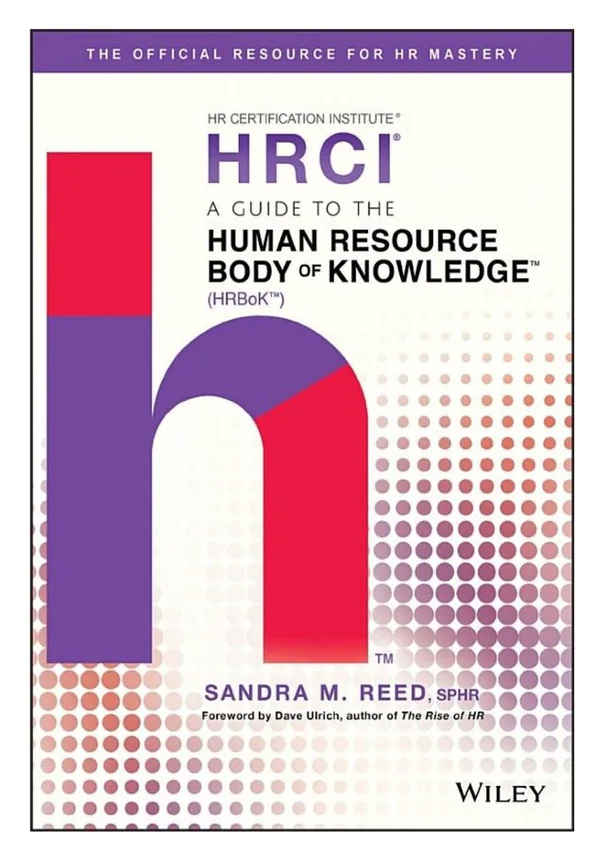
A Guide to the Human Resource Body of Knowledge by Sandra M. Reed organizes HR practice across strategy, staffing, development, rewards, employee relations, and risk. HR students, certification candidates, and practitioners can connect functional responsibilities with business goals through conceptual frameworks, examples, and discussion of ethical and organizational decision making.
Inside this title
Six HR functions connected with business strategy and operations
Current listed price $19.99Regular price $40.00Digital ebook
Reed presents human resource management as a group of connected functions serving organizational needs. Business management and strategy establish the context for workforce planning, employment, human resource development, compensation and benefits, employee and labor relations, and risk management.
Examples and practical frameworks show how staffing forecasts, job analysis, recruitment, performance management, training, and total rewards fit within that broader picture. Labor relations and workplace risk extend the discussion to organizational obligations and ethical questions. The guide can provide a structured foundation for early-career HR study, a review across specialties for experienced practitioners, and background reading for readers exploring professional HR certification topics.
Study guide included
Inside A Guide to the Human Resource Body of Knowledge.
A Guide to the Human Resource Body of Knowledge by Sandra M. Reed maps the six functional areas of HR practice onto one question: what must people do for the organization to succeed? Certification candidates, HR students and practitioners get frameworks, cases and audit exercises that tie staffing, rewards and risk to business results.
Reed opens with the profession's history and competencies, then follows the decisions HR makes from workforce planning and hiring through development, rewards, employee relations and risk. Cases and organizational audits show how those choices reach the same people and the same outcomes. Because the chapters are arranged by function while pointing at shared consequences, a compensation decision can be read beside a development plan instead of in isolation. Readers build a habit of starting from a business result, locating the work and skills it requires, and checking whether staffing, learning, pay and relations pull in the same direction.
Business strategy and the people plan
Reed begins with the organization's purpose, operating model and external pressures, then translates them into workforce priorities. Organizational development supplies a way to examine structure, teams and process together before a program is proposed. The chapter closes on the business case, asking readers to tie an intervention to a result managers care about and to name the evidence that would show it worked.
Translate strategy into workforce priorities
Diagnose process before buying a program
Attach every proposal to a measurable result
Chapter 2 · pp. 33 to 106
Forecasting work and filling roles
The plan cascades from business objectives to labor demand, estimating roles, skills, schedules and locations, then comparing that need with current staff and likely departures. Job analysis makes duties and capabilities visible so recruiting and selection can be tied to the work itself. Succession, retention and separation extend the plan, protecting knowledge that would otherwise be expensive to replace.
Estimate roles, skills and locations
Tie selection criteria to job analysis
Plan succession before vacancies open
Chapter 3 · pp. 109 to 170 · R. Riveter case, p. 138
Needs assessment and learning transfer
Development work starts by locating the performance gap at organizational, job and individual levels. Observation, metrics and employee reports help separate a skill deficit from a broken process, unclear priority or missing tool. Design then targets what people should be able to do, and evaluation matches the measure to the purpose — attendance, demonstrated skill or a change in the work itself.
Diagnose the gap before choosing training
Design for use on the job
Match outcome measures to purpose
Chapter 4 · pp. 171 to 243 · ROI case, p. 235
Total rewards and perceived fairness
Base pay, variable pay and benefits are treated as one system, built from internal job comparisons and external market data. Merlini's case contrasts an across-the-board raise with one tied to reviews, surfacing how employees judge both the amount and the conversation around it. The chapter adds eligibility, employee cost and clarity, plus executive and expatriate arrangements, all read through distributive, procedural and interactional justice.
Compare internal value with market rates
Explain the basis of each pay decision
Check eligibility and clear explanation
Chapter 5 · pp. 245 to 285 · Organizational justice case, p. 245
Voice, discipline and bargaining
The employment relationship rests on expectations — some written in policy, others built through daily manager behavior. The chapter treats listening as a system: surveys reveal patterns, discussions reveal causes, and follow-up tells people what happened. When issues escalate, discipline and separation require attention to facts, applicable policy and consistency, while union settings add the agreement and grievance procedure as the frame.
Make expectations explicit and consistent
Close the loop on employee feedback
Apply facts and policy evenly
Chapter 6 · pp. 287 to 317
Hazard control and return to work
Risk management begins with identifying hazards through inspection, employee input and incident records, since the same task can carry different exposures by location or shift. A prevention program assigns roles, procedures and reporting routes, then checks through inspections whether controls still work after the job changes. Response planning adds incident review and return-to-work decisions that match what the employee can actually do.
Find hazards where the work happens
Assign owners and review dates
Plan response as well as prevention
Chapter 7 · pp. 319 to 348
Chapter and section map
The Human Resource Body of KnowledgeCh. 1, p. 1
Business Management and StrategyCh. 2, p. 33
Workforce Planning and EmploymentCh. 3, p. 109
Human Resource DevelopmentCh. 4, p. 171
Compensation and BenefitsCh. 5, p. 245
Employee and Labor RelationsCh. 6, p. 287
Risk ManagementCh. 7, p. 319
Key takeaways
Begin with the business result, then name the work and skills it requires.
Check how staffing, learning, pay and relationships affect the same decision before choosing an HR intervention.
Choose measures that reveal what changed, then use them to revise the plan.
HR certification candidates, undergraduate and graduate HR students, and practitioners moving into business-partner roles who want a structured overview of the field and its six functional areas.
Topics covered
human resource body of knowledge
HR certification
workforce planning
total rewards
employee relations
HR risk management
talent development
organizational justice
business strategy
Questions about this ebook.
Edition, audience, and study-guide details at a glance.
What is A Guide to the Human Resource Body of Knowledge about?
A Guide to the Human Resource Body of Knowledge by Sandra M. Reed organizes HR practice across strategy, staffing, development, rewards, employee relations, and risk. HR students, certification candidates, and practitioners can connect functional responsibilities with business goals through conceptual frameworks, examples, and discussion of ethical and organizational decision making.
Who is A Guide to the Human Resource Body of Knowledge for?
HR certification candidates, undergraduate and graduate HR students, and practitioners moving into business-partner roles who want a structured overview of the field and its six functional areas.
Does this page include a study guide?
Yes. This page includes an original study guide with six thematic sections, key takeaways, and a chapter and section map for structured reading.