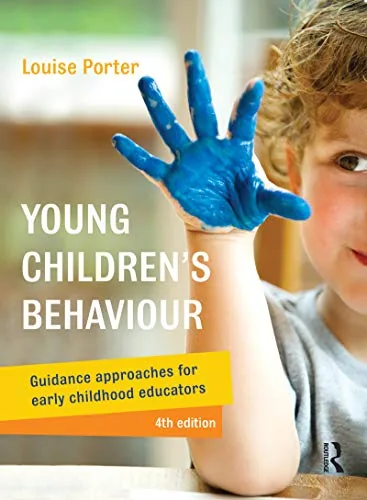
Young Children's Behaviour: Guidance Approaches examines early childhood behavior through children's developmental and emotional needs. Louise Porter discusses supportive environments, self-regulation, family partnerships, and responses to challenges such as aggression and refusal. Early childhood educators and students can explore guidance approaches grounded in developmental psychology and attachment theory.
Inside this title
Children's needs and communication as contexts for challenging behavior
Current listed price $24.99Regular price $45.00Digital ebook
Louise Porter frames challenging behavior as something to understand in relation to children's needs and communication. Developmental psychology and attachment theory inform her discussion of guidance, supportive relationships, and classroom environments. The book considers familiar difficulties such as tantrums, hitting, refusal, and anxiety within that broader developmental perspective.
Practical examples accompany discussion of self-regulation, emotional competence, and collaboration with families. Attention also extends to children with trauma or additional needs. For early childhood education students and practicing educators, the text offers material for examining how adult responses and learning environments contribute to children's social and emotional development, both in the classroom and through connections with home.
Study guide included
Inside Young Children's Behaviour: Guidance Approaches.
Louise Porter reads difficult behavior in early childhood as a signal of developmental and emotional need rather than as simple misbehavior. Guidance, supportive relationships and classroom design are central, and family partnership is treated as part of the response, not an afterthought.
Porter builds her account on developmental psychology and attachment theory, then applies them to the everyday difficulties of group care. A child's tantrum, refusal, hitting or anxiety is examined for what it communicates and for the needs behind it. From there the book turns to what adults can change: the physical and social environment, the quality of relationships, and the routines that support settling. Self-regulation and emotional competence are presented as capacities that grow with adult help. Collaboration with families runs through the discussion, and separate attention goes to children affected by trauma or additional needs. The result is a guidance stance rather than a catalogue of fixes.
Behavior as communication
Challenging behavior is approached as something to understand in relation to a child's needs and limited means of expression. The question shifts from how to stop an act to what the child is trying to accomplish or signal. That reframing shapes everything the later chapters recommend.
Behavior carries meaning about needs
Understanding precedes response
The child's viewpoint is taken seriously
Topic 1
Development and attachment as the frame
Developmental psychology and attachment theory supply the lens for interpreting what adults observe. A behavior that looks arbitrary may be typical for a stage, or may reflect a child's experience of safety and connection. The framework keeps expectations aligned with what children can actually manage.
Expectations should match developmental stage
Attachment shapes how children respond
Secure relationships support exploration
Topic 2
Supportive classroom environments
The physical and social setting is treated as a source of difficulty or support. Space, routines, transitions and the number of demands can either overload children or help them settle. Guidance therefore includes designing the environment, not only reacting to incidents after they occur.
Environment can reduce or provoke strain
Predictable routines support security
Transitions need deliberate planning
Topic 3
Self-regulation and emotional competence
Self-regulation is presented as a developing capacity that children build with adult support, not a trait they either have or lack. Naming feelings, tolerating frustration and recovering from distress are treated as skills. The adult's role is to scaffold rather than to demand instant control.
Regulation develops with adult help
Emotional vocabulary supports coping
Recovery matters as much as control
Topic 4
Responding to aggression, refusal and anxiety
Familiar difficulties such as hitting, tantrums, refusal and anxiety are examined through the same developmental lens. The book pairs practical examples with attention to what each behavior communicates. Responses are framed around connection and teaching rather than escalation.
Difficult episodes are read for meaning
Practical examples connect to theory
Response aims at teaching, not winning
Topic 5
Families and children with additional needs
Collaboration with families is treated as part of guidance, since children move between home and care with different expectations. Attention also extends to children affected by trauma or additional needs, whose behavior may require a more careful reading. Partnership and observation replace blanket rules.
Home and care settings should align
Trauma changes how behavior is read
Additional needs call for tailored support
Topics 6–7
Topic map
Understanding Behavior Through NeedsTopic 1
Developmental and Attachment PerspectivesTopic 2
Designing Supportive EnvironmentsTopic 3
Building Self-RegulationTopic 4
Responding to Tantrums and AggressionTopic 5
Working With FamiliesTopic 6
Trauma and Additional NeedsTopic 7
Key takeaways
Read difficult behavior as information about needs before deciding how to respond.
Change the environment and the relationship, not just the child's conduct.
Treat self-regulation as a skill built with adult help over time.
Early childhood educators, students of early childhood education, and caregivers who want a developmental rather than punitive approach to behavior.
Topics covered
young children's behavior
guidance approaches
early childhood education
self-regulation
attachment theory
family partnerships
challenging behavior
Louise Porter
Questions about this ebook.
Edition, audience, and study-guide details at a glance.
What is Young Children's Behaviour: Guidance Approaches about?
Young Children's Behaviour: Guidance Approaches examines early childhood behavior through children's developmental and emotional needs. Louise Porter discusses supportive environments, self-regulation, family partnerships, and responses to challenges such as aggression and refusal. Early childhood educators and students can explore guidance approaches grounded in developmental psychology and attachment theory.
Who is Young Children's Behaviour: Guidance Approaches for?
Early childhood educators, students of early childhood education, and caregivers who want a developmental rather than punitive approach to behavior.
Does this page include a study guide?
Yes. This page includes an original study guide with six thematic sections, key takeaways, and a topic map for structured reading.