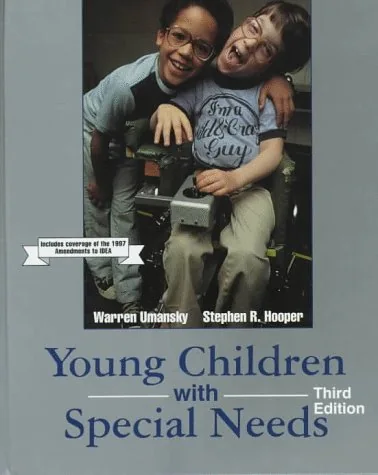
Young Children with Special Needs, Third Edition, introduces early childhood special education and intervention through the child, setting, family, and service process. Warren Umansky and Stephen R. Hooper examine developmental disabilities, assessment, family partnerships, inclusive environments, and individualized planning for students and practitioners working with young children.
Inside this title
Developmental characteristics across cognitive, communication, physical, and health disabilities
Current listed price $17.00Regular price $29.00Digital ebook
The text considers cognitive, communication, social-emotional, physical, and health-related disabilities within the early years. Developmental characteristics are connected with the environments in which children learn, keeping both the individual child and the surrounding setting central to the discussion.
Family-centered work includes cultural diversity, parent participation, and collaboration among professionals. Assessment in natural environments leads into individualized education and family service planning, with intervention discussed across motor, language, cognitive, and adaptive development. Historical and legal foundations provide context for the service system. The third edition suits introductory coursework and readers studying how child characteristics, family relationships, and educational processes fit together in early intervention.
Study guide included
Inside Young Children with Special Needs, 3rd Edition.
Young Children with Special Needs introduces early intervention by holding four things together: the child, the setting, the family, and the service process. Warren Umansky and Stephen R. Hooper survey developmental disabilities, assessment, family partnerships, inclusive environments, and individualized planning for readers preparing to work with young children.
The book treats cognitive, communication, social-emotional, physical, and health-related disabilities as they appear in the early years, always tying developmental characteristics to the environments where children learn. Family-centered discussion covers cultural diversity, parent participation, and collaboration across disciplines. Assessment conducted in natural environments leads into individualized education and family service planning, and intervention is followed across motor, language, cognitive, and adaptive domains. Historical and legal foundations explain how the service system took shape. The third edition is built for introductory coursework and for readers who want child characteristics, family relationships, and educational processes understood together.
Developmental Disabilities in the Early Years
The text surveys disabilities across cognitive, communication, social-emotional, physical, and health dimensions as they present in young children. Each area is described in developmental terms so that characteristics are understood as part of a child's functioning rather than as labels.
Describe disabilities across developmental domains
Recognize early childhood presentations
Connect characteristics to functioning
Topic 1
The Child Within the Setting
Developmental characteristics are read alongside the environments where learning happens. Home, classroom, and inclusive settings shape what a child can do and what support is needed. Keeping both child and setting in view prevents explanations that rest on the individual alone.
Examine home and classroom settings
Relate environment to participation
Consider inclusive placements
Topic 2
Family Partnerships and Cultural Diversity
Families are treated as partners rather than recipients of decisions. The book discusses parent participation, cultural diversity, and collaboration among professionals, showing how family context should inform goals. Partnership is presented as a process requiring attention and respect.
Build family partnerships
Respond to cultural diversity
Collaborate across disciplines
Topic 3
Assessment in Natural Environments
Assessment is placed where children actually spend time. The text explains how observation and evaluation in natural environments can inform decisions about strengths and needs. Results are meant to guide planning rather than stand as ends in themselves.
Assess in natural settings
Gather information from familiar contexts
Use findings to guide planning
Topic 4
Individualized Education and Family Service Planning
Assessment leads into planning that is specific to the child and family. The book describes individualized education and family service planning as ways to translate findings into goals and supports. Legal and historical foundations give the process its context.
Translate assessment into goals
Plan education and family services
Situate planning in legal foundations
Topic 5
Intervention Across Developmental Domains
Intervention is followed across motor, language, cognitive, and adaptive development. The text shows how support in one domain connects with progress in others, keeping the child's overall development in view. Readers see early intervention as coordinated rather than fragmented.
Support motor development
Address language and communication
Coordinate cognitive and adaptive intervention
Topics 6–7
Topic map
Cognitive, communication, social-emotional, physical, and health disabilitiesTopic 1
Home, classroom, and inclusive learning environmentsTopic 2
Family-centered practice and cultural diversityTopic 3
Multidisciplinary collaborationTopic 4
Assessment in natural environmentsTopic 5
Individualized education and family service plansTopic 6
Motor, language, cognitive, and adaptive interventionTopic 7
Key takeaways
A young child's needs are understood through the interaction of the child, the setting, and the family.
Natural-environment assessment gives planning information that resembles the child's real daily life.
Intervention works best when goals across developmental domains are coordinated rather than isolated.
Students in early childhood special education, instructors teaching introductory courses, and practitioners who work with young children, families, and multidisciplinary early intervention teams.
Topics covered
early childhood special education
young children with special needs
developmental disabilities
family partnerships
inclusive environments
natural environment assessment
individualized planning
Umansky Hooper
Questions about this ebook.
Edition, audience, and study-guide details at a glance.
What is Young Children with Special Needs, 3rd Edition about?
Young Children with Special Needs, Third Edition, introduces early childhood special education and intervention through the child, setting, family, and service process. Warren Umansky and Stephen R. Hooper examine developmental disabilities, assessment, family partnerships, inclusive environments, and individualized planning for students and practitioners working with young children.
Which edition of Young Children with Special Needs, 3rd Edition is this?
This listing is for the 3rd edition. Check the title, ISBN, and book details above before ordering, especially if your course or reading list names a specific edition.
Who is Young Children with Special Needs, 3rd Edition for?
Students in early childhood special education, instructors teaching introductory courses, and practitioners who work with young children, families, and multidisciplinary early intervention teams.
Does this page include a study guide?
Yes. This page includes an original study guide with six thematic sections, key takeaways, and a topic map for structured reading.
Keep your curiosity going.
More books from this carefully grouped reading set.