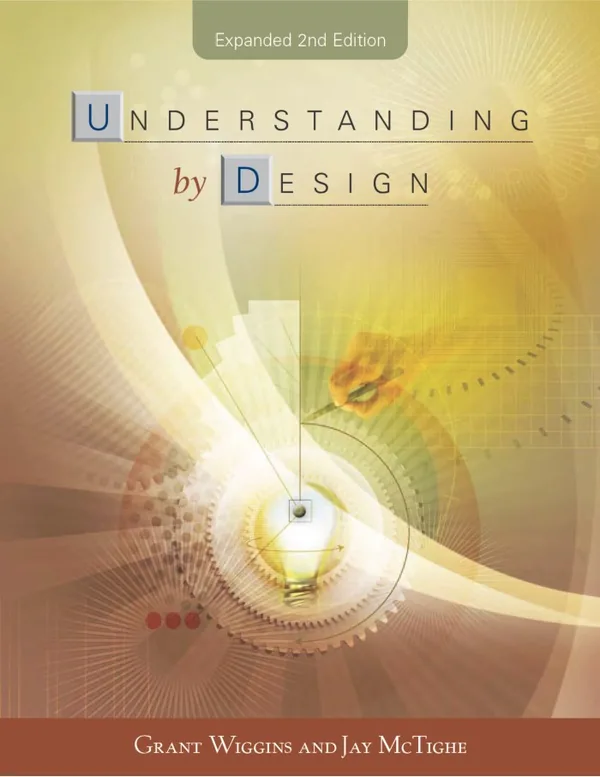
Understanding by Design, Expanded 2nd Edition presents Grant Wiggins and Jay McTighe's backward-design approach to curriculum planning. For teachers, curriculum leaders, and instructional coaches, it links desired learning results with assessment evidence and instruction, using essential questions, performance tasks, and six facets of understanding to guide unit design.
Inside this title
Three-stage backward design connecting goals, evidence, and instruction
Current listed price $14.99Regular price $29.00Digital ebook
Planning begins with what students should understand and be able to transfer to new situations. Wiggins and McTighe then ask educators to determine what evidence would demonstrate those results before choosing classroom activities. This three-stage sequence places learning goals, assessment, and instruction within the same design process.
The expanded second edition develops essential questions, performance tasks, and the six facets of understanding as tools for making learning intentions visible. The WHERETO framework supports decisions about the learning plan, while examples and design review encourage refinement of curriculum units. Teachers across subjects, curriculum coordinators, administrators, and higher education faculty can use the book to examine alignment and plan learning around understanding.
Study guide included
Inside Understanding by Design, Expanded 2nd Edition.
Backward design flips the usual order: name what should endure after the unit ends, decide what would prove it, and only then choose activities. Wiggins and McTighe turn that sequence into a working method for teachers and curriculum teams who want alignment rather than coverage.
The expanded second edition sets out three stages: identify desired results, determine acceptable evidence, and plan learning experiences and instruction. Around that spine the authors place essential questions, transfer goals, performance tasks, and the six facets that describe understanding, all meant to make intentions visible before a lesson is written. WHERETO supplies a checklist for sequencing the plan, and design review gives colleagues a way to test a unit against its own stated aims. Examples span grade levels and subjects, so the method reads as a discipline for revision rather than a template to fill in.
Begin at the endpoint
The first stage asks designers to state what learners should understand, know, and be able to do long after the unit closes. Transfer goals push past recall toward applying ideas in unfamiliar settings. Naming those results first prevents activities from becoming the de facto purpose of instruction, and it gives later choices something concrete to answer to.
Name enduring understandings before activities
Write transfer goals for new situations
Separate long-term aims from lesson tasks
Topic 1-2
Evidence of learning before teaching
Stage two treats assessment as the question of what would count as proof. Performance tasks ask students to use knowledge in realistic ways, while other evidence checks the smaller skills that support that performance. Deciding this in advance exposes units whose planned activities cannot actually demonstrate the stated learning, which is the point of the sequence.
Define acceptable evidence in advance
Design tasks that require application
Check smaller skills alongside performance
Topic 3-4
Essential questions worth revisiting
Essential questions are open, recurring, and arguable rather than answerable in one sentence. They organise inquiry across a unit and invite learners to connect content with larger human concerns. The authors treat them as design tools: a question that can be settled by looking up a fact is probably a prompt, not an essential question.
Frame questions that stay open
Revisit questions across a unit
Connect content to larger concerns
Topic 5
Six facets of understanding
Understanding is described through explanation, interpretation, application, perspective, empathy, and self-knowledge. The facets work as a diagnostic lens: a student may explain a concept and still fail to apply it, or apply it without seeing its limits. Using all six pushes assessment past a single mode of performance and reveals which kind of understanding is missing.
Check more than one facet
Notice gaps between explaining and applying
Include perspective and self-assessment
Topic 6
Sequencing the unit with WHERETO
WHERETO is a checklist for the learning plan rather than a formula. It prompts attention to where the unit is heading, how learners are hooked, what they will explore and rehearse, how understanding is revised, how progress is evaluated, how tasks are tailored, and how the whole experience is organised. The point is to catch omissions in planning.
State where the unit is going
Plan hooks and exploration deliberately
Use the list to find omissions
Topic 7
Review as a design habit
The authors present design review as an ongoing practice in which teachers examine a unit against its own goals, evidence, and activities. Peer critique and reflection surface misalignment early, while rubrics and protocols give the conversation structure. Curriculum improvement becomes a recurring cycle of revision rather than a one-time production event.
Audit units against stated aims
Use protocols to structure critique
Revise units through repeated cycles
Topic 8
Topic map
Three Stages of Backward DesignTopic 1
Desired Results and Transfer GoalsTopic 2
Assessment Evidence and Performance TasksTopic 3
Essential Questions for InquiryTopic 4
Six Facets of UnderstandingTopic 5
WHERETO Learning PlanTopic 6
Curriculum Alignment and Design ReviewTopic 7
Key takeaways
Decide what should last beyond the unit before writing any activity, then let that goal govern every later choice.
Assessment evidence designed early reveals whether planned lessons can actually demonstrate the understanding you claimed.
A unit improves through repeated critique against its own aims, not through adding more activities.
K-12 teachers, curriculum coordinators, instructional coaches, and higher education faculty who design units and want a structured, practical method for aligning learning goals, assessment evidence, and instruction.
Topics covered
backward design
essential questions
performance tasks
six facets of understanding
curriculum alignment
WHERETO framework
transfer goals
unit design
Questions about this ebook.
Edition, audience, and study-guide details at a glance.
What is Understanding by Design, Expanded 2nd Edition about?
Understanding by Design, Expanded 2nd Edition presents Grant Wiggins and Jay McTighe's backward-design approach to curriculum planning. For teachers, curriculum leaders, and instructional coaches, it links desired learning results with assessment evidence and instruction, using essential questions, performance tasks, and six facets of understanding to guide unit design.
Which edition of Understanding by Design, Expanded 2nd Edition is this?
This listing is for the 2nd edition. Check the title, ISBN, and book details above before ordering, especially if your course or reading list names a specific edition.
Who is Understanding by Design, Expanded 2nd Edition for?
K-12 teachers, curriculum coordinators, instructional coaches, and higher education faculty who design units and want a structured, practical method for aligning learning goals, assessment evidence, and instruction.
Does this page include a study guide?
Yes. This page includes an original study guide with six thematic sections, key takeaways, and a topic map for structured reading.