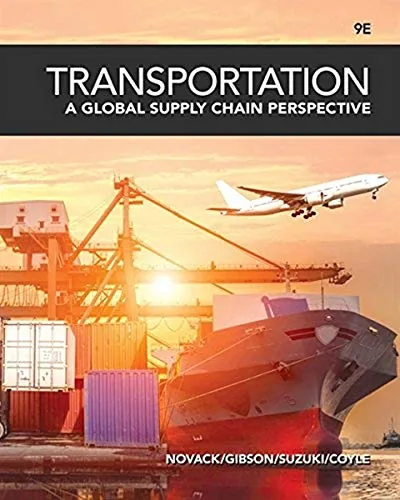
Transportation: A Global Supply Chain Perspective, Ninth Edition, examines freight movement as part of supply chain strategy. Designed for logistics students and professionals, it compares rail, road, air, water, and pipeline transport while addressing economics, pricing, third-party logistics, government policy, international operations, technology, sustainability, and transportation risk.
Inside this title
Comparative coverage of rail, road, air, water, and pipelines
Current listed price $36.99Regular price $107.00Digital ebook
The textbook connects decisions about transportation modes and service providers with wider questions of inventory, distribution, and global trade. Comparative treatment of rail, truck, air, water, and pipeline operations establishes a foundation for examining modal costs, pricing, and the role of third-party logistics providers.
International management topics include documentation, customs, and trade regulation, while discussion of government policy considers infrastructure and safety. Technology, tracking, analytics, sustainability, and disruption risk broaden the operational perspective. Students in supply chain and transportation courses can use this organization to connect economic principles with logistics decisions; practitioners can consult it when examining how transport choices affect other activities in a supply network.
Study guide included
Inside Transportation: A Global Supply Chain Perspective, 9th Edition.
This survey treats freight movement as a strategic function rather than a back-office task. The authors compare transport modes, explain how carriers set prices, and place logistics providers, international trade rules, technology, and environmental concerns within the wider flow of goods from origin to final customer.
The text positions transportation inside the broader supply chain, then works through the operating characteristics of each major mode and the trade-offs among cost, speed, capacity, and reliability. Pricing receives detailed attention because rates reflect both carrier economics and shipper bargaining. Outsourcing to logistics intermediaries is examined as a make-or-buy decision with service implications. Later portions address cross-border paperwork, customs procedures, and the regulatory environment, followed by information systems, emissions, and disruption planning. The organization suits a semester course but also serves as a reference for practitioners weighing transport choices against inventory and customer service goals.
Transport as a value-creating link
Rather than a cost to be minimized, movement is framed as the activity that connects production with demand. The text explains how service level, location decisions, and inventory policy interact, and why transport performance affects the whole network's responsiveness.
Place and time utility
Trade-off with inventory holdings
Service quality dimensions
Topic 1
Comparing modes on operating terms
Rail, highway, aviation, maritime, and pipeline carriage each carry distinct economics. The comparison weighs fixed versus variable cost, reach, speed, and cargo suitability, giving readers a basis for choosing a mode or a combination rather than assuming one is best.
Cost structure by mode
Speed, capacity, and accessibility
Intermodal combinations
Topic 2
Rate making and cost analysis
Freight charges emerge from carrier cost structures shaped by distance, weight, and handling. The text explains rate bases, classification, and the bargaining context between shippers and providers, then connects pricing decisions to total logistics cost rather than the invoice alone.
Cost drivers in carriage
Rate structures and classification
Total cost perspective
Topic 3
Intermediaries and contracted services
Many firms delegate movement to third-party providers. The book describes the services these intermediaries offer, the reasons firms outsource, and the governance questions that arise when control is partly external, including performance measurement and relationship management.
Scope of third-party services
Motives for outsourcing
Contract and performance oversight
Topic 4
Cross-border movement and public rules
International shipments add documentation, customs clearance, and regulatory compliance to the physical task. Government involvement also shapes infrastructure and safety. The discussion links operational detail with the policy environment that constrains and enables trade.
Documents and customs flow
Trade regulation and tariffs
Infrastructure and safety policy
Topics 5-6
Information, sustainability, and disruption
The final themes examine how tracking systems and analytics change visibility and decision speed, how environmental pressure affects mode selection and fleet choices, and how risk planning prepares networks for interruptions. These concerns are presented as integral to transport strategy.
Visibility through tracking and analytics
Emissions and sustainable choices
Risk assessment and continuity
Topic 7
Topic map
Transportation within the supply chainTopic 1
Modal capabilities and comparisonTopic 2
Freight costing and pricingTopic 3
Third-party logistics and outsourcingTopic 4
International operations and documentationTopic 5
Policy, regulation, and infrastructureTopic 6
Technology, sustainability, and riskTopic 7
Key takeaways
Transport decisions should be judged by total supply chain effect, not by freight rate in isolation.
Each mode offers a distinct cost-service profile; selection depends on the shipment and the network.
Outsourcing and cross-border operations add coordination and compliance work that must be planned for.
Students in logistics and supply chain programs, and managers who need a structured view of freight decisions and provider relationships.
Topics covered
transportation management
global supply chain
freight modes
logistics pricing
third-party logistics
international trade documentation
transport policy
sustainability in logistics
supply chain risk
Questions about this ebook.
Edition, audience, and study-guide details at a glance.
What is Transportation: A Global Supply Chain Perspective, 9th Edition about?
Transportation: A Global Supply Chain Perspective, Ninth Edition, examines freight movement as part of supply chain strategy. Designed for logistics students and professionals, it compares rail, road, air, water, and pipeline transport while addressing economics, pricing, third-party logistics, government policy, international operations, technology, sustainability, and transportation risk.
Which edition of Transportation: A Global Supply Chain Perspective, 9th Edition is this?
This listing is for the 9th edition. Check the title, ISBN, and book details above before ordering, especially if your course or reading list names a specific edition.
Who is Transportation: A Global Supply Chain Perspective, 9th Edition for?
Students in logistics and supply chain programs, and managers who need a structured view of freight decisions and provider relationships.
Does this page include a study guide?
Yes. This page includes an original study guide with six thematic sections, key takeaways, and a topic map for structured reading.
Keep your curiosity going.
More books from this carefully grouped reading set.