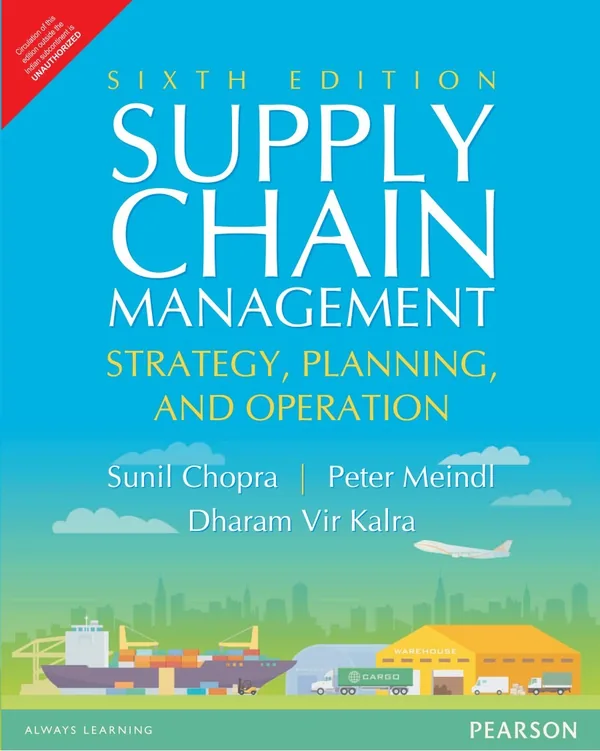
Supply Chain Management: Strategy, Planning, and Operation, 6th Edition
By Sunil Chopra, Peter Meindl, Dharam Vir Kalra
About this ebook
Supply Chain Management: Strategy, Planning, and Operation, 6th Edition, connects strategic network decisions with quantitative planning and everyday operations. Sunil Chopra, Peter Meindl, and Dharam Vir Kalra examine forecasting, inventory, transportation, sourcing, coordination, and risk. The textbook serves business and engineering students as well as supply chain analysts and managers.
Inside this title
Strategic fit connects supply chain responsiveness with cost decisions
Current listed price $15.99Regular price $29.00Digital ebook
Strategic fit provides the foundation for examining how a supply chain balances responsiveness and cost. Network design and facility location are considered alongside demand forecasting, aggregate planning, and sales and operations planning. Quantitative models and spreadsheet-based analysis connect these decisions with the assumptions behind them.
Inventory, transportation, warehousing, sourcing, and coordination bring the discussion into operating activities. The bullwhip effect illustrates the consequences of decisions across supply chain partners, while pricing and revenue management consider seasonal or perishable products. Global uncertainty, sustainability, and risk broaden the strategic perspective. End-of-chapter problems support students and practitioners analyzing trade-offs across the supply chain rather than within a single function.
Study guide included
Inside Supply Chain Management: Strategy, Planning, and Operation, 6th Edition.
A textbook connecting supply chain strategy with quantitative planning and daily operations. Chopra, Meindl, and Kalra examine strategic fit, network design, forecasting, inventory, transportation, sourcing, coordination, pricing, and risk, with models and spreadsheet analysis for business and engineering students and practitioners.
The book frames supply chain management as a set of trade-offs rather than isolated functions. Strategic fit establishes how a chain balances responsiveness against cost, and that choice informs network design and facility location. Demand forecasting, aggregate planning, and sales and operations planning connect strategy with quantitative models and spreadsheet-based analysis. Inventory, transportation, warehousing, sourcing, and coordination then carry the discussion into operating activities, where the bullwhip effect shows how decisions ripple across partners. Pricing and revenue management address seasonal or perishable products, while global uncertainty, sustainability, and risk widen the perspective. End-of-chapter problems let readers analyze trade-offs across the entire chain.
Strategic Fit and the Responsiveness–Cost Trade-off
Strategic fit is the organizing idea of the book. A supply chain must match its design to the demand it serves, balancing responsiveness against cost. Later decisions are judged against this alignment.
Define strategic fit
Balance responsiveness and cost
Align design with demand
Topic 1
Network Design and Facility Location
Network decisions set the physical shape of a supply chain. Facility location and the arrangement of the network determine how goods move and what costs follow. The text connects these long-term choices with the strategy already established.
Plan the supply chain network
Choose facility locations
Connect design with strategy
Topic 2
Forecasting and Aggregate Planning
Planning requires estimates of demand and a way to match supply to them. Demand forecasting and aggregate planning translate expectations into coordinated decisions. Sales and operations planning brings the functions together.
Forecast demand
Plan aggregate supply
Coordinate through S&OP
Topics 3–4
Inventory and Transportation
Inventory and transportation carry strategy into operating decisions. The book examines how stock levels and movement choices interact with cost and service. Models make the assumptions behind these choices explicit.
Manage inventory levels
Plan transportation
Analyze cost and service trade-offs
Topic 5
Sourcing, Coordination, and the Bullwhip Effect
Sourcing and coordination concern relationships across the chain. The bullwhip effect illustrates how local decisions can produce large swings upstream. The text treats coordination as a design problem rather than a matter of good intentions.
Examine sourcing decisions
Understand the bullwhip effect
Improve coordination across partners
Topic 6
Pricing, Sustainability, and Risk
Pricing and revenue management address products whose value changes with time or availability. Sustainability and global uncertainty add environmental and strategic risk to the picture. The final material widens planning beyond cost and service.
Apply revenue management
Consider sustainability
Plan for global uncertainty and risk
Topics 7–8
Topic map
Strategic fit and supply chain driversTopic 1
Network design and facility locationTopic 2
Demand forecasting and aggregate planningTopic 3
Sales and operations planningTopic 4
Inventory and transportation decisionsTopic 5
Sourcing and supply chain coordinationTopic 6
Pricing and revenue managementTopic 7
Sustainability, global uncertainty, and riskTopic 8
Key takeaways
Strategic fit ties supply chain design to the balance between responsiveness and cost.
Forecasting, inventory, and transportation decisions are best judged across the whole chain, not one function.
Business and engineering students in supply chain courses, analysts, and managers who need both strategic framing and quantitative planning tools.
Topics covered
supply chain management
strategic fit
network design
demand forecasting
inventory
transportation
bullwhip effect
Chopra Meindl Kalra
Questions about this ebook.
Edition, audience, and study-guide details at a glance.
What is Supply Chain Management: Strategy, Planning, and Operation, 6th Edition about?
Supply Chain Management: Strategy, Planning, and Operation, 6th Edition, connects strategic network decisions with quantitative planning and everyday operations. Sunil Chopra, Peter Meindl, and Dharam Vir Kalra examine forecasting, inventory, transportation, sourcing, coordination, and risk. The textbook serves business and engineering students as well as supply chain analysts and managers.
Which edition of Supply Chain Management: Strategy, Planning, and Operation, 6th Edition is this?
This listing is for the 6th edition. Check the title, ISBN, and book details above before ordering, especially if your course or reading list names a specific edition.
Who is Supply Chain Management: Strategy, Planning, and Operation, 6th Edition for?
Business and engineering students in supply chain courses, analysts, and managers who need both strategic framing and quantitative planning tools.
Does this page include a study guide?
Yes. This page includes an original study guide with six thematic sections, key takeaways, and a topic map for structured reading.
Keep your curiosity going.
More books from this carefully grouped reading set.