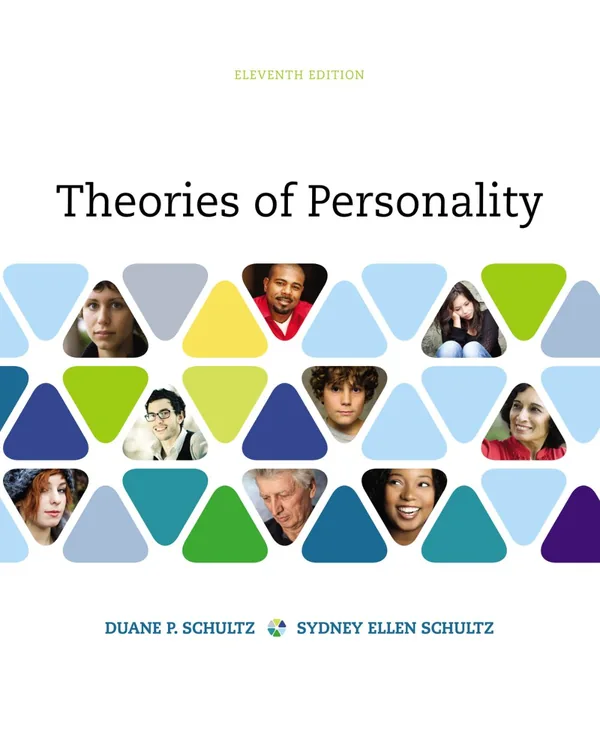
Cover of Theories of Personality, 11th Edition

Theories of Personality, 11th Edition

By Duane P. Schultz, Sydney Ellen Schultz

About this ebook

Theories of Personality, 11th Edition surveys psychoanalytic, humanistic, trait, behavioral, and cognitive perspectives on personality. Duane P. Schultz and Sydney Ellen Schultz connect theorists' lives with their ideas and examine research and applications. Psychology students can compare competing explanations while considering cultural, gender, and social influences on personality development.

Inside this title
  • Biographical context for the development of major personality theories
Current listed price $31.00Regular price $80.00Digital ebook
Review order preview

Digital ebook. No physical book.

Format
Digital ebook
ISBN
9780357689028
Last updated
2026-11-03

What this book covers.

Personality theories explain human differences in contrasting ways. This textbook places Freud, Jung, Adler, and Horney alongside humanistic, trait, behavioral, and social-cognitive thinkers. Biographical accounts provide context for the development of theories, while critical evaluation and research discussion give students grounds for comparing their assumptions.

The eleventh edition covers perspectives associated with Maslow, Rogers, Allport, Cattell, Kelly, Bandura, and Mischel, among others. Cultural context, gender, and ethnicity form part of its discussion of personality development. Application exercises connect theoretical ideas with examples, making the text useful for coursework that asks students to assess explanations rather than simply memorize the names of theorists.

Study guide included

Inside Theories of Personality, 11th Edition.

Personality theory is a set of competing answers to the same question: why are people different? Schultz and Schultz set psychoanalytic, humanistic, trait, behavioral, and social-cognitive accounts side by side, adding biographical context and critical evaluation so students learn to compare explanations rather than memorize names.

The textbook treats each theorist as a position to be understood and assessed. Freud, Jung, Adler, and Horney represent psychoanalytic approaches; Maslow and Rogers carry the humanistic tradition; Allport and Cattell work on traits; behavioral and social-cognitive perspectives appear through figures such as Bandura and Mischel. Biographical material explains how a theorist's life shaped the questions asked. Research discussion and critical evaluation give readers grounds for judging the accounts against one another, while cultural, gender, and ethnic considerations complicate any single explanation of personality development. Application exercises connect ideas with examples, making the text suitable for courses that ask students to evaluate rather than recite.

Psychoanalytic perspectives

Psychoanalytic theory treats personality as shaped by unconscious processes and early experience. The section examines Freud, Jung, Adler, and Horney as related but distinct positions, showing where they agree and where they diverge. Readers are asked to follow each theorist's central claim rather than collapse the tradition into a single view.

  • Trace unconscious and developmental claims
  • Distinguish thinkers within the tradition
  • Follow each theorist's central claim
Topic 1 · Psychoanalytic Approaches

Humanistic perspectives

Humanistic theory emphasizes growth, meaning, and the person's own experience. The section examines Maslow and Rogers, connecting their accounts of motivation and self-concept with the methods they favored. Readers are asked to consider what this perspective gains by centering subjective experience and what it may leave harder to test.

  • Center growth, meaning, and experience
  • Connect motivation with self-concept
  • Weigh strengths against testability
Topic 2 · Humanistic Approaches

Trait perspectives

Trait theory asks how personality can be described in stable dimensions. The section examines Allport and Cattell, showing how traits are identified and organized. Readers are asked to consider the difference between describing consistent patterns and explaining why they exist, a distinction that shapes how trait theory is evaluated.

  • Describe personality through stable dimensions
  • See how traits are identified and organized
  • Distinguish description from explanation
Topic 3 · Trait Approaches

Behavioral perspectives

Behavioral theory locates personality in observable conduct and learning. The section examines how reinforcement and environment explain individual differences, contrasting this account with approaches that begin inside the person. Readers are asked to notice what behaviorism explains well and where it may seem to leave experience out.

  • Explain differences through learning
  • Focus on observable conduct
  • Notice what the account leaves out
Topic 4 · Behavioral Approaches

Social-cognitive perspectives

Social-cognitive theory connects behavior with thought, expectation, and situation. The section examines Bandura and Mischel, showing how observational learning and self-regulation complicate a purely behavioral account. Readers are asked to see the person as active in selecting and interpreting situations rather than merely responding to them.

  • Connect behavior with thought and situation
  • Consider observational learning
  • See the person as active, not passive
Topic 5 · Social-Cognitive Approaches

Comparison, culture, and evaluation

The textbook keeps returning to comparison. Biographical context explains how theories arose, while research and critical discussion test their claims. The section also examines cultural, gender, and ethnic influences, asking whether a theory developed in one setting applies elsewhere. Readers are asked to evaluate explanations rather than accept them by reputation.

  • Compare theories on shared questions
  • Use biography to explain origins
  • Test whether claims travel across cultures
Topic 6 · Comparison and Evaluation

Topic map

  • Psychoanalytic PerspectivesTopic 1
  • Humanistic PerspectivesTopic 2
  • Trait PerspectivesTopic 3
  • Behavioral PerspectivesTopic 4
  • Social-Cognitive PerspectivesTopic 5
  • Biography and the Origins of TheoryTopic 6
  • Culture, Gender, and EthnicityTopic 7
  • Critical Evaluation and ApplicationTopic 8

Key takeaways

  • Compare theories by the question they ask, not only by the name attached to them.
  • Notice the difference between describing personality and explaining it.
  • Evaluate whether a theory's claims hold across cultures, genders, and ethnic contexts.

Psychology undergraduates and instructors who need a comparative survey of personality theories and practice evaluating competing explanations rather than memorizing theorists.

Topics covered

  • personality theories
  • psychoanalytic theory
  • humanistic psychology
  • trait theory
  • behavioral theory
  • social-cognitive theory
  • personality development
  • critical evaluation

Questions about this ebook.

Edition, audience, and study-guide details at a glance.

What is Theories of Personality, 11th Edition about?

Theories of Personality, 11th Edition surveys psychoanalytic, humanistic, trait, behavioral, and cognitive perspectives on personality. Duane P. Schultz and Sydney Ellen Schultz connect theorists' lives with their ideas and examine research and applications. Psychology students can compare competing explanations while considering cultural, gender, and social influences on personality development.

Which edition of Theories of Personality, 11th Edition is this?

This listing is for the 11th edition. Check the title, ISBN, and book details above before ordering, especially if your course or reading list names a specific edition.

Who is Theories of Personality, 11th Edition for?

Psychology undergraduates and instructors who need a comparative survey of personality theories and practice evaluating competing explanations rather than memorizing theorists.

Does this page include a study guide?

Yes. This page includes an original study guide with six thematic sections, key takeaways, and a topic map for structured reading.

Keep your curiosity going.

More books from this subject area.

More social sciences ebooks