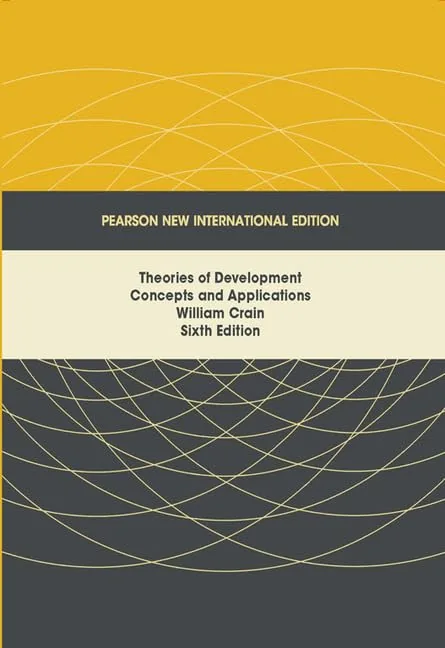
Theories of Development: Concepts and Applications, 6th Edition - Pearson New International Edition
By William Crain
About this ebook
Theories of Development, 6th Edition, compares major explanations of cognitive, social, emotional, and moral development. William Crain introduces thinkers including Piaget, Vygotsky, Freud, Erikson, Bowlby, and Bandura, connecting their ideas with practical questions. This Pearson New International Edition supports students of developmental psychology, education, and related helping professions.
Inside this title
Comparative coverage of major theorists of human development
Current listed price $22.00Regular price $49.00Digital ebook
William Crain organizes developmental psychology around the ideas of influential theorists, showing how their assumptions lead to different explanations of human growth. The book traces connections and disagreements among psychoanalytic, cognitive, attachment, and learning perspectives. Rousseau's naturalistic tradition provides one point of comparison with approaches that emphasize environmental influence.
Applications connect abstract concepts with education, parenting, and therapeutic concerns. Readers are encouraged to consider the evidence supporting a theory as well as the limits of its explanations. The sixth edition offers a comparative route through developmental thought for students who need to understand several frameworks together, rather than treating each account of development as an isolated set of terms.
Study guide included
Inside Theories of Development: Concepts and Applications, 6th Edition - Pearson New International Edition.
Crain introduces developmental psychology through its major theorists rather than as a single consensus. Each framework is presented with its assumptions, its account of cognitive, social, emotional or moral growth, and the practical questions it raises for education, parenting and therapy.
The guide treats the sixth edition as a comparative survey. It begins with Rousseau's naturalistic picture of unfolding capacity, then follows Piaget's stages and Vygotsky's sociocultural account before turning to psychoanalytic, attachment and learning perspectives. Because each theorist begins from different premises, the book's value lies in seeing where they converge and where they conflict. Applications to schooling and helping professions are kept in view throughout. Readers are asked to weigh evidence, not merely memorise labels. The sequence moves from child-centred to environment-centred explanations.
Rousseau and natural unfolding
Rousseau's account treats development as a natural unfolding guided by inner timing and by experience in a suitable environment. Crain presents this as a counterweight to views that stress instruction or conditioning, and uses it to show how assumptions about human nature shape advice about raising and teaching children.
Growth follows an inner developmental timetable
Environment should support rather than force
Assumptions about nature shape practical advice
Topic 1
Piaget and cognitive stages
Piaget describes children as actively constructing knowledge through assimilation, accommodation and equilibration. Crain follows the stages from sensorimotor action to formal reasoning and explains the clinical interview method behind the claims. The theme also notes later criticism of stage boundaries and of underestimating young children's competence.
Children construct knowledge through action
Assimilation and accommodation drive change
Stage boundaries have been widely debated
Topic 2
Vygotsky and social learning
Vygotsky places learning in social interaction and cultural tools, with language and instruction doing work that Piaget's individual constructivism leaves implicit. The zone of proximal development and scaffolding are explained as practical ideas for teaching, and the discussion contrasts the two theorists' views of what development precedes.
Learning is embedded in social interaction
Language and tools mediate thinking
Instruction can lead development forward
Topic 3
Freud, Erikson and psychodynamic growth
Psychoanalytic theory is presented through Freud's account of drives and early experience and through Erikson's extension into a sequence of psychosocial tasks across the lifespan. Crain shows how both frame emotional development, while noting the difficulty of testing psychodynamic claims and the differences between the two systems.
Early experience shapes emotional development
Erikson extends stages across the lifespan
Psychodynamic claims are hard to test
Topics 4–5
Bowlby and the attachment bond
Attachment theory explains the bond between infant and caregiver as a biologically prepared system with consequences for later relationships. Crain covers Bowlby's ethological starting point and the observational work that followed, along with questions about continuity, temperament and the cultural assumptions built into measures of security.
Attachment is biologically prepared
Caregiver responsiveness shapes security
Continuity and cultural bias are contested
Topic 6
Bandura and social cognitive theory
Social learning and social cognitive theory shift attention to imitation, reinforcement and self-efficacy. Bandura's experiments and later work on modelling are used to show how behaviour can be acquired without direct reward, and the theme considers what such findings imply for discipline, media influence and the limits of purely internal explanations.
Behaviour is acquired through observation
Self-efficacy affects effort and persistence
Reinforcement is not the only route to learning
Topic 7
Topic map
The Naturalistic TraditionTopic 1
Piaget's Cognitive DevelopmentTopic 2
Vygotsky's Sociocultural TheoryTopic 3
Freud's Psychoanalytic AccountTopic 4
Erikson's Psychosocial StagesTopic 5
Bowlby and Attachment TheoryTopic 6
Bandura and Learning TheoryTopic 7
Comparing and Applying TheoriesTopic 8
Key takeaways
Read each theorist on their own terms before comparing, because their starting assumptions differ sharply.
Notice which domains each framework explains well and which it tends to ignore or oversimplify.
Use the applications as tests of understanding rather than as recipes for practice.
Developmental psychology students, education and counselling trainees, and general readers who want a structured comparison of the major theories of human growth and their practical applications.
Topics covered
theories of development
William Crain
Piaget cognitive stages
Vygotsky sociocultural theory
Erikson psychosocial stages
attachment theory Bowlby
Bandura social learning
developmental psychology textbook
Questions about this ebook.
Edition, audience, and study-guide details at a glance.
What is Theories of Development: Concepts and Applications, 6th Edition - Pearson New International Edition about?
Theories of Development, 6th Edition, compares major explanations of cognitive, social, emotional, and moral development. William Crain introduces thinkers including Piaget, Vygotsky, Freud, Erikson, Bowlby, and Bandura, connecting their ideas with practical questions. This Pearson New International Edition supports students of developmental psychology, education, and related helping professions.
Which edition of Theories of Development: Concepts and Applications, 6th Edition - Pearson New International Edition is this?
This listing is for the 6th edition. Check the title, ISBN, and book details above before ordering, especially if your course or reading list names a specific edition.
Who is Theories of Development: Concepts and Applications, 6th Edition - Pearson New International Edition for?
Developmental psychology students, education and counselling trainees, and general readers who want a structured comparison of the major theories of human growth and their practical applications.
Does this page include a study guide?
Yes. This page includes an original study guide with six thematic sections, key takeaways, and a topic map for structured reading.