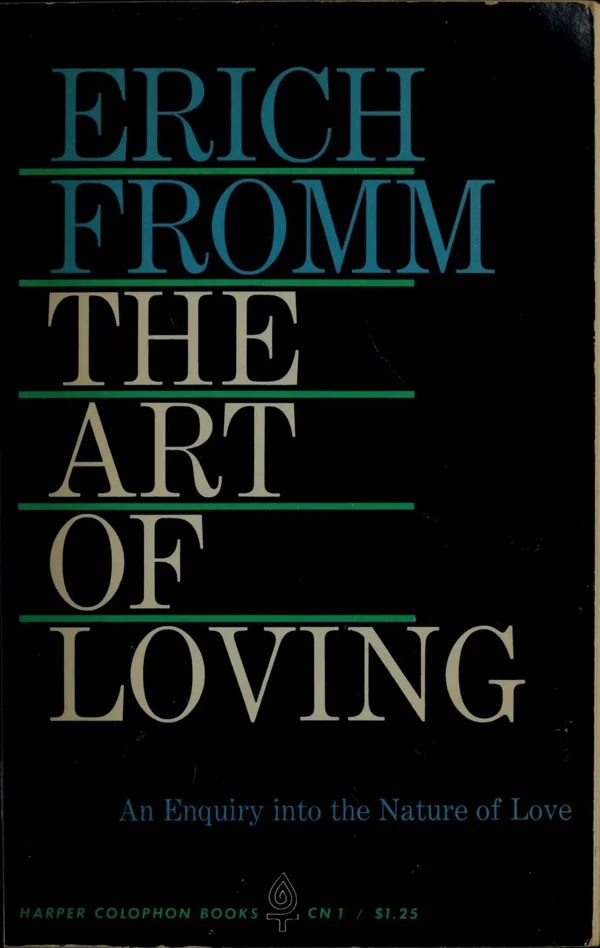
Erich Fromm's The Art of Loving examines love as a capacity developed through attention and practice. This work of psychoanalysis and social philosophy considers care, responsibility, respect, and knowledge across different forms of love, while questioning how consumer culture and social expectations shape personal relationships.
Inside this title
Care, responsibility, respect, and knowledge as elements of love
Current listed price $8.99Regular price $16.00Digital ebook
Fromm begins with the problem of human separateness and asks what it means to love maturely. His account distinguishes a relationship that preserves individual integrity from forms of attachment organized around dependency. Care, responsibility, respect, and knowledge provide recurring terms for understanding the capacity he describes.
The discussion moves through brotherly, parental, erotic, and self-love, as well as love of God. Fromm also critiques the treatment of love as an exchange or commodity in modern Western society. A final practical emphasis on discipline, concentration, and patience connects the argument to sustained personal effort. Readers of psychology, philosophy, and relationship literature can explore the book as a reflective theory of loving.
Study guide included
Inside The Art of Loving.
Fromm treats love as an ability to be cultivated, not a feeling that happens to a person. Starting from the isolation of individual existence, he asks what mature relatedness requires and examines care, responsibility, respect and knowledge across the forms love takes, including the pressures of a consumer society.
The argument begins with separateness: the experience of being an individual apart from others, and the ways people try to overcome it. Fromm contrasts mature love, which preserves integrity, with attachments built on dependency. He then works through four elements, care, responsibility, respect and knowledge, and applies them to brotherly, parental, erotic and self-love, as well as love of God. A critical section considers how modern Western society treats love as an exchange of commodities. The closing discussion turns to practice, naming discipline, concentration and patience as conditions for developing the capacity. The book belongs to psychoanalysis and social philosophy, and it invites reflective reading rather than offering a technique.
Human separateness as the starting problem
Fromm begins from the fact that each person is a separate consciousness, and that this separateness is experienced as isolation. The book surveys ways people try to escape it, including conformity and distraction, and argues that these attempts do not produce real connection. Naming the problem this way makes love a response to a human condition rather than merely a preference or a mood.
Separateness is experienced as isolation
Conformity and distraction are attempted escapes
Love answers a condition, not a preference
Topic 1
Mature love versus dependency
The distinction between mature love and dependent attachment runs through the book. Mature love, in Fromm's account, joins people while preserving each person's integrity; dependent attachment uses the other to fill a lack. The contrast gives the reader a way to evaluate relationships without reducing them to intensity of feeling, since intensity alone does not distinguish the two.
Mature love preserves individual integrity
Dependency uses the other to fill a lack
Intensity alone does not distinguish the two
Topic 2
Care, responsibility, respect and knowledge
These four elements form the book's working account of love. Care is active concern for the other's growth, responsibility is a willing response, respect preserves the other as they are, and knowledge sees them without illusion. Together they describe love as a practice with content, which is why Fromm can speak of it as an art rather than a passing emotion.
Care concerns the other's growth
Respect preserves the other's integrity
Knowledge sees without illusion
Topic 3
Forms of love
Fromm applies his account across brotherly, parental, erotic and self-love, and to love of God. Each form has its own character, and the discussion shows how the same elements appear differently in each. Self-love receives particular attention, since the book argues against the idea that loving oneself competes with loving others, a claim that reframes a common assumption about self-regard.
Each form of love has its own character
The same elements appear differently across forms
Self-love is not opposed to loving others
Topic 4
Love under consumer culture
The critical section examines how modern Western society shapes expectations about relationships. Fromm argues that a culture organized around exchange encourages people to treat love as a commodity and partners as objects to be compared. The critique connects personal experience to social structure, suggesting that difficulties in loving are not only individual failures but also responses to a particular cultural setting.
Exchange culture shapes relationship expectations
Love can be treated as a commodity
Personal difficulty has a social dimension
Topic 5
Discipline, concentration and patience
The book closes by treating love as something learned through practice. Discipline, concentration and patience are named as conditions for developing the capacity, along with overcoming narcissism and cultivating humility. This practical turn follows from the earlier argument: if love is an art, then it requires sustained effort rather than the right partner or the right feeling.
Love is learned through sustained practice
Concentration and patience are conditions
Effort matters more than finding the right person
Topic 6
Topic map
Human Separateness and Its EscapesTopic 1
Mature Love and Dependent AttachmentTopic 2
Care, Responsibility, Respect and KnowledgeTopic 3
Brotherly, Parental, Erotic and Self-LoveTopic 4
Love in a Consumer SocietyTopic 5
The Practice of LovingTopic 6
Key takeaways
Read love as a capacity with content, not as an intensity of feeling.
Use the four elements, care, responsibility, respect and knowledge, to examine a relationship rather than judge it by passion alone.
Take the closing practical section seriously: the book treats loving as something developed through discipline and patience.
Readers of psychology, philosophy and relationship literature who want a reflective theory of love, including students of Fromm and anyone examining how social conditions shape personal relationships.
Topics covered
Erich Fromm
the art of loving
mature love
self-love
human separateness
care responsibility respect knowledge
consumer culture and love
philosophy of love
Questions about this ebook.
Edition, audience, and study-guide details at a glance.
What is The Art of Loving about?
Erich Fromm's The Art of Loving examines love as a capacity developed through attention and practice. This work of psychoanalysis and social philosophy considers care, responsibility, respect, and knowledge across different forms of love, while questioning how consumer culture and social expectations shape personal relationships.
Who is The Art of Loving for?
Readers of psychology, philosophy and relationship literature who want a reflective theory of love, including students of Fromm and anyone examining how social conditions shape personal relationships.
Does this page include a study guide?
Yes. This page includes an original study guide with six thematic sections, key takeaways, and a topic map for structured reading.