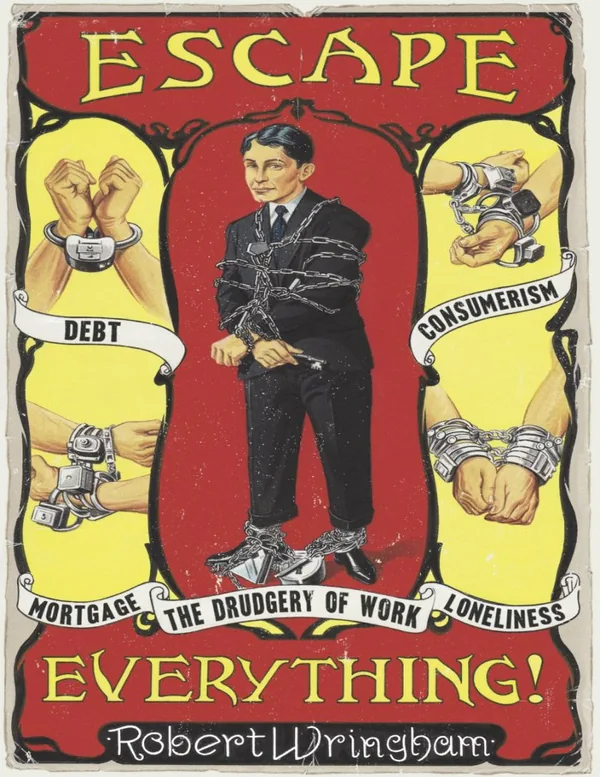
Escapology presents Robert Wringham's critique of work, consumption, debt, and social expectations as constraints on personal autonomy. Combining philosophy, examples, and lifestyle planning, the book addresses readers interested in simple living and alternative working arrangements, asking how everyday commitments influence the time and freedom available to them.
Inside this title
Critical examination of work, debt, consumption, and social expectations
Current listed price $11.99Regular price $24.00Digital ebook
Wringham treats escape as a practical question about the arrangements that govern daily life. Work routines, spending, debt, and social obligation become subjects for examining what people accept as normal and how those expectations shape their choices. His countercultural argument asks readers to reconsider familiar definitions of success.
The practical discussion includes reducing expenses, declining unwanted obligations, exploring alternative income arrangements, and planning a transition toward greater autonomy. Examples connect these themes with the psychology of remaining in unsatisfying situations and the difficulties of sustaining change. Readers drawn to minimalism, intentional living, freelancing, or critiques of consumer culture can explore the book as a particular philosophy of work and personal freedom.
Study guide included
Inside Escapology.
Wringham frames escape as a hands-on problem about the routines that shape a life. Work, spending, debt, and social expectation are examined as traps people accept as normal, and the book pairs that critique with concrete thinking about expenses, obligations, and alternative ways to earn.
The argument begins by asking what counts as a constraint and why so many people treat it as a fact of nature. Routines of employment, consumption, borrowing, and social obligation are held up for inspection, with attention to the psychology that keeps people in unsatisfying situations. From there the book turns practical: lowering costs, declining unwanted commitments, exploring other ways to earn, and planning a shift toward more autonomy. Examples carry the philosophy into decisions, and the difficulties of sustaining change are treated as part of the subject rather than an obstacle to skip.
Work as an arrangement
Employment is examined as a set of arrangements rather than an inevitability, with attention to the time and obligation it consumes. Wringham asks what people give up for the security and identity work provides. The critique is aimed at unexamined acceptance, not at everyone who happens to like their job.
Inspect what work consumes
Question the default assumption
Separate necessity from habit
Topic 1-2
Consumption, debt, and obligation
Spending and borrowing are presented as commitments that quietly claim future freedom. The book connects consumer expectation with the pressure to keep earning, so debt becomes a constraint on choice rather than a neutral tool. Examining these commitments is framed as the first move toward autonomy.
Trace spending to future obligation
See debt as claimed freedom
Notice consumer expectations around you
Topic 3-4
Social expectations and definitions
Definitions of success arrive from family, peers, and culture, and they shape what people feel they must do. Wringham asks readers to notice which expectations they have chosen and which they have absorbed. The point is not to reject every obligation but to make the choice visible.
Name inherited definitions of success
Distinguish chosen from absorbed
Make obligations visible as choices
Topic 5
Lowering expenses as a lever
Reducing costs is treated as a practical lever on autonomy, since lower spending means less income is required to sustain a life. The book discusses expenses as decisions rather than sacrifices, and it connects frugality with the broader argument about consumption. The aim is room to choose, not deprivation for its own sake.
Treat costs as choices
Connect spending to required income
Aim at room to choose
Topic 6
Alternative income and freelance arrangements
Different working arrangements, including freelance and project-based income, are explored as ways to loosen the tie between a fixed schedule and a livelihood. Wringham presents alternatives with their tradeoffs rather than as a simple escape. The question becomes what kind of arrangement fits the life a person is trying to plan.
Compare ways of earning honestly
Weigh flexibility against security
Match work to the life planned
Topic 7
Planning the transition to autonomy
The practical close asks how a person actually moves from intention to a different arrangement. That means planning finances, obligations, and timing while anticipating the difficulty of sustaining change. The psychology of staying put is treated as part of the plan, because a transition that ignores it tends to reverse.
Plan finances before leaving
Anticipate the pull of routine
Build in a way to sustain change
Topic 8
Topic map
Critique of Work and RoutineTopic 1
Consumption and Consumer CultureTopic 2
Debt as a ConstraintTopic 3
Social Expectations and SuccessTopic 4
Simple Living and Reduced ExpensesTopic 5
Alternative Income ArrangementsTopic 6
Psychology of Staying StuckTopic 7
Planning a TransitionTopic 8
Key takeaways
Inspect work, spending, debt, and social obligation as arrangements you can question, not as fixed conditions of adult life.
Lower spending changes how much income autonomy requires, which makes frugality a lever rather than a sacrifice.
A transition needs a plan for the pull of routine, because the psychology of staying put outlasts the decision to leave.
Readers drawn to minimalism, simple living, freelancing, and critiques of consumer culture who want a practical, philosophical argument about work, debt, consumption, and the pursuit of personal autonomy.
Topics covered
simple living
personal autonomy
critique of work
consumer culture
debt and freedom
alternative income
intentional living
escaping routine
Questions about this ebook.
Edition, audience, and study-guide details at a glance.
What is Escapology about?
Escapology presents Robert Wringham's critique of work, consumption, debt, and social expectations as constraints on personal autonomy. Combining philosophy, examples, and lifestyle planning, the book addresses readers interested in simple living and alternative working arrangements, asking how everyday commitments influence the time and freedom available to them.
Who is Escapology for?
Readers drawn to minimalism, simple living, freelancing, and critiques of consumer culture who want a practical, philosophical argument about work, debt, consumption, and the pursuit of personal autonomy.
Does this page include a study guide?
Yes. This page includes an original study guide with six thematic sections, key takeaways, and a topic map for structured reading.