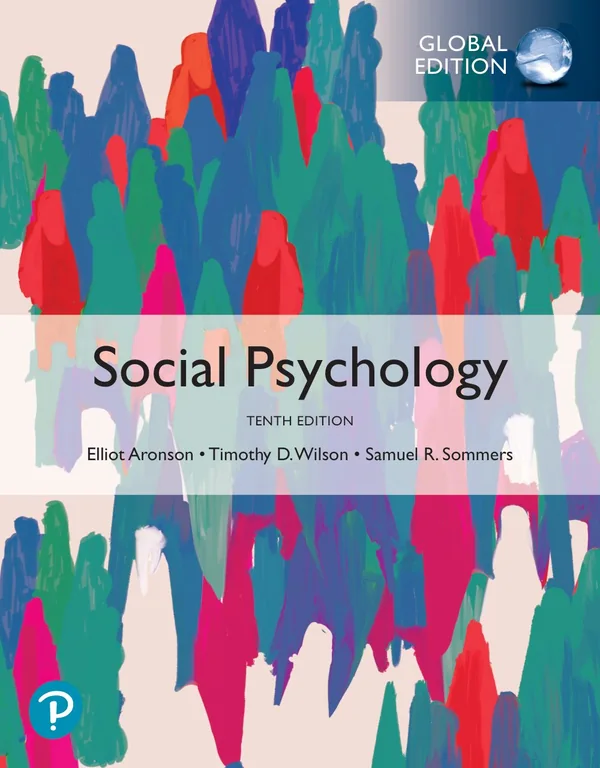
By Elliot Aronson, Timothy D. Wilson, Samuel R. Sommers
About this ebook
Social Psychology studies how situations and other people influence thought, feeling, and behavior. Elliot Aronson, Timothy D. Wilson, and Samuel R. Sommers use research and everyday scenarios in the tenth Global Edition to introduce students to social cognition, attitudes, persuasion, conformity, group processes, prejudice, aggression, and helping behavior.
Inside this title
Examines situational influences on thought, feeling, and behavior
Current listed price $25.00Regular price $57.00Digital ebook
Explanations of behavior often begin with personality, but this text asks readers to examine the surrounding social situation as well. Attribution, cognitive dissonance, self-perception, and social cognition provide tools for investigating how people interpret themselves and others. Heuristics and biases connect these theories with ordinary judgments.
Further chapters consider attitude change, persuasion, conformity, obedience, group decision-making, prejudice, aggression, and altruism. Research evidence is paired with recognizable social scenarios to show how questions about behavior can be studied scientifically. The tenth Global Edition is intended primarily for undergraduate social psychology courses, and its applied examples also support readers interested in communication, group relationships, and the social influences involved in everyday decisions.
Study guide included
Inside Social Psychology, 10th Edition (Global Edition).
Aronson, Wilson and Sommers argue that behavior is easier to explain once you ask how a person read the situation. The tenth Global Edition uses classic and current research to cover social cognition, the self, persuasion, conformity, groups, relationships, helping, aggression and prejudice.
The opening chapters define the field and its methods, emphasizing construal, random assignment and the limits of correlation. Social cognition and perception introduce schemas, heuristics and attribution. The self, dissonance and attitude chapters show how people manage consistency and process persuasive messages. Conformity, obedience and group dynamics explain when others inform or pressure. Later chapters treat attraction, bystander intervention, aggression and prejudice through distinct mechanisms. Applied sections on sustainability, health and law test whether findings transfer, and the text keeps asking what the evidence can actually support.
Situations, construals and method
Social psychology begins with the meaning a person assigns to a setting, not with a trait label. The methods chapters show why experiments with random assignment support causal claims that correlation cannot, and where measurement and setting still limit conclusions.
Ask how the actor interpreted the situation
Separate correlation from causation
Check sampling, measurement and setting
Chs. 1–2 · Introduction and methodology
Inference, schemas and attribution
Accessible schemas and shortcuts shape what people notice and recall. Attribution material uses consensus, distinctiveness and consistency to judge whether behavior belongs to the person or the setting, and it warns about underweighting situational information.
Notice which schema is guiding judgment
Compare behavior across people and settings
Correct for the pull of dispositional explanations
Chs. 3–4 · Social cognition and social perception
Self, dissonance and attitudes
Self-knowledge arrives through experience, comparison and observation of one's own behavior. Dissonance explains why people adjust beliefs after acting, and the attitude chapters distinguish careful argument evaluation from reliance on peripheral cues.
Treat introspection as informative but incomplete
Notice post-decision justification
Separate systematic from heuristic processing
Chs. 5–7 · Self, dissonance, and attitude change
Conformity, obedience and groups
People conform for information or for approval, and those motives predict different responses to dissent and anonymity. Group chapters examine effort, polarization and pressure toward agreement, along with structures that keep independent judgment alive.
Distinguish informational from normative influence
Test whether anonymity changes what is said
Protect dissent before the group converges
Chs. 8–9 · Conformity, obedience, and group processes
Relationships, helping and harm
Proximity, similarity and reciprocity shape attraction, while bystander research breaks intervention into a sequence of judgments. Aggression and prejudice are analyzed through separate mechanisms, including norms, provocation and group categories.
Trace each step that can block helping
Keep explanations of aggression distinct
Use cooperative interdependence to change relations
Chs. 10–13 · Attraction, helping, aggression, and prejudice
Applications that test context
Sustainability, health and legal applications show that a mechanism must be identified before an intervention is chosen. Confidence is not accuracy, and eyewitness and jury research demonstrates why procedure matters as much as memory.
Name the obstacle before designing an intervention
Separate confidence from correctness
Test whether an effect survives a new setting
Social Psychology in Action 1–3 · Sustainability, health, and law
Chapter and section map
Introducing Social Psychology and MethodologyChs. 1–2
Social Cognition and Social PerceptionChs. 3–4
The Self and Cognitive DissonanceChs. 5–6
Attitudes, Conformity, and Group ProcessesChs. 7–9
Attraction and Relationships and Prosocial BehaviorChs. 10–11
Aggression and PrejudiceChs. 12–13
Social Psychology in ActionApplied sections 1–3
Key takeaways
Ask how the person construed the situation before assigning a trait.
Distinguish what people believe from what they are willing to say aloud.
Test whether a laboratory finding survives a change of setting before applying it.
Undergraduates taking social psychology, and readers in communication, management or law who want an evidence-based account of situational influence.
Topics covered
social psychology
social cognition
attitudes and persuasion
conformity and obedience
group processes
prejudice and aggression
prosocial behavior
applied social psychology
Questions about this ebook.
Edition, audience, and study-guide details at a glance.
What is Social Psychology, 10th Edition (Global Edition) about?
Social Psychology studies how situations and other people influence thought, feeling, and behavior. Elliot Aronson, Timothy D. Wilson, and Samuel R. Sommers use research and everyday scenarios in the tenth Global Edition to introduce students to social cognition, attitudes, persuasion, conformity, group processes, prejudice, aggression, and helping behavior.
Which edition of Social Psychology, 10th Edition (Global Edition) is this?
This listing is for the 10th edition. Check the title, ISBN, and book details above before ordering, especially if your course or reading list names a specific edition.
Who is Social Psychology, 10th Edition (Global Edition) for?
Undergraduates taking social psychology, and readers in communication, management or law who want an evidence-based account of situational influence.
Does this page include a study guide?
Yes. This page includes an original study guide with six thematic sections, key takeaways, and a chapter and section map for structured reading.