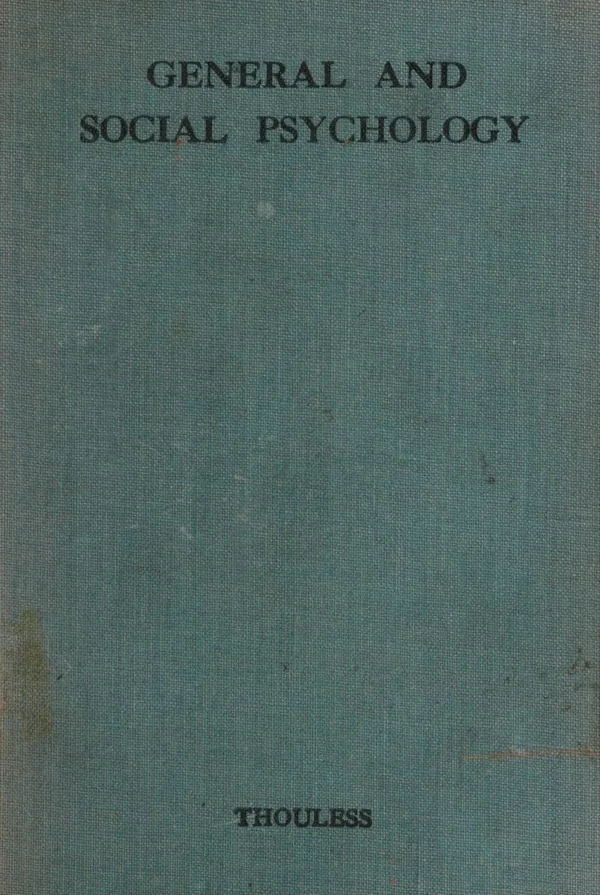
General and Social Psychology connects individual mental processes with social behavior in a historical textbook for economics and social science students. Robert H. Thouless moves from perception, emotion, learning, and motivation to attitudes, persuasion, leadership, and collective behavior, showing how psychological concepts entered prewar social science teaching.
Inside this title
Perception, emotion, and motivation as foundations of social behavior
Current listed price $19.99Regular price $40.00Digital ebook
Thouless builds his account of social behavior on the psychology of the individual. Sensation and perception, emotional responses, habit formation, and motivation provide the groundwork for examining how people influence one another and participate in groups. Economic and social examples connect the introductory concepts with the interests of the intended student audience.
The second edition also considers belief, persuasion, personality, and the relationship between personal characteristics and social roles. Readers studying the history of psychology can examine how these subjects were organized and explained in the 1930s. Its value lies in that period perspective and in its integration of general and social psychology within a single course of study.
Study guide included
Inside General and Social Psychology, 2nd Edition.
Thouless treats social conduct as an extension of individual mental life, not a separate subject. Perception, feeling, habit and motive are laid out first, then used to explain attitudes, persuasion, leadership and group behavior in a textbook written for economics and social science students of the 1930s.
The book follows a deliberate sequence: sensation and perception, emotional response, learning and habit, then motivation. Only after that groundwork does it turn to attitudes, belief, persuasion and the psychology of groups. Personality and social roles are considered near the end, where personal traits meet the demands of position. Economic and social illustrations keep the material close to the intended readership. Read as a historical document, it shows how prewar social science teaching organized psychology and where it drew the line between individual and collective explanation.
Perception as the base of conduct
Thouless begins with sensation and perception because he treats them as the raw material of social life. How a person notices, selects and organizes a stimulus shapes what they can respond to later. The discussion keeps asking how far perception is passive registration and how far it is active construction influenced by expectation and prior experience.
Sensation supplies the material for perception
Attention selects what will be noticed
Expectation shapes how a stimulus is read
Topics 1–2
Emotion, habit and motivation
Emotional response, repeated action and drive are presented as connected rather than separate chapters of mind. Habit is described as social as well as personal, since customs supply the patterns individuals rehearse. Motivation supplies direction, and the text shows how these three ideas prepare the ground for explaining why people act as they do in company.
Emotion and bodily response are linked
Habit grows from repetition and social custom
Motivation gives behavior its direction
Topics 2–3
Attitudes and the mechanics of persuasion
Attitudes are treated as dispositions that can be formed, maintained and changed. The book examines the conditions under which a message is accepted, including the standing of the speaker and the fit between argument and existing belief. Persuasion is analyzed as a social process rather than a technique, and suggestion is presented as an ordinary feature of group life.
Attitudes guide how a message is received
Speaker standing affects acceptance
Suggestion works through ordinary social influence
Topic 5
Leadership and group psychology
Groups are examined for what they add to individual behavior: shared standards, pressures toward conformity, and the emergence of leaders. Leadership is discussed in terms of function and situation rather than fixed traits alone, and the text considers how collective decisions can differ from what members would choose separately.
Groups generate shared standards and pressure
Leadership is read through function and situation
Collective decisions may diverge from individual ones
Topic 6
Personality meeting social roles
The later chapters bring personal characteristics into contact with the positions people occupy. A role carries expectations, and the book asks how temperament, ability and habit interact with those demands. This is where the general and social strands join, since individual differences matter in relation to the situations and obligations that call on them.
Roles carry expectations and obligations
Temperament interacts with social demands
Individual and social explanation meet here
Topic 7
Belief and the textbook's period frame
Belief is discussed as something held with varying degrees of confidence and supported or disturbed by social surroundings. The second edition also deserves reading as a record of how psychology was taught to economics students in the 1930s: which questions were central, which methods were assumed, and how confidently the boundary between individual and social explanation was drawn.
Belief varies in confidence and social support
The text reflects prewar teaching priorities
Historical framing is part of its value
Topics 5–7
Topic map
Foundations: Sensation and PerceptionTopic 1
Emotional Response and Its ExpressionTopic 2
Learning, Habit and Social CustomTopic 3
Motivation and Direction of ConductTopic 4
Attitudes, Belief and PersuasionTopic 5
Leadership and Collective BehaviorTopic 6
Personality and Social RolesTopic 7
Key takeaways
Read the individual chapters before the social ones; the argument depends on that order.
Habit and custom are treated as social facts, so personal learning always has a cultural setting.
Judge the book by its period assumptions rather than against present-day research methods.
Students of psychology's history, economics and social science readers, and anyone curious about how prewar textbooks joined individual mental processes with the study of group behavior.
Topics covered
general and social psychology
perception and emotion
habit formation
attitudes and persuasion
leadership and groups
social roles
prewar psychology textbook
Robert H Thouless
Questions about this ebook.
Edition, audience, and study-guide details at a glance.
What is General and Social Psychology, 2nd Edition about?
General and Social Psychology connects individual mental processes with social behavior in a historical textbook for economics and social science students. Robert H. Thouless moves from perception, emotion, learning, and motivation to attitudes, persuasion, leadership, and collective behavior, showing how psychological concepts entered prewar social science teaching.
Which edition of General and Social Psychology, 2nd Edition is this?
This listing is for the 2nd edition. Check the title, ISBN, and book details above before ordering, especially if your course or reading list names a specific edition.
Who is General and Social Psychology, 2nd Edition for?
Students of psychology's history, economics and social science readers, and anyone curious about how prewar textbooks joined individual mental processes with the study of group behavior.
Does this page include a study guide?
Yes. This page includes an original study guide with six thematic sections, key takeaways, and a topic map for structured reading.