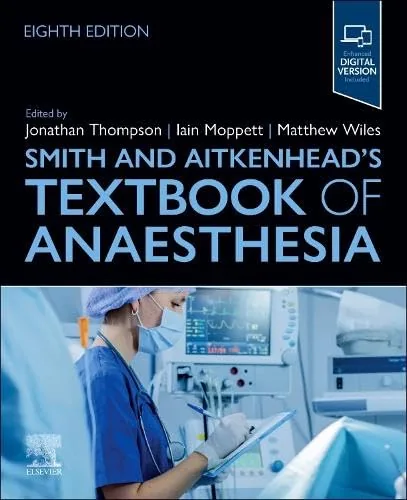
Smith and Aitkenhead's Textbook of Anaesthesia, 8th Edition
Edited by Jonathan Thompson, Iain Moppett, Matthew Wiles
About this ebook
Smith and Aitkenhead's Textbook of Anaesthesia, Eighth Edition, covers the scientific and clinical subjects encountered in anaesthetic training. Edited by Jonathan Thompson, Iain Moppett, and Matthew Wiles, it addresses preoperative assessment, pharmacology, airway management, regional techniques, perioperative medicine, pain, and critical care, with key points and self-assessment questions supporting study.
Inside this title
Preoperative assessment, anaesthetic pharmacology, airway management, and regional techniques
Current listed price $29.00Regular price $70.00Digital ebook
The text follows anaesthetic care from assessment and preparation through intraoperative management and postoperative concerns. Pharmacology considers induction agents, volatile anaesthetics, neuromuscular blockers, opioids, and local agents, relating drug effects to pharmacokinetics and pharmacodynamics. Airway material ranges from basic ventilation to advanced techniques.
Regional anaesthesia connects anatomy with neuraxial and peripheral blocks, while perioperative medicine includes fluids, transfusion, and temperature management. Obstetric, paediatric, cardiac, neurosurgical, and trauma settings broaden the clinical scope. Pain pathways and critical care topics add ventilation, sedation, and sepsis to the discussion. Anaesthesia trainees and readers revisiting the subject can use chapter key points and questions to organize their study of the eighth edition.
Study guide included
Inside Smith and Aitkenhead's Textbook of Anaesthesia, 8th Edition.
A training text that follows anaesthetic care from assessment to recovery. Thompson, Moppett, and Wiles set pharmacology and airway management beside regional techniques, perioperative medicine, specialist patient groups, pain, and critical care, with key points and self-assessment questions to organize study.
The eighth edition follows the arc of anaesthetic care rather than listing topics in isolation. Preoperative assessment and preparation come first, then pharmacology: induction agents, volatile anaesthetics, neuromuscular blockers, opioids, and local agents, each related to pharmacokinetics and pharmacodynamics. Airway material runs from basic ventilation to advanced techniques, and regional anaesthesia connects anatomy with neuraxial and peripheral blocks. Perioperative medicine covers fluids, transfusion, and temperature management. Obstetric, pediatric, cardiac, neurosurgical, and trauma settings extend the clinical range, while pain pathways and critical care add ventilation, sedation, and sepsis. Chapter key points and questions support trainees revisiting the subject.
Preoperative assessment and preparation
Care begins with judging the patient's condition and readiness. The text treats assessment as the basis for later choices rather than a preliminary formality.
Assessment identifies risks before anaesthesia
Preparation follows from findings
Planning connects assessment to intraoperative decisions
Topic 1
Pharmacology of anaesthetic agents
Drug classes are presented with their mechanisms and time courses. Pharmacokinetics and pharmacodynamics are used to explain differences in onset, offset, and effect.
Induction agents differ in onset and profile
Volatile agents are described by their effects
Neuromuscular blockers and opioids serve distinct roles
Topic 2
Airway management and ventilation
Airway material spans routine support and advanced rescue. The text links technique choice to the situation and to the patient's anatomy.
Basic ventilation underpins airway care
Advanced techniques address difficult situations
Technique choice depends on assessment
Topic 3
Regional anaesthesia and anatomy
Regional techniques are tied to anatomy so that blocks are understood rather than memorized. Neuraxial and peripheral approaches are treated as related families.
Anatomy guides block placement
Neuraxial and peripheral blocks differ in scope
Local agents connect technique to effect
Topic 4
Perioperative medicine and specialist settings
Fluids, transfusion, and temperature management carry care through the operation. Specialist groups adjust general principles to particular risks.
Fluid and transfusion decisions affect stability
Temperature management is part of perioperative care
Obstetric, pediatric, and cardiac settings change priorities
Topic 5
Pain and critical care
Pain pathways are presented alongside critical care topics, connecting anaesthetic practice to intensive settings.
Pain pathways inform analgesic choices
Critical care adds ventilation and sedation
Sepsis is treated as a distinct critical problem
Topic 6
Topic map
Preoperative Assessment and PreparationTopic 1
Anaesthetic PharmacologyTopic 2
Airway Management and VentilationTopic 3
Regional AnaesthesiaTopic 4
Perioperative Fluids, Transfusion, and TemperatureTopic 5
Specialist Patient GroupsTopic 6
Pain Medicine and Critical CareTopic 7
Key takeaways
Anaesthetic care is a sequence that begins with assessment and continues after the procedure.
Pharmacology explains differences in drug onset, effect, and recovery.
Specialist settings adjust general principles rather than replace them.
Anaesthesia trainees, residents preparing for examinations, and readers revisiting the scientific and clinical foundations of anaesthetic practice.
Topics covered
Smith and Aitkenhead's Textbook of Anaesthesia 8th Edition
anaesthesia textbook
anaesthetic pharmacology
airway management
regional anaesthesia
perioperative medicine
pain medicine
critical care
Questions about this ebook.
Edition, audience, and study-guide details at a glance.
What is Smith and Aitkenhead's Textbook of Anaesthesia, 8th Edition about?
Smith and Aitkenhead's Textbook of Anaesthesia, Eighth Edition, covers the scientific and clinical subjects encountered in anaesthetic training. Edited by Jonathan Thompson, Iain Moppett, and Matthew Wiles, it addresses preoperative assessment, pharmacology, airway management, regional techniques, perioperative medicine, pain, and critical care, with key points and self-assessment questions supporting study.
Which edition of Smith and Aitkenhead's Textbook of Anaesthesia, 8th Edition is this?
This listing is for the 8th edition. Check the title, ISBN, and book details above before ordering, especially if your course or reading list names a specific edition.
Who is Smith and Aitkenhead's Textbook of Anaesthesia, 8th Edition for?
Anaesthesia trainees, residents preparing for examinations, and readers revisiting the scientific and clinical foundations of anaesthetic practice.
Does this page include a study guide?
Yes. This page includes an original study guide with six thematic sections, key takeaways, and a topic map for structured reading.