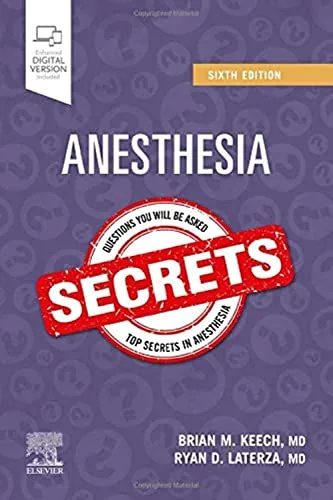
Anesthesia Secrets, 6th Edition reviews anesthesiology through concise questions and answers. Brian M. Keech and Ryan D. Laterza present a topic-based study resource for residents, nurse anesthetists, and medical students, covering physiology, pharmacology, airway management, regional techniques, specialty anesthesia, perioperative care, and pain medicine.
Inside this title
Concise question-and-answer review linking science with anesthetic practice
Current listed price $17.99Regular price $34.00Digital ebook
Questions provide the entry point to each topic, followed by focused explanations that connect basic science with anesthetic practice. Pharmacology and cardiopulmonary, renal, and hepatic physiology form part of the foundation, alongside airway management and the clinical considerations surrounding anesthetic drugs.
Coverage extends to neuraxial and peripheral nerve techniques, pediatric and obstetric anesthesia, critical care, postoperative care, and pain medicine. The question-and-answer format allows readers to work through subjects in short sections or revisit an individual concept. Anesthesiology residents and nurse anesthetists can use the sixth edition for organized review, while medical students on anesthesia placements can use it to orient themselves to the specialty's vocabulary and recurring clinical questions.
Study guide included
Inside Anesthesia Secrets, 6th Edition.
Anesthesia rewards recall under pressure, so this review is built from questions rather than paragraphs. Each prompt opens a topic, then a short explanation links the underlying science to what happens in the room, letting readers test themselves before reading the answer.
The format is deliberately uniform: a question, a focused answer, and enough explanation to reconnect the fact to practice. Pharmacology and cardiopulmonary, renal, and hepatic physiology provide the basic-science layer. Airway management and the clinical behaviour of anesthetic drugs follow. Neuraxial and peripheral nerve techniques, pediatric and obstetric cases, critical care, postoperative management, and pain medicine widen the scope. Because sections are short, the book can be worked through systematically over weeks or consulted for a single concept before a case.
Studying through question and answer
The question-and-answer structure is a study method as much as a format. Answering before reading forces retrieval, which exposes gaps that rereading tends to hide. Readers can move through a subject in short sittings or open a single item before a case, and the brief explanations keep the review usable when time is short.
Answer before reading the explanation
Work in short, repeatable sittings
Use single items for just-in-time review
Topic 1
Physiology that governs dosing
Cardiopulmonary, renal, and hepatic physiology are treated as the basis for predicting how a patient will respond. Cardiac output, gas exchange, clearance, and metabolism determine what an anesthetic does and how long it lasts. The review keeps returning to these processes because dosing decisions that ignore them become guesswork.
Relate cardiac output to drug onset
Connect renal and hepatic function to clearance
Predict response from physiology, not habit
Topic 2
Anesthetic pharmacology and drug choice
Drug groups are reviewed by what they do clinically: induction, maintenance, analgesia, and muscle relaxation. Onset, offset, side effects, and interactions are connected to the situations where each choice matters. The emphasis stays practical, asking readers to know not only the mechanism but the reason one agent would be preferred over another.
Separate induction, maintenance, and analgesic agents
Compare onset, offset, and side effects
Match drug choice to clinical situation
Topic 3
Airway assessment and management
Airway topics carry a different weight because failure there escalates quickly. Assessment, device selection, and the sequence of responses to a difficult airway are reviewed in a way that supports rehearsal. The section is less about memorising equipment than about knowing which step follows which when the expected plan does not work.
Assess the airway before induction
Know the sequence when intubation fails
Rehearse escalation, not just equipment names
Topic 4
Regional and neuraxial techniques
Spinal, epidural, and peripheral nerve approaches are reviewed by anatomy, indication, and complication. Understanding where the needle is going explains both the block produced and the risks that accompany it. The questions press readers to connect technique to the dermatomes or nerve distributions involved rather than treat blocks as a list.
Learn block anatomy with its indication
Recognise complications specific to each technique
Recognise complications specific to each technique
Topic 5
Special populations and pain
Pediatric, obstetric, and critically ill patients change the assumptions behind routine practice, and the review marks where. Postoperative care and pain medicine close the arc, covering recovery, analgesia planning, and the transition out of the operating room. The recurring question is what makes this patient different from the standard case.
Identify what changes in pediatric and obstetric care
Plan postoperative analgesia deliberately
Adapt routine practice to critical illness
Topic 6-7
Topic map
Studying with QuestionsTopic 1
Cardiopulmonary, Renal, and Hepatic PhysiologyTopic 2
Anesthetic Drugs and Clinical BehaviourTopic 3
Airway Assessment and ManagementTopic 4
Neuraxial and Peripheral Nerve BlocksTopic 5
Pediatric and Obstetric AnesthesiaTopic 6
Critical Care and Postoperative ManagementTopic 7
Pain MedicineTopic 8
Key takeaways
Answer first, then read: retrieval shows what you actually know, while rereading only feels like knowing.
Most dosing decisions reduce to physiology, especially cardiac output, clearance, and hepatic metabolism.
Airway competence is a sequence of fallbacks, not a single technique that either works or does not.
Anesthesiology residents, nurse anesthetists preparing for board review, and medical students on anesthesia placements who need a concise, question-driven way to revisit core material quickly before clinical cases.
Topics covered
anesthesia review
board review questions
airway management
anesthetic pharmacology
regional anesthesia
perioperative care
pain medicine
clinical physiology
Questions about this ebook.
Edition, audience, and study-guide details at a glance.
What is Anesthesia Secrets, 6th Edition about?
Anesthesia Secrets, 6th Edition reviews anesthesiology through concise questions and answers. Brian M. Keech and Ryan D. Laterza present a topic-based study resource for residents, nurse anesthetists, and medical students, covering physiology, pharmacology, airway management, regional techniques, specialty anesthesia, perioperative care, and pain medicine.
Which edition of Anesthesia Secrets, 6th Edition is this?
This listing is for the 6th edition. Check the title, ISBN, and book details above before ordering, especially if your course or reading list names a specific edition.
Who is Anesthesia Secrets, 6th Edition for?
Anesthesiology residents, nurse anesthetists preparing for board review, and medical students on anesthesia placements who need a concise, question-driven way to revisit core material quickly before clinical cases.
Does this page include a study guide?
Yes. This page includes an original study guide with six thematic sections, key takeaways, and a topic map for structured reading.