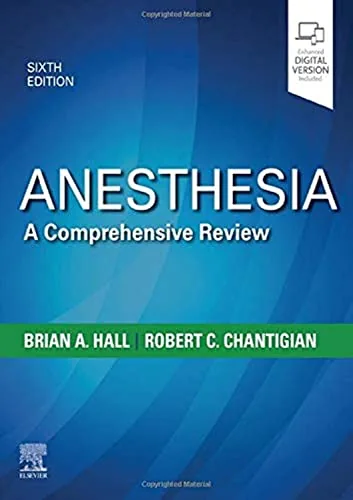
Anesthesia: A Comprehensive Review, Sixth Edition uses multiple-choice questions and explanations to revisit basic science and clinical anesthesiology. Brian A. Hall and Robert C. Chantigian address trainees and clinicians studying pharmacology, physiology, equipment, perioperative management, regional techniques, pain medicine, and anesthesia for different patient populations and surgical settings.
Inside this title
Multiple-choice questions with explanations of answer choice reasoning
Current listed price $31.00Regular price $78.00Digital ebook
Questions provide the organizing structure for this review of anesthesiology. Each answer is accompanied by an explanation that examines the relevant principle and the reasoning behind the available choices, allowing readers to revisit gaps in their understanding while studying individual topics.
Basic science coverage includes anesthetic drugs, organ physiology, physics, monitoring, and equipment. Clinical sections consider airway management, fluids, regional anesthesia, perioperative complications, obstetric and pediatric care, pain, and critical illness. Published in 2020, the sixth edition serves anesthesiology trainees and clinicians looking for a question-based account of the knowledge presented in that edition, whether working through a topic systematically or selecting areas for further review.
Study guide included
Inside Anesthesia: A Comprehensive Review, Sixth Edition.
Hall and Chantigian build a review of anesthesiology around multiple-choice questions, each answered with an explanation of why the alternatives fail. Basic science and clinical practice are covered together, from anesthetic drugs and organ physiology to airway management, regional techniques, special populations, pain and critical illness.
The sixth edition, published in 2020, uses questions to organize study rather than to simulate an examination alone. Each item is followed by reasoning that examines the relevant principle, so a wrong answer becomes a way to locate a gap. Basic science appears first: anesthetic pharmacology, organ physiology, physics, monitoring and equipment. Clinical material then moves through airway management, fluids and regional anesthesia into perioperative complications, obstetric and pediatric care, pain medicine and critical illness. The arrangement lets readers work systematically through a topic or select areas for targeted review, and the explanations make the book usable for revision without a separate answer key.
Learning from explained answers
The question format is a teaching device, not only a test. Every answer is followed by reasoning that examines the relevant principle and shows why the other choices are wrong. A reader who answers incorrectly is directed to the gap rather than simply told the correct option, which is what makes the book usable for study.
Explanations accompany each answer
Incorrect choices are analysed, not just dismissed
The format is designed for learning, not only assessment
Topic 1
Pharmacology and physiology
Anesthetic drugs and organ physiology form the basic science core. The material is presented through questions that ask the reader to apply a principle rather than recall a list, so pharmacology and physiology appear as the reasoning behind clinical decisions.
Anesthetic pharmacology is a core basic science area
Organ physiology underpins clinical reasoning
Questions ask for application rather than recall alone
Topics 2-3
Physics, monitoring and equipment
The physical principles behind monitoring and equipment are treated as knowledge a clinician needs, not as background for engineers. Questions link physical behaviour to what a monitor displays and to how equipment performs, keeping the basic science attached to its clinical use.
Physical principles are tied to monitoring
Equipment behaviour is explained through physics
Basic science stays connected to practice
Topic 4
Airway, fluids and regional techniques
Clinical sections cover airway management, fluid management and regional anesthesia, where procedural decisions meet physiological reasoning. The review presents these as areas requiring both a principle and a practical sequence, and the question format tests whether the reader can connect the two.
Airway management combines principle and procedure
Fluid management depends on physiological reasoning
Regional techniques are reviewed as clinical skills
Topic 5
Complications and special populations
Perioperative complications, obstetric care and pediatric anesthesia are grouped as situations where ordinary principles must be adjusted. The book asks the reader to recognise what changes when the patient is pregnant, a child or critically unwell, rather than treating these populations as minor variations.
Complications require recognition and response
Obstetric and pediatric care alter usual assumptions
Special populations are treated as distinct clinical problems
Topic 6
Pain medicine and critical illness
Pain medicine and critical illness extend the review beyond the operating room. The questions address assessment and management in patients whose needs differ from routine surgical cases, completing a coverage that runs from basic science to intensive care.
Pain medicine extends beyond intraoperative care
Critical illness presents its own management problems
The review spans basic science to intensive care
Topic 7
Topic map
Question-Based Review and Answer ReasoningTopic 1
Anesthetic PharmacologyTopic 2
Organ PhysiologyTopic 3
Physics, Monitoring and EquipmentTopic 4
Airway, Fluids and Regional AnesthesiaTopic 5
Perioperative Complications and Special PopulationsTopic 6
Pain Medicine and Critical IllnessTopic 7
Key takeaways
The explanations carry the teaching, so the book should be read for its reasoning rather than used only to check answers.
Basic science and clinical sections are meant to be studied together, not as separate subjects.
The material can be worked through systematically or sampled by topic for targeted revision.
Anesthesiology trainees preparing for examinations and clinicians who want a question-based review that spans basic science, perioperative care and special populations.
Topics covered
anesthesia review
anesthesiology questions
anesthetic pharmacology
organ physiology
monitoring and equipment
airway management
regional anesthesia
perioperative complications
pain medicine
critical illness
Questions about this ebook.
Edition, audience, and study-guide details at a glance.
What is Anesthesia: A Comprehensive Review, Sixth Edition about?
Anesthesia: A Comprehensive Review, Sixth Edition uses multiple-choice questions and explanations to revisit basic science and clinical anesthesiology. Brian A. Hall and Robert C. Chantigian address trainees and clinicians studying pharmacology, physiology, equipment, perioperative management, regional techniques, pain medicine, and anesthesia for different patient populations and surgical settings.
Which edition of Anesthesia: A Comprehensive Review, Sixth Edition is this?
This listing is for the 6th edition. Check the title, ISBN, and book details above before ordering, especially if your course or reading list names a specific edition.
Who is Anesthesia: A Comprehensive Review, Sixth Edition for?
Anesthesiology trainees preparing for examinations and clinicians who want a question-based review that spans basic science, perioperative care and special populations.
Does this page include a study guide?
Yes. This page includes an original study guide with six thematic sections, key takeaways, and a topic map for structured reading.