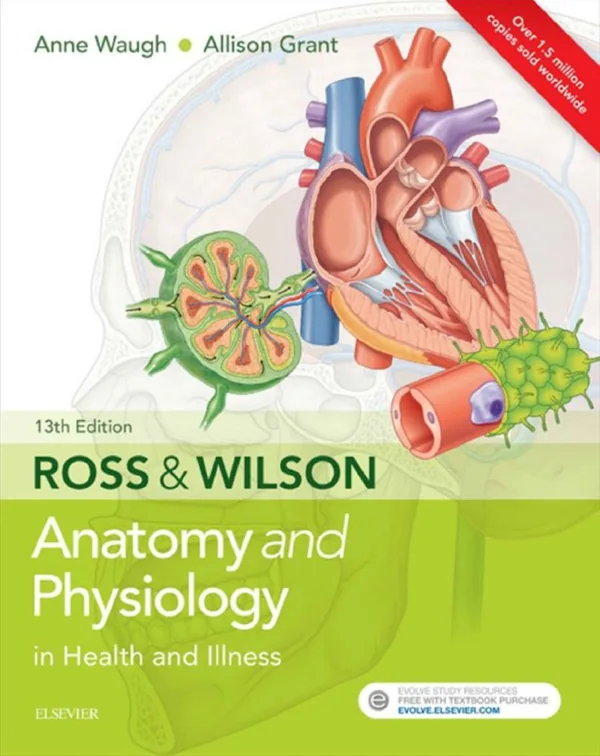
Ross & Wilson Anatomy and Physiology in Health and Illness, 13th Edition
By Anne Waugh, Allison Grant
About this ebook
Ross & Wilson Anatomy and Physiology in Health and Illness, Thirteenth Edition, introduces body structure and function alongside changes associated with disease. Aimed at nursing and allied health students, it uses system-based explanations, illustrations, clinical examples, and self-assessment to connect cellular foundations, homeostasis, anatomy, and the physiological consequences of illness.
Inside this title
Body-system anatomy and physiology connected with common disease processes
Current listed price $29.99Regular price $60.00Digital ebook
The text builds from cellular structure into the anatomy and function of the body's major systems. Normal physiological processes are paired with discussion of how disease disrupts them, allowing learners to connect structural knowledge with mechanisms of illness. Homeostasis provides a recurring link across the system-based coverage.
Illustrations support anatomical study, while clinical examples and questions encourage readers to apply terminology and revisit explanations. Conditions such as heart failure, diabetes, and respiratory disease illustrate the relationship between normal function and pathophysiology. Students beginning nursing or allied health courses can use the book as a foundation for later clinical subjects, with self-assessment material supporting review of the concepts introduced.
Study guide included
Inside Ross & Wilson Anatomy and Physiology in Health and Illness, 13th Edition.
Waugh and Grant set out to make body structure and body function legible together, then to place disease beside both. The result is a teaching text for nurses and allied health students who need to reason from cells and feedback loops toward the changes illness produces in whole systems.
This edition keeps anatomy and physiology in one continuous argument. Chapters open with chemistry, membranes and tissue organisation, then move through transport, signalling, exchange and defence before ending with inheritance and reproduction. Each system is described in its healthy state first, so that later disturbances have something to be measured against. Illustrations, clinical asides and self-assessment questions recur throughout, and many chapters place age-related change next to the normal process it modifies. The book assumes no clinical experience; it asks only that the reader build a structural vocabulary and follow a feedback loop from sensor to response.
Cells, tissues and the internal environment
The opening chapters fix a shared descriptive vocabulary and set out how matter is organised into cells, then into tissues that cooperate inside an organ. Membrane transport and osmosis are treated as working mechanisms rather than definitions, and negative feedback is introduced early so later systems can be read as regulation rather than as lists of parts.
Name structures before assigning them functions
Diffusion follows gradients; active transport spends energy
Treat feedback as a loop with a sensed variable
Ch. 1–3
Blood, circulation and lymphatic return
Here the reader follows material rather than memorising names. Blood is presented as a transport and defence medium, the heart as a pump that keeps the two circuits in series, and the vessel types as a graded transition from pressure carriage to exchange. Lymphatic drainage closes the loop by returning fluid that leaves the capillaries, with immune tissue positioned along the route.
Separate pulmonary from systemic flow when tracing blood
Compare artery, capillary and vein by wall and role
Link fluid accumulation to pressure, permeability or drainage
Ch. 4–6
Nervous and endocrine coordination compared
Two control systems are placed side by side so their speeds and reach can be contrasted. Neural signalling is traced from receptor through integration to effector, including the involuntary division, and the special senses show how different stimuli become interpretable signals. Endocrine chapters then follow hormones through the bloodstream to receptor-bearing targets, where feedback from the responding gland shapes further release.
Trace stimulus, sensory path, integration and motor output
Receptor distribution limits which tissues a hormone affects
Ch. 7–9
Exchange, digestion and renal output
This stretch separates bulk movement from diffusion, a distinction that pays off in both breathing and eating. Ventilation and digestion are treated as preparation steps that make exchange possible at a thin surface, while the nephron is broken into filtration, reabsorption and secretion so that final urine can be explained rather than merely listed. Acid balance ties renal work back to respiration.
Mark where bulk flow ends and diffusion begins
Follow the filtrate through all three nephron processes
Connect breathing to carbon dioxide and acid balance
Ch. 10–13
Barriers, immunity and mechanical movement
Protection is layered rather than singular, and the chapter sequence reflects that: skin as a physical and sensory interface, innate responses that act quickly and broadly, then adaptive recognition with memory. Movement is handled as a mechanical system in which bones carry load, joints constrain motion and muscles pull through tendons, so the direction of force matters as much as its size.
Layer defenses instead of relying on one surface
Distinguish structures that move from those that support
Ch. 14–16
Inheritance, reproduction and age-related change
The closing chapters connect stored genetic information to the traits that eventually appear, keeping genotype and observable characteristic as separate ideas. Reproductive anatomy is then tied to gamete production and hormonal control, and fertilisation opens a developmental sequence. Life-span change is handled by naming the normal process first and then identifying which step has altered.
Keep genotype separate from the trait it produces
Explain inheritance patterns with gamete formation diagrams
Ch. 17–18
Chapter and section map
Anatomy and organisation of the bodyCh. 1
Cells and tissuesCh. 3
The cardiovascular systemCh. 5
The nervous systemCh. 7
The respiratory systemCh. 10
The urinary systemCh. 13
Resistance and immunityCh. 15
Introduction to geneticsCh. 17
Key takeaways
Sketch a system as ordered structures before attaching functions, so that later disturbances have somewhere concrete to land.
Every feedback loop needs a sensed variable, a detector and a response; without all three the diagram is incomplete.
Account for an observation by tracing material or signal across systems rather than memorising a single organ's behaviour.
Nursing and allied health students taking first anatomy and physiology courses, plus readers returning to the subject who want disease framed against normal function. No prior clinical placement is assumed.
Topics covered
anatomy and physiology
negative feedback loops
nursing foundation text
body systems
clinical anatomy
cell membrane transport
health and illness
Questions about this ebook.
Edition, audience, and study-guide details at a glance.
What is Ross & Wilson Anatomy and Physiology in Health and Illness, 13th Edition about?
Ross & Wilson Anatomy and Physiology in Health and Illness, Thirteenth Edition, introduces body structure and function alongside changes associated with disease. Aimed at nursing and allied health students, it uses system-based explanations, illustrations, clinical examples, and self-assessment to connect cellular foundations, homeostasis, anatomy, and the physiological consequences of illness.
Which edition of Ross & Wilson Anatomy and Physiology in Health and Illness, 13th Edition is this?
This listing is for the 13th edition. Check the title, ISBN, and book details above before ordering, especially if your course or reading list names a specific edition.
Who is Ross & Wilson Anatomy and Physiology in Health and Illness, 13th Edition for?
Nursing and allied health students taking first anatomy and physiology courses, plus readers returning to the subject who want disease framed against normal function. No prior clinical placement is assumed.
Does this page include a study guide?
Yes. This page includes an original study guide with six thematic sections, key takeaways, and a chapter and section map for structured reading.