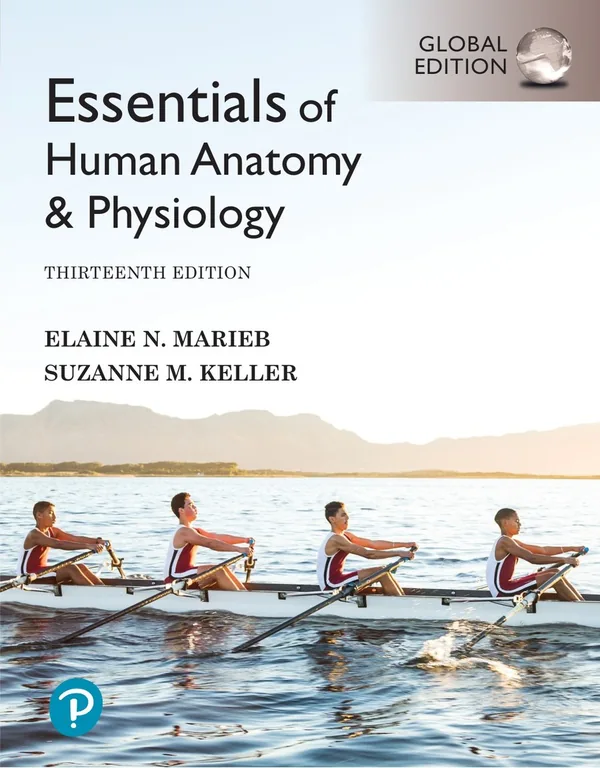
The Global Edition of Essentials of Human Anatomy & Physiology, 13th Edition presents an introductory account of human body systems. Marieb and Keller link anatomical structures with physiological processes through illustrations, clinical cases, and homeostatic principles for nursing, allied health, and life science learners.
Inside this title
Global Edition identification for matching regional course requirements
Current listed price $34.99Regular price $91.00Digital ebook
Anatomical language, cellular processes, and tissue organization establish the foundations for this survey of the human body. The chapters then examine organ systems and their relationships, connecting structures such as heart chambers and nephrons to the functions they support. Feedback loops and homeostasis provide recurring explanations for physiological regulation.
Clinical cases, labeled illustrations, and concept questions give students several ways to examine the material. The text also introduces interpretation of physiological graphs and observations, bringing together terminology and application. This listing identifies the Global Edition, a distinction relevant when matching course requirements because examples and end-of-chapter material can differ between regional editions.
Study guide included
Inside Essentials of Human Anatomy & Physiology, 13th Edition (Global Edition).
The Global Edition of a widely used one-semester anatomy and physiology survey. Marieb and Keller connect structures to functions through homeostasis, updated clinical features and system-by-system chapters, supporting nursing, allied health and life science learners studying in the Global Edition format.
Orientation and chemistry come first, then cells and tissues act as the bridge to organ systems. Readers study support and control before following exchange through blood, lymph, lungs, the digestive tract and kidneys. Chapter previews and feature boxes tie normal mechanisms to examples of imbalance, including updated respiratory and immune context, and the reproductive chapter extends the same approach into development. Illustrations and clinical boxes show how a normal mechanism can fail, while the Global Edition keeps the same system sequence and adapts examples for an international readership.
From molecules to body tissues
Anatomical terms and planes create a common language for describing where a structure sits. Physiology then asks how that structure performs its work. Water and ions form the cellular environment, while membranes control exchange through passive and active mechanisms. Four tissue types cover, support, contract and communicate, and their arrangement makes organ function possible.
Anchor descriptions in anatomical position
Match transport method to the gradient
Connect tissue arrangement to organ work
Chs. 1–3 · Orientation, chemistry, cells and tissues
Barriers, bones and movement
Skin layers divide protective, sensory and vascular jobs, and sweat plus altered blood flow regulate heat loss. The skeleton supports and protects while serving as a living mineral store that remodels. Joints constrain motion, and muscles generate pull when fibres shorten, with neural input, calcium and ATP controlling contraction and opposing muscles stabilising position.
Relate each skin layer to a function
Explain heat loss through skin responses
Link muscle contraction to calcium and ATP
Chs. 4–6 · Skin, skeleton and muscle
Signals and feedback loops
Sensory receptors translate stimuli into nerve signals, and pathways carry information to the brain and instructions back to effectors. Reflexes shorten some response loops, while the autonomic system adjusts internal organs. Hormones travel widely in blood but act only on tissues with matching receptors, so negative feedback can correct a deviation in glucose or another regulated variable.
Follow the sensory-to-effector route
Separate reflex from voluntary control
Predict a hormone's target from its receptor
Chs. 7–9 · Nervous system, senses and endocrine system
Transport, immunity and gas exchange
Blood carries cells and plasma proteins with distinct roles, and the heart maintains pulmonary and systemic flow through valves. Alveolar surfaces exchange oxygen and carbon dioxide. Lymphatic vessels recover fluid and present material to immune cells, while innate defences respond broadly and adaptive defences recognise specific targets, creating memory after exposure.
Match blood components to their functions
Trace flow through pulmonary and systemic routes
Contrast innate and adaptive immunity
Chs. 10–13 · Blood, circulation, defenses and respiration
Nutrition, excretion and balance
Digestion breaks food down and absorbs products, chiefly across the small intestine's large surface, while metabolism covers the reactions that follow inside cells. Kidneys filter plasma at glomeruli and then modify the filtrate by reabsorption and secretion. The result adjusts water, electrolytes, acid-base status and waste removal rather than simply producing urine.
Distinguish absorption from cellular metabolism
Trace filtrate modification along the nephron
Connect kidney transport to acid-base balance
Chs. 14–15 · Digestion, metabolism and the urinary system
Reproduction and early development
Gonads produce gametes, and ducts and chambers provide the conditions for them to meet. Following sperm and oocyte routes shows where production, transport and fertilisation occur. Hormones coordinate ovarian and uterine cycles, and after fertilisation the placenta mediates exchange between the developing organism and the parent.
Map gamete production and transport
Relate hormonal cycles to tissue changes
Explain placental exchange surfaces
Ch. 16 · The Reproductive System
Chapter and section map
Human body and orientationp. 23
Cells and tissuesp. 82
Skin, skeleton and musclespp. 128, 152, 199
Nervous and endocrine systemspp. 242, 324
Cardiovascular and lymphatic systemspp. 373, 414
Respiration and digestionpp. 454, 482
Urinary and reproductive systemspp. 533, 562
Key takeaways
Pair each named structure with a function and a route for materials or signals.
Distinguish a local tissue response from coordinated changes that follow in other systems.
For fluid balance, separate water leaving the body from water shifting between compartments.
Nursing, allied health and life science students using the Global Edition in an introductory anatomy and physiology course, and readers who want a concise but well-illustrated reference.
Topics covered
homeostatic regulation
tissue types
skeletal system
endocrine feedback
cardiac cycle
lymphatic immunity
kidney physiology
human reproduction
Questions about this ebook.
Edition, audience, and study-guide details at a glance.
What is Essentials of Human Anatomy & Physiology, 13th Edition (Global Edition) about?
The Global Edition of Essentials of Human Anatomy & Physiology, 13th Edition presents an introductory account of human body systems. Marieb and Keller link anatomical structures with physiological processes through illustrations, clinical cases, and homeostatic principles for nursing, allied health, and life science learners.
Which edition of Essentials of Human Anatomy & Physiology, 13th Edition (Global Edition) is this?
This listing is for the 13th edition. Check the title, ISBN, and book details above before ordering, especially if your course or reading list names a specific edition.
Who is Essentials of Human Anatomy & Physiology, 13th Edition (Global Edition) for?
Nursing, allied health and life science students using the Global Edition in an introductory anatomy and physiology course, and readers who want a concise but well-illustrated reference.
Does this page include a study guide?
Yes. This page includes an original study guide with six thematic sections, key takeaways, and a chapter and section map for structured reading.