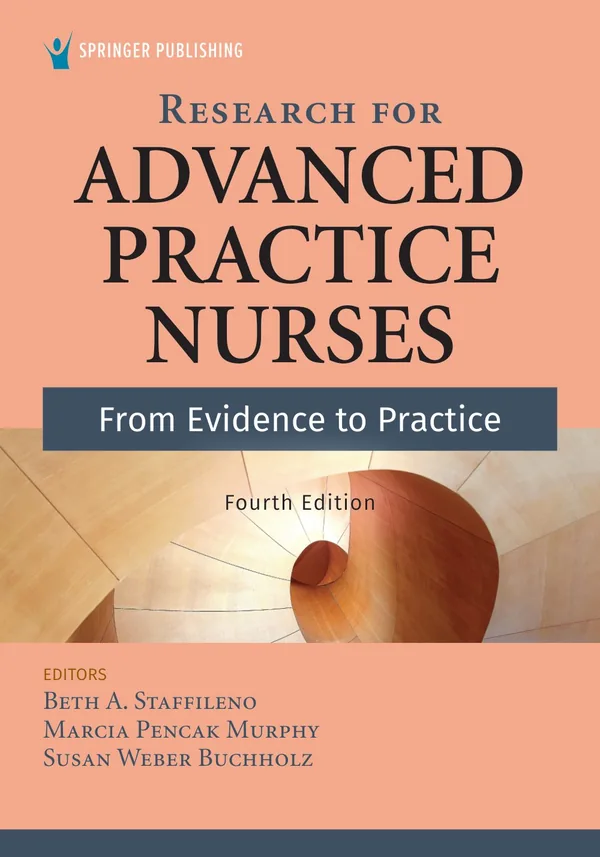
Research for Advanced Practice Nurses: From Evidence to Practice, 4th Edition
By Beth A. Staffileno, Marcia Pencak Murphy, Susan Weber Buchholz
About this ebook
Research for Advanced Practice Nurses: From Evidence to Practice, Fourth Edition follows the evidence-based practice process from clinical questions to dissemination. Beth A. Staffileno, Marcia Pencak Murphy, and Susan Weber Buchholz address evidence searching, critical appraisal, practice change, outcomes, and research ethics for graduate nursing students and advanced practice nurses.
Inside this title
Clinical question development, database searching, and evidence appraisal
Current listed price $29.99Regular price $60.00Digital ebook
Clinical questions provide the starting point for this guide to research and evidence-based practice in advanced nursing roles. The text considers PICO(T) question formulation, database searching, and appraisal of different study designs before examining how findings can inform protocols and practice changes. Quantitative and qualitative evidence both enter that process.
Further topics include questionnaire design, data collection, institutional review boards, quality improvement, and outcomes measurement. Dissemination through scholarly writing, presentations, and posters connects completed work with professional communication. Intended for master's and doctoral nursing education, the fourth edition can support advanced practice nurses and clinical scholars studying how to develop, evaluate, and communicate an evidence-informed project.
Study guide included
Inside Research for Advanced Practice Nurses: From Evidence to Practice, 4th Edition.
The editors follow how nurse practitioners turn a care concern into evidence strong enough to steer practice, tying literature searching and appraisal to rollout, ethical review, evaluation, and messaging. Exemplars throughout show that improvement rests on sound evidence plus an organization capable of carrying it.
Early chapters cover the evidence-based approach and what sustains it, followed by a methods section on framing questions, selecting designs, and gathering data. Later chapters address reviews, judging programs, and putting changes in place. The closing material gives comparable weight to costs, results, ethical review, and sharing findings. Case examples recur, showing why a promising change can stall when ownership, workflow, or staff time are left unaddressed. Throughout, the emphasis falls on matching the strength of a claim to the evidence behind it.
Begin with a gap in care
Evidence-based practice pairs research findings with clinical judgment and with what patients or families prefer, so the starting point is the existing routine and why it merits attention. Teams should name the group, the context, and the result they want to understand and involve people touched by the routine, since records alone miss needs. Turning those ideas into terms, synonyms, and a recorded, repeatable query shows what studies exist and whom they cover.
Name the process and its problem
Include people the process affects
Keep the search repeatable
Part I, Chapters 1–3
Conditions that let improvement last
Mapping a workflow shows where delay and variation arise, and a team must gauge both process movement and the intended result. Thinking about care aims also means watching staff experience, patient experience, and available resources. Sustaining a change requires leaders who free up time, champions who surface barriers, and agreement on who owns the work, how feedback returns, and when follow-up happens before a pilot starts; otherwise gains may rest on one enthusiast.
Map steps and where they vary
Agree on ownership before piloting
Plan follow-up, not just launch
Part I, Chapters 4–5
Appraise studies, then pick a method
Appraisal asks whether a study addresses the local problem, weighing design, sampling, instruments, analysis, and the conclusions; even a plausible conclusion may rest on a comparison leaving alternatives open. A conceptual model names expected relationships and separates what must be measured from what is assumed. Trials and quasi-experiments test effects, descriptive and correlational work shows how practice varies, and qualitative work reveals lived experience, obstacles, and setting. Conclusions should stay within what the design allows.
Check whether the study fits locally
Let a framework name relationships
Write conclusions at the right certainty
Part II, Chapters 6–10
Sampling and measuring on purpose
Eligibility, recruitment, and context belong in the plan, and random selection serves different aims than a convenience group or a purposive one. Teams should ask whether the sample can carry the intended analysis, whether excluded groups differ in relevant ways, and how dropouts and gaps will be reported. Measurement needs clear wording, a response format, and evidence that tools for physiology or psychology suit the population. Standardizing schedules, training, gear, and workload protects the records.
State who is eligible and where
Report withdrawals and missing data
Standardize timing and training
Part II, Chapters 11–13
From findings to local change
A structured review states its question, search plan, inclusion rules, and appraisal method, compares findings from study to study, and asks why conclusions vary by setting or group. Program evaluation starts from a program's goals, stakeholders, and decisions, and can pair outside evidence with local data on how it runs. Evidence may still require tweaks to schedules, training, or roles, so teams must identify users, obstacles, and how reach and consistency will be tracked.
Make review methods visible
Start evaluation from decisions
Watch reach and consistency
Part III, Chapters 14–16
Expense, results, and moral duties
A project absorbs staff hours, supplies, and more, and stakeholders bear those costs unevenly, so the team should decide whose viewpoint matters and which result signals improvement. It should also ask how far an observed shift reflects outside events or shifts among the people served. Seek clarity on oversight, consent, privacy, and how records are handled, and make a poster, talk, or article expose the question, approach, results, and limits so readers can judge fit.
Choose whose perspective counts
Look for outside explanations
Make limits visible when sharing
Part IV, Chapters 17–22
Chapter and section map
Searching for EvidenceCh. 2
Continuous Quality ImprovementCh. 4
Critical Appraisal of EvidenceCh. 6
Quantitative and Qualitative DesignsChs. 9–10
Program Evaluation and ImplementationChs. 15–16
Cost, Outcomes and EthicsChs. 17–19
Exemplars of APRN-Led InitiativesCh. 22
Key takeaways
Convert a worry about care into an answerable question whose result can be observed.
Track whether a practice is followed as intended, not only whether results move.
Describe expense and workload from the viewpoint of the people who absorb them.
Graduate nursing students and advanced practice nurses who must locate evidence, judge it, and lead a practice change inside a real organization with real constraints.
Topics covered
evidence based practice
advanced practice nursing
critical appraisal
program evaluation
implementation science
quality improvement
nursing research
research dissemination
Questions about this ebook.
Edition, audience, and study-guide details at a glance.
What is Research for Advanced Practice Nurses: From Evidence to Practice, 4th Edition about?
Research for Advanced Practice Nurses: From Evidence to Practice, Fourth Edition follows the evidence-based practice process from clinical questions to dissemination. Beth A. Staffileno, Marcia Pencak Murphy, and Susan Weber Buchholz address evidence searching, critical appraisal, practice change, outcomes, and research ethics for graduate nursing students and advanced practice nurses.
Which edition of Research for Advanced Practice Nurses: From Evidence to Practice, 4th Edition is this?
This listing is for the 4th edition. Check the title, ISBN, and book details above before ordering, especially if your course or reading list names a specific edition.
Who is Research for Advanced Practice Nurses: From Evidence to Practice, 4th Edition for?
Graduate nursing students and advanced practice nurses who must locate evidence, judge it, and lead a practice change inside a real organization with real constraints.
Does this page include a study guide?
Yes. This page includes an original study guide with six thematic sections, key takeaways, and a chapter and section map for structured reading.