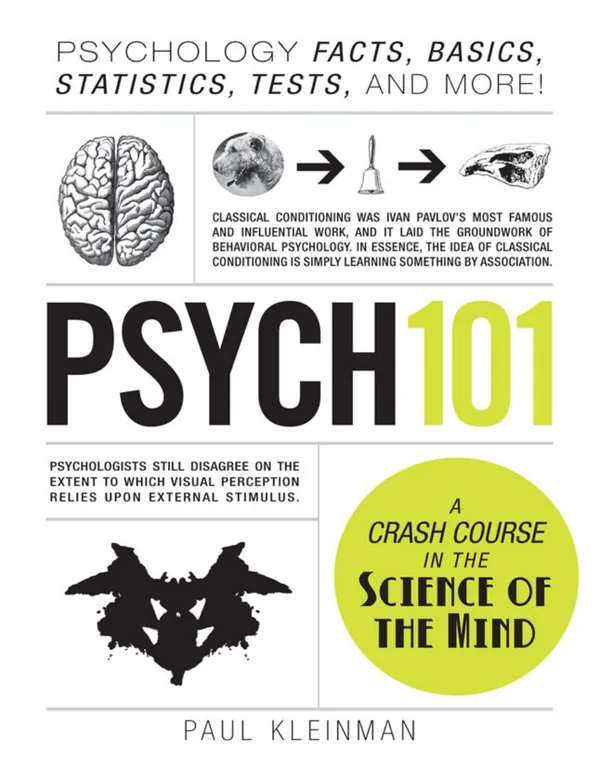
Psych 101 introduces psychology through short explanations of theories, research, experiments, and ways of measuring behavior. Paul Kleinman surveys biological, cognitive, developmental, social, and personality psychology alongside disorders and therapies. General readers and beginning students can use its focused chapters to become familiar with the field's principal questions and terminology.
Inside this title
Short chapters introducing psychological theories, history, and research
Current listed price $5.99Regular price $11.00Digital ebook
This Adams 101 introduction moves from the history of psychology and its major schools to the biological and mental processes involved in behavior. Brain structures, neurons, perception, memory, language, and decision-making appear alongside developmental theories and accounts of personality. Each short chapter focuses on a particular topic.
The social psychology material considers conformity, obedience, prejudice, and group behavior, while later discussions introduce psychological disorders and treatment approaches. Tests, statistics, and examples illustrate how psychologists investigate and describe experience. Readers can move through the book in sequence or consult individual subjects in shorter sessions. It is suited to curious beginners and students wanting an accessible orientation before more detailed psychology coursework.
Study guide included
Inside Psych 101: Psychology Facts, Basics, Statistics, Tests, and More!.
Psych 101 offers a tour of psychology in short, self-contained pieces. Kleinman moves from the field's history and schools through brain and behaviour, then into development, personality, social influence, disorder and treatment, so a curious reader can dip in anywhere without losing the thread.
The book's structure suits browsing. Chapters are brief and focused, which makes it easy to consult one topic in a spare moment or read straight through for orientation. Early material covers the discipline's history and major schools, giving later topics a frame. Biological foundations introduce neurons and brain structures, while cognitive chapters take up perception, memory, language and decision-making. Developmental theories and personality accounts explain how psychologists describe change and consistency across a life. Social psychology supplies conformity, obedience, prejudice and group behaviour, and the final stretch turns to disorders, therapies, tests and statistics. Examples and studies keep the prose concrete. It works as an accessible on-ramp for beginners and a quick refresher for students before deeper coursework.
History and the major schools
The book begins by tracing how psychology became a discipline and how its schools differed in what they studied and how. This historical frame gives later topics a place to sit. Instead of a list of names, the reader gets a sense of competing answers to the question of what psychology should be.
Psychology developed through competing schools
Each school framed its questions differently
History supplies context for later topics
Topic 1
Biological foundations of behaviour
Neurons and brain structures are introduced as the physical substrate of mental life. The material connects biology to behaviour without reducing one to the other. Readers see how the nervous system supports the processes discussed in later chapters.
Neurons underlie mental activity
Brain structures relate to functions
Biology frames later psychological topics
Topic 2
Perception, memory and cognition
Cognitive chapters cover how information is taken in, stored and used. Perception, memory, language and decision-making are treated as connected processes rather than separate curiosities. The result is a picture of the mind as active in constructing and retrieving experience.
Perception organizes incoming information
Memory stores and retrieves experience
Language and decision-making build on cognition
Topics 3–4
Development and personality
Developmental theories describe change across the lifespan, while personality accounts address consistency and individual difference. Placed together, they show psychology's two complementary questions: how people grow and how they remain recognizably themselves. The chapters survey major frameworks rather than argue for one.
Developmental theories describe change
Personality describes stable patterns
Both frameworks survey major approaches
Topics 5–6
Social psychology
Social chapters examine how people influence one another. Conformity, obedience, prejudice and group behaviour are presented as ordinary features of social life, supported by classic studies. The reader is invited to see social pressure as a normal context rather than an exotic exception.
Conformity and obedience show social influence
Prejudice reflects group processes
Classic studies anchor the discussion
Topic 7
Disorders, therapies, tests and statistics
The final material turns to psychological disorder and treatment, then to the tools psychologists use to measure and describe behaviour. Tests and statistics are introduced as ways of making claims accountable. This closes the tour by connecting ideas about mind to evidence and practice.
Disorders and therapies are introduced
Tests operationalize psychological concepts
Statistics make claims accountable
Topic 8
Topic map
History and Major SchoolsTopic 1
Biological Bases of BehaviorTopic 2
Sensation, Perception and MemoryTopic 3
Language and Decision-MakingTopic 4
Developmental TheoriesTopic 5
PersonalityTopic 6
Social Influence and Group BehaviorTopic 7
Disorders, Therapy, Tests and StatisticsTopic 8
Key takeaways
Short chapters make psychology approachable without flattening its major debates.
Biological, cognitive, developmental and social levels answer different questions.
Tests and statistics are how psychological claims become checkable.
Curious general readers and beginning students who want an accessible orientation to psychology before more detailed coursework.
Topics covered
Psych 101 Paul Kleinman
introductory psychology
psychology basics
psychological theories and experiments
cognitive and social psychology
personality and development
psychological disorders and therapy
psychology statistics
Questions about this ebook.
Edition, audience, and study-guide details at a glance.
What is Psych 101: Psychology Facts, Basics, Statistics, Tests, and More! about?
Psych 101 introduces psychology through short explanations of theories, research, experiments, and ways of measuring behavior. Paul Kleinman surveys biological, cognitive, developmental, social, and personality psychology alongside disorders and therapies. General readers and beginning students can use its focused chapters to become familiar with the field's principal questions and terminology.
Who is Psych 101: Psychology Facts, Basics, Statistics, Tests, and More! for?
Curious general readers and beginning students who want an accessible orientation to psychology before more detailed coursework.
Does this page include a study guide?
Yes. This page includes an original study guide with six thematic sections, key takeaways, and a topic map for structured reading.