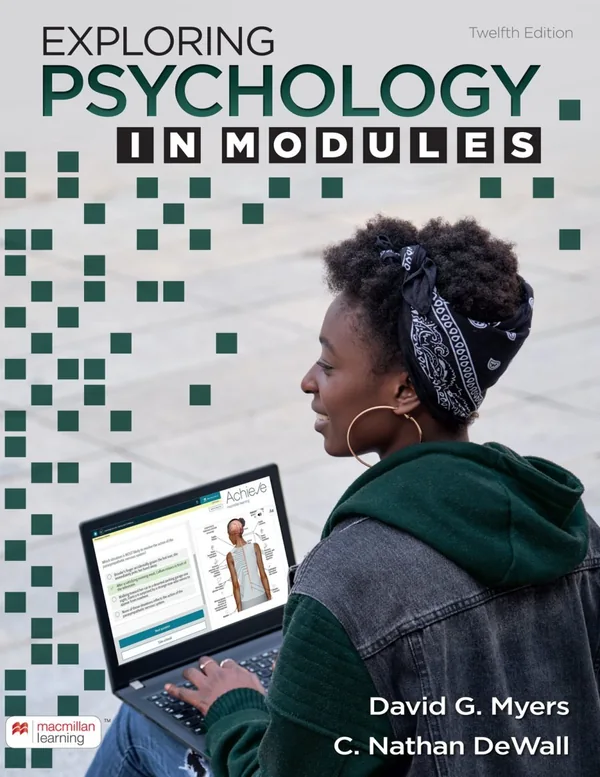
Exploring Psychology in Modules, Twelfth Edition surveys psychological science in focused units that can be assigned in different sequences. David G. Myers and C. Nathan DeWall introduce research methods, brain and behavior, learning, cognition, development, emotion, social influence, and psychological disorders, with retrieval practice and assessments for introductory students.
Inside this title
Focused modules covering the introductory psychological science curriculum
Current listed price $36.99Regular price $104.00Digital ebook
The modular format divides the introductory psychology survey into smaller topics, giving instructors flexibility in course order and students a defined focus for each reading. Scientific methods and the biological bases of behavior provide a starting point for studying perception, learning, memory, language, and decision-making.
The scope also includes development across the lifespan, motivation, emotion, stress, psychological disorders, and therapies. Research from neuroscience, cognitive psychology, and social psychology connects these areas with the study of human behavior. Learning objectives, retrieval questions, and formative assessment opportunities encourage readers to check their understanding as they progress. The book is suited to an introductory course that benefits from shorter, individually assignable units.
Study guide included
Inside Exploring Psychology in Modules, 12th Edition.
Myers and DeWall split the introductory psychology survey into short, individually assignable modules. Research methods and biology come first, then perception, learning, memory, language and decision-making, followed by lifespan development, motivation, emotion, stress, disorders, therapies and social influence, with retrieval questions closing each unit.
The modular structure is the organizing decision: each unit stands alone, so instructors can reorder the course and students get a defined target for one sitting. Content moves from scientific method and the biological bases of behavior into perception, learning, memory and cognition, then into development, motivation, emotion and stress. Disorders and therapies follow, and social influence closes the survey. Neuroscience, cognitive and social research are woven through rather than kept apart. Learning objectives and retrieval questions ask readers to test themselves as they go, which suits a first course built from shorter reading assignments.
Method before content
The opening modules treat psychology as an empirical discipline, asking how a claim was tested rather than simply reporting it. Study design, interpretation of evidence and the habits of critical reading arrive before the substantive chapters. Putting method first signals that every later finding is provisional and tied to the procedure that produced it.
Claims are judged by how they were tested
Study design limits what can be concluded
Critical reading is taught as a skill in itself
Topic 1
Biology and the construction of experience
Neural signaling, brain structure and the biological bases of behavior give the survey its physical footing. Perception then shows how sensory input is selected and organized rather than passively received. Pairing the two keeps the question of mechanism close to the question of experience.
Nervous system activity underlies behavior
Perception selects and organizes input
Mechanism and experience are studied together
Topics 2–3
Learning, memory and thought
Conditioning and other forms of learning, memory storage and retrieval, language and decision-making form a connected block about how information is acquired, held and used. The modules separate types of memory and learning, and they raise the biases that shape judgment.
Learning takes several distinct forms
Memory involves encoding, storage and retrieval
Judgment departs from strict rationality
Topics 3–4
Development, motivation and emotion
Lifespan development traces change from infancy through later life, while motivation and emotion address what directs and colors behavior. Read together, they connect growing capacities with the drives and feelings that accompany them at each stage.
Development continues across the lifespan
Motivation supplies direction to behavior
Emotion and development interact
Topic 5
Stress and psychological disorder
Stress is presented as a response with biological and psychological dimensions, and it leads into the classification of psychological disorders. The modules describe categories and symptoms while avoiding single-cause explanations for complex conditions.
Stress has bodily and psychological sides
Disorders are grouped by recognizable patterns
Symptoms rarely have one simple cause
Topic 6
Therapies and the social setting
Treatment approaches are surveyed alongside the disorders they address, and social influence shows how the presence of others alters judgment and action. Ending here returns the survey to the social context in which behavior actually occurs.
Therapies differ in aims and methods
Others shape judgment and compliance
Individual behavior is socially situated
Topics 7–8
Topic map
Research Methods and Scientific ThinkingTopic 1
Biological Bases of BehaviorTopic 2
Perception, Learning and MemoryTopic 3
Language, Thinking and Decision-MakingTopic 4
Development, Motivation and EmotionTopic 5
Stress and Psychological DisordersTopic 6
Therapies and TreatmentTopic 7
Social Influence and BehaviorTopic 8
Key takeaways
Use the module boundaries as study units; the design rewards short, self-contained sessions.
Treat method modules as prerequisites, since later findings depend on the designs introduced there.
Answer the retrieval questions before moving on to expose gaps early.
Students in an introductory psychology course, instructors who want assignable units, and general readers seeking a structured first survey of psychological science.
Topics covered
exploring psychology in modules
introductory psychology textbook
Myers and DeWall
research methods psychology
learning and memory
psychological disorders
social influence
retrieval practice
Questions about this ebook.
Edition, audience, and study-guide details at a glance.
What is Exploring Psychology in Modules, 12th Edition about?
Exploring Psychology in Modules, Twelfth Edition surveys psychological science in focused units that can be assigned in different sequences. David G. Myers and C. Nathan DeWall introduce research methods, brain and behavior, learning, cognition, development, emotion, social influence, and psychological disorders, with retrieval practice and assessments for introductory students.
Which edition of Exploring Psychology in Modules, 12th Edition is this?
This listing is for the 12th edition. Check the title, ISBN, and book details above before ordering, especially if your course or reading list names a specific edition.
Who is Exploring Psychology in Modules, 12th Edition for?
Students in an introductory psychology course, instructors who want assignable units, and general readers seeking a structured first survey of psychological science.
Does this page include a study guide?
Yes. This page includes an original study guide with six thematic sections, key takeaways, and a topic map for structured reading.