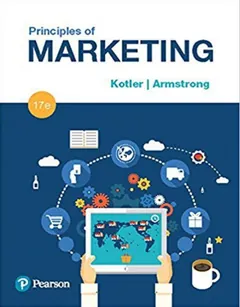
Principles of Marketing, seventeenth edition, introduces marketing through customer value, engagement, and relationship building. Kotler and Armstrong connect market analysis and segmentation with product, pricing, distribution, and communication decisions. Examples and cases make the text suitable for introductory business students, MBA learners, and readers seeking a structured marketing foundation.
Inside this title
Customer value, market segmentation, targeting, and positioning
Current listed price $42.99Regular price $96.00Digital ebook
The marketing process organizes the book's treatment of understanding markets, choosing audiences, designing strategies, and developing coordinated programs. Consumer behavior and segmentation provide a basis for positioning, while product and brand decisions connect to pricing, retailing, and distribution. The emphasis on customer relationships gives these topics a shared strategic context.
Digital engagement runs through the seventeenth edition's discussion of social media, mobile commerce, content, and customer relationship management. Cases and business examples show how traditional and digital communications fit within a marketing program. Students and managers can use the framework to examine how separate marketing decisions contribute to the value a business offers its customers.
Study guide included
Inside Principles of Marketing, 17th Edition.
Kotler and Armstrong build introductory marketing around one exchange: a chosen group's needs met by an offer whose value both sides keep capturing. Research, segmentation, positioning, the marketing mix, channels, and communication all serve that relationship, and the seventeenth edition extends the frame to digital contact, entry into foreign markets, and growth that stays responsible.
Six sections follow the arc of a marketing decision. The opening chapters define need, want, and demand, then contrast a single sale with lifetime customer value. Research and consumer or organizational buying behavior come next, followed by how a firm divides a market, picks a target, and settles its position, then the mix itself. Product design, service quality, brand signals, and price decisions precede channel design and integrated communication. The final section weighs competitors, international adaptation, and long-run effects on customers and society, with an appendix for assembling a full plan. Cases and examples anchor the ideas.
Needs, value and lasting relationships
The opening pair distinguishes a fundamental need from the culturally shaped want that expresses it, and notes that demand requires both the means and the readiness to pay. An offer bundles product, service, information, and experience, and buyers weigh expected benefit against cash, hours, and exertion. Satisfaction comes from comparing promise with delivery, and repeat purchase or customer share may reveal more than a single transaction total.
Separate need from the chosen want
Count cost in time and effort
Measure repeat custom, not one sale
Chs. 1–2
Decisions, evidence and real buyers
The immediate actors are suppliers, resellers, rivals, buyers, and public groups, while demographic, economic, technical, cultural, and political shifts change what options are worth. The book advises naming the decision first and ranking which uncertainty actually matters. Existing records should be read before new fieldwork, and observation, survey, experiment, and secondary data each settle a different question. Consumer and organizational buying follow different patterns.
State the decision before the research
Rank uncertainty by its cost
Check that samples match buyers
Chs. 3–6
Segments worth serving, positions worth holding
Consumers can be grouped by geography, demography, psychographics, or behavior, but a usable segment must be identifiable, reachable, large enough, internally distinct in response, and practical to serve. Size and growth are weighed with the strength of rivals and the company's own resources, and a narrow neglected group can fit better than the biggest one. Positioning then fixes the place an offer holds in a buyer's mind, supported by features, service, channel, people, and image.
Test whether a segment can be served
Let a small group beat a crowded one
Write the statement before the slogan
Ch. 7
Product design, brand and price logic
Design starts from the core benefit and adds features, styling, packaging, brand signals, and support that deliver it. Services bring variability and dependence on whoever provides them. Development passes through screening, concept testing, business review, build, and market testing before launch, and choices are revisited as a product moves from introduction to decline. Pricing can begin from perceived value, from cost and return, or from rival prices.
Build outward from the core benefit
Match price to promised quality
Revisit the mix at each life stage
Chs. 8–11
Channel design and coordinated communication
Intermediaries assemble assortments, supply information, and spare buyers the labor of locating and purchasing. Channel length and partners are chosen against service demands, expense, and control, since a cheaper route can still fail if it adds waiting or effort. Integrated communication aligns selling, advertising, public relations, promotion, and direct contact behind one recognizable promise. Web, social, and mobile contacts add response data that should be used with care.
Cost the buyer's effort, not yours
Give every contact the same story
Separate attention from action
Chs. 12–17
Rivals, foreign markets and durable claims
Competitive work starts from the rivals and replacement options a buyer actually considers, then compares goals, capabilities, strategy, and probable reaction. An edge lasts when a company consistently provides something important that rivals cannot easily copy. Entering another country means weighing local demand, institutions, culture, logistics, and exposure to risk, then judging how much to adapt. The final section asks how today's choices touch buyers, the company, and the wider society later on.
Study the substitute, not the label
Adapt only after local comparison
Verify a claim instead of naming it
Chs. 18–20
Chapter and section map
Customer value and engagementCh. 1, p. 26
Marketing information and insightsCh. 4, p. 122
Customer value-driven strategyCh. 7, p. 210
Pricing and customer valueCh. 10, p. 306
Marketing channelsCh. 12, p. 356
Integrated communicationCh. 14, p. 422
Sustainable marketingCh. 20, p. 596
Marketing planAppendix 1, p. 627
Key takeaways
Weigh expected benefits against the buyer's cash, hours, and exertion before writing a positioning statement.
Pick research that resolves the open decision, then confirm the evidence came from the buyers you intend to serve.
Judge a promise by repeat purchases and contribution, not by attention or a first sale.
Introductory business and MBA students, and practitioners new to marketing, who want a structured path from customer insight through the mix to competitive strategy, with cases and a plan appendix.
Topics covered
marketing principles
customer value
market segmentation
brand positioning
marketing mix
brand strategy
pricing strategy
integrated marketing communication
sustainable marketing
Questions about this ebook.
Edition, audience, and study-guide details at a glance.
What is Principles of Marketing, 17th Edition about?
Principles of Marketing, seventeenth edition, introduces marketing through customer value, engagement, and relationship building. Kotler and Armstrong connect market analysis and segmentation with product, pricing, distribution, and communication decisions. Examples and cases make the text suitable for introductory business students, MBA learners, and readers seeking a structured marketing foundation.
Which edition of Principles of Marketing, 17th Edition is this?
This listing is for the 17th edition. Check the title, ISBN, and book details above before ordering, especially if your course or reading list names a specific edition.
Who is Principles of Marketing, 17th Edition for?
Introductory business and MBA students, and practitioners new to marketing, who want a structured path from customer insight through the mix to competitive strategy, with cases and a plan appendix.
Does this page include a study guide?
Yes. This page includes an original study guide with six thematic sections, key takeaways, and a chapter and section map for structured reading.
Keep your curiosity going.
More books from this carefully grouped reading set.