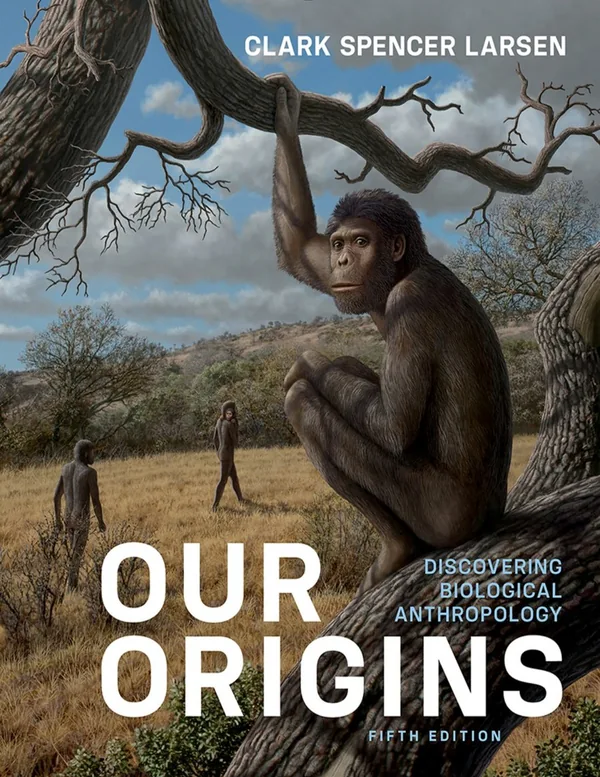
Our Origins introduces biological anthropology through human evolution, genetics, living primates, and the hominin fossil record. Clark Spencer Larsen's fifth edition connects these subjects with health, nutrition, forensics, and human diversity, giving introductory students a way to relate evidence about the evolutionary past to questions about people today.
Inside this title
Introduces human genetics, evolutionary mechanisms, and living primates
Current listed price $17.99Regular price $32.00Digital ebook
Evolutionary mechanisms and heredity establish the scientific foundation for this survey of human origins. Comparisons with living primates explore anatomy, locomotion, communication, and social systems, while fossil evidence supports investigation of bipedalism and the emergence of successive hominin groups. Archaeological material extends the narrative to tools and symbolic behavior.
The fifth edition incorporates ancient DNA perspectives and fossil discoveries such as Homo naledi. Applications to forensic anthropology, skeletal evidence of disease, and human variation show how the field extends beyond reconstructing ancestry. Illustrations, application boxes, and discussion questions invite interpretation of evidence. The book is intended for introductory anthropology students, including readers without previous coursework in anthropology or biology.
Larsen reads the human past through the biology and behavior of living people and other primates. Fossils, genes, anatomy and archaeology each supply different evidence, and the book asks how changing environments continue to shape human variation rather than treating evolution as a finished story.
Evolutionary theory and the methods of biological anthropology come first. Genetics and population processes explain how variation arises and shifts, while studies of living humans and primates give that variation context. Fossil chapters trace primate origins, early hominins and modern humans. Closing chapters connect food production, health and future change using the same habit of comparing independent lines of evidence. Throughout, the reader is asked to separate an observation from the explanation offered for it. That habit makes the book less a catalogue of ancestors than an argument about inference.
Framing testable evolutionary questions
Scientific reasoning begins with questions that evidence can check. An observation such as altered skeletal shape needs an explanation that predicts other findings, so competing accounts are compared by the patterns each implies. A locomotion hypothesis, for example, may predict relationships among several bones plus trace evidence such as footprints. Darwin's account of selection and later genetics show how inherited variation changes frequency, which is distinct from an individual's growth or adjustment.
Separate observation from explanation
Ask what each account predicts
Keep inheritance apart from adjustment
Chs. 1–2, Biological Anthropology and Evolution
Inheritance and human variation
Mutation creates variants, recombination rearranges them, gene flow moves them between groups, drift changes frequency by chance, especially in small populations, and selection depends on survival or reproduction under particular conditions. The same pattern can have several causes, so demographic and environmental evidence helps discriminate. The sickle-cell case shows consequences depending on genotype and malaria exposure, and skin pigmentation varies with environment and history; visible traits do not divide people into discrete biological races.
Weigh drift against selection
Use demography to narrow causes
Describe variation at the supported scale
Chs. 3–5, Genetics, Population Genetics and Living People
Primate anatomy and social life
Living primates differ in teeth, limbs, movement and habitat use, and comparing those features reveals how structure supports activity. Analyze several traits together, because similar features can evolve under similar pressures in separate lineages, and the strongest comparison explains why a combination matters in a given environment. Sociality chapters examine communication, organization, cooperation and learning; living species generate hypotheses, but each has its own history and must be checked against fossil and archaeological evidence.
Read several traits as a set
Explain why the combination works
Treat living species as models to test
Chs. 6–7, The Other Living Primates and Primate Sociality
Fossils require context and dating
Fossils preserve a selective record, so geological relationships establish sequence while dating methods estimate age when material and context permit. Ask whether the object and dated sample truly belong together. Preservation and recovery also bias which animals or body parts appear, making an absence hard to interpret. Early primate and hominin chapters combine teeth, limbs, locomotion and environment, and bipedalism is one question among several: a fossil may mix traits linked to different activities.
Check association of dated material
Expect bias from preservation and recovery
Handle mosaic traits carefully
Chs. 8–10, Fossils, Primate Origins and Early Hominins
Early Homo and modern dispersal
Larsen reviews early Homo and the spread of Homo erectus, comparing body form, brain size, tools and habitat, while later finds complicate any simple replacement sequence. Interpretation depends on specimen dates and associations as much as anatomy, and a tool near a fossil adds context without naming its maker. Modern origins require fossils, artifacts and ancient DNA together: Neandertal and Denisovan evidence shows dispersal involved contact as well as expansion.
Read variation within early Homo
Attach tools cautiously to makers
Combine genomes, fossils and archaeology
Chs. 11–12, Early Homo and Modern People
Agriculture and future change
Food production altered diet, activity, settlement and population size. Dental and skeletal evidence can reveal shifts in disease exposure, workload or nutritional stress, and larger settlements with higher fertility can expand populations even while some individual health measures worsen. Evaluate what each measure captures before calling the transition beneficial or harmful. Future projections stay conditional: cultural change alters exposure, but a current trend alone does not establish an evolutionary outcome.
Separate diet change from population growth
Ask what each measure captures
Keep future forecasts conditional
Chs. 13–14, Agriculture, Population and Future Evolution
Chapter and section map
What Is Biological Anthropology?p. 3
Evolution: Constructing a Fundamental Scientific Theoryp. 27
Genes and Their Evolution: Population Geneticsp. 91
The Other Living Primatesp. 167
Fossils and Their Place in Time and Naturep. 235
Early Hominin Origins and Evolutionp. 311
The Origins, Evolution, and Dispersal of Modern Peoplep. 395
Our Past 10,000 Years: Agriculture, Population, Biologyp. 451
Key takeaways
Ask what evidence would distinguish inherited change from development, learning or short-term adjustment.
Use living primates to frame comparisons, and require several fossil traits before inferring behavior.
Assess diet, disease, workload and population separately before judging what agriculture changed.
Introductory biological anthropology and human evolution students, plus general readers who want a method for weighing fossils, genes and primate comparisons as a single interpretive problem.
Topics covered
biological anthropology
human evolution
population genetics
living primates
hominin fossils
bipedal locomotion
modern human origins
early agriculture
human variation
Questions about this ebook.
Edition, audience, and study-guide details at a glance.
What is Our Origins: Discovering Biological Anthropology, 5th Edition about?
Our Origins introduces biological anthropology through human evolution, genetics, living primates, and the hominin fossil record. Clark Spencer Larsen's fifth edition connects these subjects with health, nutrition, forensics, and human diversity, giving introductory students a way to relate evidence about the evolutionary past to questions about people today.
Which edition of Our Origins: Discovering Biological Anthropology, 5th Edition is this?
This listing is for the 5th edition. Check the title, ISBN, and book details above before ordering, especially if your course or reading list names a specific edition.
Who is Our Origins: Discovering Biological Anthropology, 5th Edition for?
Introductory biological anthropology and human evolution students, plus general readers who want a method for weighing fossils, genes and primate comparisons as a single interpretive problem.
Does this page include a study guide?
Yes. This page includes an original study guide with six thematic sections, key takeaways, and a chapter and section map for structured reading.