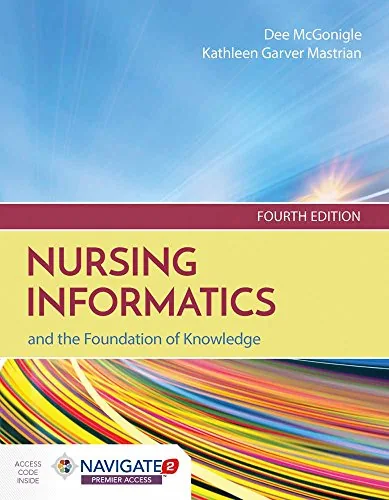
Nursing Informatics and the Foundation of Knowledge, 4th Edition, examines how nurses acquire, process, generate, and share knowledge through information technology. Dee McGonigle and Kathleen Mastrian connect their conceptual model with electronic records, analytics, systems development, and information ethics. The text addresses nursing students and professionals in practice, education, administration, and research.
Inside this title
Organizes nursing informatics around the Foundation of Knowledge model
Current listed price $30.99Regular price $71.00Digital ebook
The Foundation of Knowledge model supplies the organizing idea for this examination of nursing informatics. Data, information, knowledge, and wisdom are considered in relation to clinical decisions and professional responsibilities. Electronic health records and standardized nursing terminologies illustrate how information is represented and exchanged across healthcare systems.
The fourth edition also discusses data mining, the system development life cycle, telehealth, and consumer informatics. Planning and implementing technology are considered alongside privacy, security, and confidentiality. These topics allow readers to study informatics as both a technical activity and a part of nursing work. Students and practicing nurses can use the material to connect information systems with education, administration, research, and patient care processes.
Study guide included
Inside Nursing Informatics and the Foundation of Knowledge (4th Edition).
McGonigle and Mastrian build their nursing informatics text around one question: how do nurses turn raw data into usable knowledge? The fourth edition follows that model through electronic records, analytics, system planning, telehealth, and ethics, placing technology inside ordinary clinical, educational, administrative, and research work.
The Foundation of Knowledge model is the spine of the book. Data, information, knowledge, and wisdom are treated as stages nurses move through when making decisions, not as abstract categories. From there the text examines how clinical information is captured in electronic health records, coded with standardized nursing terminologies, and exchanged between systems. Later sections turn to data mining, the system development life cycle, telehealth, and consumer-facing tools. Privacy, security, confidentiality, and information ethics are handled alongside technical topics, keeping the discussion anchored in professional responsibility. The fourth edition addresses students and working nurses across practice, education, administration, and research, and each chapter ties informatics back to one of those settings.
The Foundation of Knowledge model
The model is the book's organizing device, tracing a path from unprocessed data through information and knowledge toward wisdom. Each stage is defined by what a nurse can do with it, so the framework stays practical rather than purely conceptual. Clinical judgment sits at the end of the sequence, where organized knowledge informs a decision.
Data becomes information when it is organized and given context
Knowledge connects information to understanding and experience
Wisdom applies knowledge to a specific clinical situation
Topics 1–2
Electronic records and standardized terminology
Documentation and vocabulary are treated together because a record is only useful if its contents can be understood consistently. The text looks at how nursing care is represented in electronic health records and why standardized terminologies matter for exchange. The emphasis falls on accurate capture and shared meaning across systems.
Electronic records store and retrieve clinical documentation
Standardized terminologies give nursing data consistent meaning
Shared vocabulary supports exchange between care settings
Topic 3
Data mining and clinical analytics
Analytics is presented as a way to find patterns in accumulated clinical information. Data mining techniques are discussed as tools for turning large stores of records into observations that can inform practice. The treatment keeps the clinical purpose in view rather than focusing on algorithms alone.
Large datasets can reveal patterns not visible in single cases
Mined findings can support clinical and administrative decisions
Analysis depends on well-structured, reliable data
Topic 4
Systems development and technology implementation
The system development life cycle is described as the structured path from identifying a need to deploying and maintaining a technology. Planning and implementation are treated as organizational activities involving users, requirements, and testing. The chapter ties the technical sequence to the realities of a healthcare setting.
Needs assessment precedes system design
Implementation involves users, testing, and transition
Maintenance continues after a system goes live
Topic 5
Telehealth and consumer informatics
Remote care and patient-facing tools extend informatics beyond the walls of a health system. The book considers telehealth as a mode of service delivery and consumer informatics as technology used by patients and families. Both raise questions about access, information quality, and the nurse's role.
Telehealth delivers care at a distance
Consumer tools put information in patients' hands
Remote and patient-facing technology changes nursing workflows
Topic 6
Privacy, security, and information ethics
Confidentiality and ethics are treated as inseparable from information systems. The text examines how privacy and security obligations shape the design and use of records, and how professional values guide decisions about data. These concerns run through the technical material rather than appearing as an afterthought.
Privacy protections govern how patient data is handled
Security measures guard records against unauthorized access
Ethical judgment guides data use in clinical settings
Topics 3, 7
Topic map
The Foundation of Knowledge ModelTopic 1
Data, Information, Knowledge and Wisdom in PracticeTopic 2
Electronic Health Records and Standardized TerminologiesTopic 3
Data Mining and Clinical AnalyticsTopic 4
System Development Life Cycle and ImplementationTopic 5
Telehealth and Consumer InformaticsTopic 6
Privacy, Security, and Information EthicsTopic 7
Key takeaways
The knowledge model gives informatics a purpose: better decisions, not just better systems.
Records and terminologies are only as useful as the shared meaning behind them.
Ethics and security belong in the design conversation, not after deployment.
Nursing students and practicing nurses in clinical, educational, administrative, and research roles, plus informatics specialists who want a model-driven introduction to the field.
Topics covered
nursing informatics
Foundation of Knowledge model
electronic health records
standardized nursing terminologies
clinical data analytics
system development life cycle
telehealth
information ethics
Questions about this ebook.
Edition, audience, and study-guide details at a glance.
What is Nursing Informatics and the Foundation of Knowledge (4th Edition) about?
Nursing Informatics and the Foundation of Knowledge, 4th Edition, examines how nurses acquire, process, generate, and share knowledge through information technology. Dee McGonigle and Kathleen Mastrian connect their conceptual model with electronic records, analytics, systems development, and information ethics. The text addresses nursing students and professionals in practice, education, administration, and research.
Which edition of Nursing Informatics and the Foundation of Knowledge (4th Edition) is this?
This listing is for the 4th edition. Check the title, ISBN, and book details above before ordering, especially if your course or reading list names a specific edition.
Who is Nursing Informatics and the Foundation of Knowledge (4th Edition) for?
Nursing students and practicing nurses in clinical, educational, administrative, and research roles, plus informatics specialists who want a model-driven introduction to the field.
Does this page include a study guide?
Yes. This page includes an original study guide with six thematic sections, key takeaways, and a topic map for structured reading.