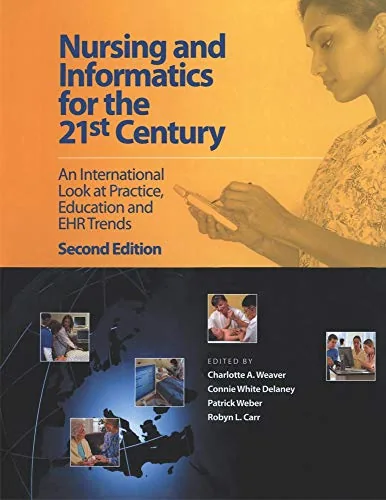
Nursing and Informatics for the 21st Century (2nd Edition)
Edited by Charlotte A. Weaver, Connie White Delaney, Patrick Weber, Robyn L. Carr
About this ebook
Nursing and Informatics for the 21st Century, 2nd Edition, examines nursing technology through international case studies of practice, education, and electronic health records. Edited by Weaver, Delaney, Weber, and Carr, the collection explores implementation experiences and organizational lessons. It suits nursing informatics students, nurse educators, healthcare leaders, and professionals studying health information projects.
Inside this title
International cases examine nursing practice, education, and electronic records
Current listed price $32.99Regular price $82.00Digital ebook
International contributions show how informatics initiatives develop within hospitals, educational programs, and national health systems. Cases describe their settings, approaches, results, and lessons, providing material for comparing implementation choices rather than treating technology adoption as a uniform process. Nursing workflow and leadership are recurring concerns.
The second edition brings together discussions of electronic records, educational competencies, patient engagement, interoperability, and clinical decision support. Differences among countries offer a context for considering institutional priorities and the people involved in change. Nurse educators can examine curriculum approaches, while informaticians and healthcare administrators can study the organizational questions surrounding information systems. The collection presents these experiences within the historical context of its edition.
Study guide included
Inside Nursing and Informatics for the 21st Century (2nd Edition).
Weaver, Delaney, Weber, and Carr gather international accounts of nursing informatics in action. Rather than prescribing one path, the collection compares how hospitals, schools, and national systems introduced technology, what they learned, and how nurses led or adapted to the change.
The second edition is built from cases rather than a single argument. Contributors describe informatics projects in different countries and settings, reporting the context, the approach taken, the results, and the lessons drawn. That structure invites comparison: the same technology can succeed or stall depending on workflow, leadership, and institutional priorities. Recurring subjects include electronic health records, interoperability, clinical decision support, patient engagement, and the competencies nurses need. Education receives separate attention, with discussion of curriculum redesign and how informatics is taught. Because the cases are rooted in their own health systems, the book suits readers who want to understand implementation as a situated, human process rather than a uniform technical rollout.
International cases as a method
The book teaches through examples drawn from several countries. Each case reports its setting, approach, results, and lessons, so readers can compare rather than generalize. The method treats implementation as context-dependent and asks what transfers between systems.
Cases come from multiple countries and settings
Each reports context, approach, results, and lessons
Comparison replaces one-size-fits-all conclusions
Topic 1
Electronic records in practice
Electronic health records appear across the cases as both a goal and a source of difficulty. Contributors describe how records changed documentation and access to information, and what that meant for nurses. The accounts keep clinical workflow in view rather than treating the record as a neutral container.
Records alter documentation and access
Nurses' workflows shape adoption
Implementation reveals organizational priorities
Topic 2
Nursing workflow and leadership
Workflow and leadership are recurring concerns. Informatics projects succeed when they fit how nurses actually work and when nurses have a voice in decisions. The cases show leadership operating through design choices, training, and sustained involvement.
Technology must fit real nursing workflows
Nurse involvement influences outcomes
Leadership appears in design and training decisions
Topic 3
Competencies and curriculum redesign
Education is treated as part of the informatics story. Contributors discuss which competencies nurses need and how programs revised their curricula to teach them. The focus falls on preparing practitioners who can use information systems thoughtfully, not just operate them.
Informatics competencies are identified for practice
Curricula are revised to include them
Preparation goes beyond tool operation
Topic 4
Patient engagement and decision support
Several cases address tools that reach patients or support clinical choices. Patient engagement and clinical decision support raise questions about information quality, usability, and the division of responsibility. The book presents these as design and workflow issues as much as technical ones.
Patient-facing tools change the care relationship
Decision support must fit clinical reasoning
Usability affects whether tools are trusted
Topics 5–6
Implementation lessons and organizational change
The collection closes around what organizations learn when they adopt technology. Interoperability, priorities, and the people involved determine whether a project takes hold. The recurring lesson is that change is organizational and gradual, not purely a matter of installing systems.
Interoperability depends on coordination across systems
Institutional priorities shape adoption
People and process determine lasting change
Topic 7
Topic map
International Cases and Their SettingsTopic 1
Electronic Health Records in PracticeTopic 2
Nursing Workflow and LeadershipTopic 3
Informatics Competencies and Curriculum RedesignTopic 4
Patient Engagement and Clinical Decision SupportTopic 5
Interoperability Across SystemsTopic 6
Implementation Lessons and Organizational ChangeTopic 7
Key takeaways
The same system can produce different results in different settings.
Nurses' workflow and voice are central to whether informatics projects hold.
Read the cases as comparisons; the value lies in the contrasts, not a single recipe.
Nursing informatics students, nurse educators, healthcare leaders, and professionals involved in health information projects who want international, experience-based perspectives.
Topics covered
nursing informatics
international case studies
electronic health records
nursing workflow
informatics competencies
curriculum redesign
interoperability
clinical decision support
Questions about this ebook.
Edition, audience, and study-guide details at a glance.
What is Nursing and Informatics for the 21st Century (2nd Edition) about?
Nursing and Informatics for the 21st Century, 2nd Edition, examines nursing technology through international case studies of practice, education, and electronic health records. Edited by Weaver, Delaney, Weber, and Carr, the collection explores implementation experiences and organizational lessons. It suits nursing informatics students, nurse educators, healthcare leaders, and professionals studying health information projects.
Which edition of Nursing and Informatics for the 21st Century (2nd Edition) is this?
This listing is for the 2nd edition. Check the title, ISBN, and book details above before ordering, especially if your course or reading list names a specific edition.
Who is Nursing and Informatics for the 21st Century (2nd Edition) for?
Nursing informatics students, nurse educators, healthcare leaders, and professionals involved in health information projects who want international, experience-based perspectives.
Does this page include a study guide?
Yes. This page includes an original study guide with six thematic sections, key takeaways, and a topic map for structured reading.