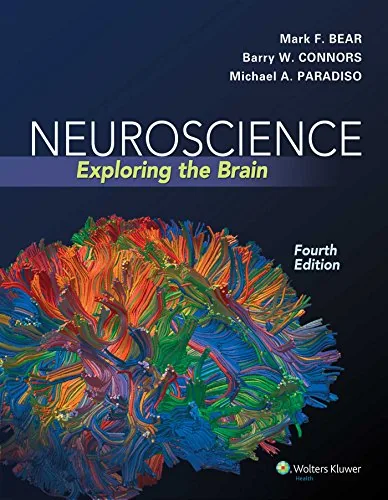
By Mark F. Bear, Barry W. Connors, Michael A. Paradiso
About this ebook
Neuroscience: Exploring the Brain, fourth edition, introduces nervous system structure and function for neuroscience, psychology, biology, and medical students. Bear, Connors, and Paradiso connect neurons and synapses with sensory processing, movement, regulation, and cognition, using illustrations and clinical examples to relate cellular mechanisms to brain activity and behavior.
Inside this title
Neurons, glia, action potentials, and synaptic communication mechanisms
Current listed price $9.99Regular price $18.00Digital ebook
Beginning with neurons, glia, action potentials, and synaptic communication, this textbook develops an explanation of how nervous tissue supports coordinated function. Sensory pathways and motor systems extend the discussion from individual cells to networks that interpret information and control movement.
Sleep, wakefulness, emotion, motivation, learning, and memory bring behavioral questions into the same framework. Neural development and plasticity help explain how circuits change, while examples of neurological and psychiatric disorders illustrate the consequences of disrupted function. Figures, review questions, and clinical applications support an introductory neuroscience course. The fourth edition also gives students from related disciplines a structured foundation for more specialized brain and behavior study.
Study guide included
Inside Neuroscience: Exploring the Brain, 4th Edition.
Bear, Connors and Paradiso link sensation, movement, behavior and memory to events in cells and circuits. The text moves from electrical and chemical signaling to specialized systems, then explains how development and experience reshape the connections that support what an organism does.
The authors begin with neurons, glia, membranes and synapses, then connect those mechanisms to nervous system anatomy. Sensory chapters trace signals from receptors to brain representations, while motor chapters link spinal circuits to coordinated action. Later chapters examine regulation, motivation, sleep, language and mental illness. The final part returns to cellular mechanisms through development, memory systems and synaptic plasticity. Clinical cases appear beside the physiology, showing how a lesion or disorder can isolate one contribution from a larger system. Each level constrains the next.
Electrical signals and chemical synapses
Neurons have regions for receiving, integrating and transmitting signals, and glia maintain the environment and support rapid conduction through myelin. Ion gradients and selective permeability set the resting potential, and a sufficient voltage change opens channels in sequence to trigger an action potential. At synapses, calcium entry releases transmitter, and receptors on the receiving cell decide the effect.
Follow voltage from dendrite to axon
Relate transmitter to receptor type
Weigh input timing and location
Chs. 2–6 · Neurons, Membranes, and Synapses
How sensory systems encode the world
Smell and taste begin with chemistry, vision with light, hearing with mechanical movement, and each receptor converts particular features into a cellular response. Processing starts before cortex: retinal circuits, for instance, emphasize local contrast and split information into parallel channels. Receptive fields describe where a stimulus changes a cell's activity, and convergence builds selectivity.
Compare what each receptor detects
Trace parallel channels through pathways
Read single responses within the pathway
Chs. 8–12 · Sensory Systems
Spinal circuits and coordinated movement
Motor neurons activate muscle fibers, and motor units differ in their contribution to force. Sensory input from muscle and tissue enters spinal circuits, where stretch reflexes show feedback and withdrawal responses recruit interneurons and coordinated muscles. Descending pathways add posture, orienting and voluntary control, while basal ganglia and cerebellum contribute selection, coordination and learning.
Start with the circuit near the muscle
Add descending control and feedback
Avoid assigning movement to one region
Chs. 13–14 · Spinal and Brain Control of Movement
Regulation, motivation and behavioral state
The hypothalamus coordinates internal conditions through endocrine, autonomic and behavioral routes, while diffuse modulatory systems project widely and change how circuits respond. Motivation joins physiological need and learned expectation, and hormones plus circuits interact with context rather than controlling behavior alone. Sleep and waking alter which signals are prioritized.
Distinguish local from diffuse modulation
Relate behavior to interacting systems
Treat state as a filter on signal
Chs. 15–19 · Chemical Control, Motivation, Emotion, and Sleep
What evidence shows about higher function
Language often depends more on the left hemisphere, though the pattern varies by task and person. Injury and split-brain studies reveal which pathways contribute and what changes when hemispheres cannot communicate, but the task must be specified. Attention shifts processing, and mental illness joins circuits, biology and behavior, so one symptom or image does not establish a mechanism.
Specify the task when reading lateralization
Compare evidence across scales
Demand convergence before causal claims
Chs. 20–22 · Language, Attention, Consciousness, and Mental Illness
Development and the mechanisms of memory
Neural development involves differentiation, migration and guidance of growing processes, with molecular signals laying routes and activity refining connections. Experience can be especially powerful while a circuit is still forming. Different kinds of learning rely on partly different circuits, and synaptic strengthening or weakening offers a plausible storage mechanism, though behavior also depends on encoding and retrieval.
Separate wiring from activity refinement
Keep memory systems distinct
Distinguish system from synapse evidence
Chs. 23–25 · Wiring, Memory Systems, and Synaptic Change
Chapter and section map
Neurons and GliaPDF p. 66
Synaptic TransmissionPDF p. 152
Sensory and Motor SystemsPDF p. 306
Spinal Control of MovementPDF p. 496
Chemical Control of the Brain and BehaviorPDF p. 564
LanguagePDF p. 728
The Changing BrainPDF p. 824
Molecular Mechanisms of Learning and MemoryPDF p. 908
Key takeaways
Trace information from receptor or synapse through a circuit before explaining a behavior.
Design experimental tasks that distinguish perception, verbal report and motor response within the same study.
Keep evidence for a memory system separate from evidence for a cellular plasticity mechanism.
Neuroscience, psychology, biology and medical students who want a systems-level introduction connecting cellular mechanisms to sensation, movement, regulation, cognition and memory across species and levels of analysis.
Topics covered
systems neuroscience
synaptic transmission
sensory systems
motor control
synaptic plasticity
memory systems
neural development
brain function
Questions about this ebook.
Edition, audience, and study-guide details at a glance.
What is Neuroscience: Exploring the Brain, 4th Edition about?
Neuroscience: Exploring the Brain, fourth edition, introduces nervous system structure and function for neuroscience, psychology, biology, and medical students. Bear, Connors, and Paradiso connect neurons and synapses with sensory processing, movement, regulation, and cognition, using illustrations and clinical examples to relate cellular mechanisms to brain activity and behavior.
Which edition of Neuroscience: Exploring the Brain, 4th Edition is this?
This listing is for the 4th edition. Check the title, ISBN, and book details above before ordering, especially if your course or reading list names a specific edition.
Who is Neuroscience: Exploring the Brain, 4th Edition for?
Neuroscience, psychology, biology and medical students who want a systems-level introduction connecting cellular mechanisms to sensation, movement, regulation, cognition and memory across species and levels of analysis.
Does this page include a study guide?
Yes. This page includes an original study guide with six thematic sections, key takeaways, and a chapter and section map for structured reading.