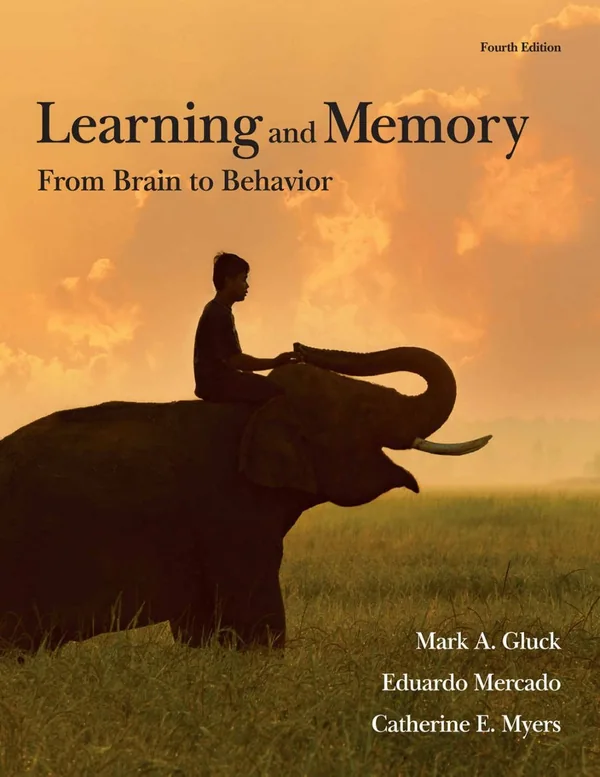
Learning and Memory: From Brain to Behavior, 4th Edition
By Mark A. Gluck, Eduardo Mercado, Catherine E. Myers
About this ebook
Learning and Memory: From Brain to Behavior, fourth edition, examines how experience changes behavior through brain systems and cellular mechanisms. Written for psychology and neuroscience students, it brings cognitive research together with conditioning, spatial memory, emotional learning, synaptic plasticity, and clinical examples involving disrupted memory.
Inside this title
Behavioral and cognitive accounts linked to neural memory systems
Current listed price $19.99Regular price $40.00Digital ebook
How does a learned association become a lasting memory? Gluck, Mercado, and Myers approach that question across behavioral, cognitive, neural, and molecular levels. Their account relates observable learning to the brain circuits and synaptic changes that support it, rather than treating these areas as separate subjects.
Topics include classical conditioning, hippocampal contributions to spatial and episodic memory, basal ganglia function, and emotional learning. Sleep, consolidation, reconsolidation, and long-term synaptic changes extend the explanation of memory storage. Discussions of amnesia, Alzheimer's disease, and PTSD connect experimental concepts with clinical questions. The fourth edition supports dedicated undergraduate learning and memory courses and related graduate review.
Study guide included
Inside Learning and Memory: From Brain to Behavior, 4th Edition.
Gluck, Mercado and Myers explain how experience changes behavior, pairing experiments into learning and memory with the neural systems which support them. They separate several kinds of experience-dependent change and show that each needs an appropriate task, measure and explanation.
Opening chapters tie psychological theory with neuroscience methods. A learning module travels from repeated events toward prediction, consequences and categories. A memory module distinguishes episodic from semantic memory, skill from working memory, and then considers emotion, observation and lifespan change. Case studies and experiments recur, asking readers to link a measured effect with plausible cognitive and neural mechanisms while staying alert to fatigue, strategy or task differences that could mimic learning. A closing module extends the analysis to emotion, social observation and age.
Connecting behavior with brain evidence
Association, consequence and cognitive representation can each explain superficially similar behavior, so an experiment gains power when the result is defined precisely, researchers may measure response frequency, accuracy, speed or transfer, then design a comparison that rules out fatigue, motivation or a changed opportunity to respond. The neuroscience chapter adds neurons, synapses, lesions, imaging and cellular work; a brain pattern says where a task engages a system, while damage and plasticity add complementary evidence.
Define the effect to explain
Connect methods without conflating them
Seek agreement across levels
Chs. 1–2
Learning from repeated exposure
Habituation is a reduced response after repeated presentation, whereas sensitization is heightened responsiveness following a salient event. Tiredness or sensory adaptation can mimic either, so reading depends on controls such as another stimulus or a delay. Aplysia offers a simple system in which withdrawal behavior can be compared with changes at identified connections. Perceptual learning and familiarity also change with exposure, though they require different performance measures.
Separate weaker response from weaker ability
Use simple systems to test mechanisms
Compare responses across stimuli and delays
Ch. 3
Prediction, cues and consequences
Classical conditioning asks which cue predicts an outcome, and timing and predictiveness decide how much is learned. Prediction-error accounts explain why unexpected outcomes teach more than well-predicted ones, while extinction alters the observed response without necessarily erasing what was learned. Operant conditioning asks what an action produces: reinforcement raises the behavior it precedes, punishment lowers it, and adding versus removing an event is a separate question. Generalization and discrimination mark how far a response travels.
Identify which event predicts another
Ask what the action produces
Distinguish added from removed events
Chs. 4–6
Event memory and factual knowledge
Episodic memory carries a lived event, its context; semantic memory supplies facts and concepts without the occasion of learning. A memory test should state whether it asks for recognition, factual knowledge, recall or contextual detail, because each places different demands on encoding and retrieval. Patient H.M. showed severe difficulty forming new conscious memories after medial temporal surgery, yet improved on some skills, a contrast that helps explain why memory can break apart selectively.
Describe what a person remembers
Use dissociations to examine systems
Measure recollection and skill separately
Ch. 7
Skills and working memory
Skill memory appears as greater accuracy or fluency performance, and practice effects may depend on the conditions of training. A transfer task asks whether learning carries to a new version or setting. Basal ganglia and cerebellum contribute in ways that vary by task. Working memory holds and manipulates a limited amount of information, while cognitive control keeps goals active, suppresses irrelevant responses and updates as demands change, with prefrontal systems implicated.
Study skills across practice and transfer
Examine what cognitive control does
Separate movement learning from instruction recall
Chs. 8–9
Emotion, observation and age
Arousal and emotional weight shape attention and subsequent memory without turning recollection a faithful record. Social learning can occur through observation, interaction or shifted attention to an object, and showing imitation requires evidence that an observer learned the form of an action rather than merely approaching the same place or tool. Across the lifespan, experience and neural development alter strategies, recall and control, so age differences on a test can reflect several processes.
Interpret emotion and social learning carefully
Compare development and aging through tasks
Do not treat age as one cause
Chs. 10–12
Chapter and section map
Fundamental Themes in the Psychology of Learning and MemoryCh. 1
The Neuroscience of Learning and MemoryCh. 2
Habituation, Sensitization and FamiliarizationCh. 3
Classical ConditioningCh. 4
Operant ConditioningCh. 5
Episodic Memory and Semantic MemoryCh. 7
Working Memory and Cognitive ControlCh. 9
Integrative Topics ModuleChs. 10–12
Key takeaways
Pick a performance metric that separates the learning process one want to explain.
Use both recollection and skill tests when probing selective memory effects.
Compare cue value and the effects of actions before giving any conditioning label.
Psychology and neuroscience students studying learning, memory and their neural bases, plus readers who want the experimental reasoning behind the claims. Case studies make it useful for course review.
Topics covered
learning and memory
classical conditioning
operant conditioning
episodic memory
working memory
synaptic plasticity
skill learning
memory across lifespan
Questions about this ebook.
Edition, audience, and study-guide details at a glance.
What is Learning and Memory: From Brain to Behavior, 4th Edition about?
Learning and Memory: From Brain to Behavior, fourth edition, examines how experience changes behavior through brain systems and cellular mechanisms. Written for psychology and neuroscience students, it brings cognitive research together with conditioning, spatial memory, emotional learning, synaptic plasticity, and clinical examples involving disrupted memory.
Which edition of Learning and Memory: From Brain to Behavior, 4th Edition is this?
This listing is for the 4th edition. Check the title, ISBN, and book details above before ordering, especially if your course or reading list names a specific edition.
Who is Learning and Memory: From Brain to Behavior, 4th Edition for?
Psychology and neuroscience students studying learning, memory and their neural bases, plus readers who want the experimental reasoning behind the claims. Case studies make it useful for course review.
Does this page include a study guide?
Yes. This page includes an original study guide with six thematic sections, key takeaways, and a chapter and section map for structured reading.