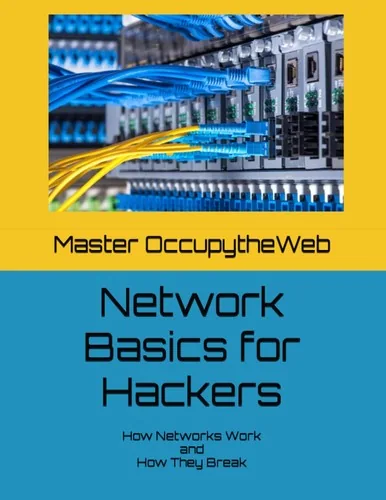
Network Basics for Hackers explains network communication through the perspective of security assessment. Occupytheweb introduces TCP/IP, UDP, subnetting, and the OSI model, then uses Linux tools and packet analysis to examine protocol weaknesses. The book is intended for beginning and intermediate cybersecurity learners building networking knowledge.
Inside this title
TCP/IP, UDP, subnetting, and OSI model foundations
Current listed price $8.00Regular price $13.00Digital ebook
The book begins with the structure of networks and the rules devices use to exchange information. TCP/IP, addressing, subnetting, and the OSI model establish a vocabulary for understanding traffic before practical exercises introduce observation with Wireshark and tcpdump. Packet capture and filtering connect protocol descriptions with visible network behavior.
Later discussions examine weaknesses involving ARP, DNS, DHCP, and routing. Attack scenarios are used to show how assumptions within network protocols can affect security, with defensive considerations accompanying the analysis. Linux-based exercises provide the learning approach throughout. Readers studying penetration testing or network defense can use the material to connect foundational networking concepts with security assessment in authorized environments.
Study guide included
Inside Network Basics for Hackers: How Networks Work and How to Break Them.
Occupytheweb teaches networking through the eyes of an assessor: learn how traffic moves, then examine where protocol assumptions create openings. TCP/IP, subnetting, packet capture, and Linux tooling form the practical base for security study in authorized environments, written for beginning and intermediate learners.
The book starts with how networks are structured and the rules devices use to exchange information. TCP/IP, addressing, subnetting, and the OSI model establish vocabulary before practical work introduces observation with Wireshark and tcpdump. Packet capture and filtering connect protocol descriptions to visible traffic. Later sections examine weaknesses involving ARP, DNS, DHCP, and routing, using attack scenarios to show how assumptions built into protocols can affect security. Defensive considerations accompany the analysis rather than appearing as a separate appendix. Linux-based exercises carry the learning approach throughout. Readers studying penetration testing or network defense can use the material to link foundational concepts with assessment practice.
TCP/IP and OSI Foundations
The opening theme builds a shared vocabulary. It explains the layered model and how TCP and UDP differ in reliability and connection behavior, giving readers a way to describe traffic before analyzing it. Foundations are presented as tools for later observation rather than as abstract definitions to memorize.
Layered models of network communication
TCP versus UDP behavior
How protocol layers relate
Shared vocabulary for traffic analysis
Topics 1-2 - TCP/IP and OSI
IP Addressing and Subnetting
Addressing determines how devices are identified and grouped. The theme covers IP addressing and subnetting, connecting the arithmetic to the practical question of which hosts can reach which others. This matters for security work because network boundaries shape where traffic can be observed and where attacks may travel.
IP address structure and classes
Subnet boundaries and host ranges
Host grouping and reach
Security implications of boundaries
Topic 3 - Addressing and subnetting
Packet Capture and Filtering
Capturing traffic turns protocol knowledge into evidence. The theme introduces packet capture and filtering with Linux tools, showing how to isolate relevant traffic from a noisy stream. Filters are treated as analytical choices that determine what is seen and what is missed during analysis in practice.
Capturing live network traffic
Filtering to isolate flows
Linux tooling and capture workflow
What filters can miss
Topic 4 - Packet capture
Wireshark and tcpdump in Practice
The theme focuses on reading captured packets in the analyzer. Examples show how protocol behavior appears in real traffic and how anomalies become visible when a baseline is understood. The emphasis is on interpreting what the tools display rather than treating output as self-explanatory before drawing conclusions.
Reading packet headers and payloads
Establishing a normal traffic baseline
Spotting anomalies against the baseline
Interpreting packet analyzer output
Topic 5 - Wireshark and tcpdump
ARP, DNS, and DHCP Weaknesses
Several core protocols rely on trust among local participants. The theme examines weaknesses in ARP, DNS, and DHCP and shows how assumptions about identity and configuration can be exploited. Attack scenarios illustrate the consequences, with defensive considerations discussed alongside them and how exposure might be reduced.
Trust assumptions in ARP
DNS resolution and trust weaknesses
DHCP configuration and assignment risks
Defensive measures for local protocols
Topic 6 - ARP and DNS weaknesses
Routing and Defensive Considerations
Routing determines paths through networks and offers another area where assumptions matter. The theme considers routing behavior and the security questions it raises, then draws the defensive threads together. Readers are encouraged to think about both how a weakness works and what reduces exposure in an authorized setting.
How routing directs traffic
Security questions in routing
Reducing exposure to protocol attacks
Authorized testing and legal boundaries
Topics 7-8 - Routing and defense
Topic map
TCP/IP fundamentalsTopic 1
OSI modelTopic 2
IP addressing and subnettingTopic 3
Packet captureTopic 4
Wireshark and tcpdumpTopic 5
ARP and DNS weaknessesTopic 6
DHCP and routingTopic 7
Defensive considerationsTopic 8
Key takeaways
Protocol assumptions, more than exotic bugs, are often the opening an assessor looks for.
Packet capture makes networking concepts observable, turning protocol descriptions into traffic you can inspect and test.
Defensive understanding grows from the same protocol knowledge used to find weaknesses.
Beginning and intermediate cybersecurity learners, penetration testing students, and network defenders who want foundational TCP/IP, subnetting, and packet analysis skills grounded in Linux tools and authorized practice.
Topics covered
network basics
TCP/IP fundamentals
IP subnetting
packet capture
Wireshark packet analysis
tcpdump capture
network security
OSI model
Questions about this ebook.
Edition, audience, and study-guide details at a glance.
What is Network Basics for Hackers: How Networks Work and How to Break Them about?
Network Basics for Hackers explains network communication through the perspective of security assessment. Occupytheweb introduces TCP/IP, UDP, subnetting, and the OSI model, then uses Linux tools and packet analysis to examine protocol weaknesses. The book is intended for beginning and intermediate cybersecurity learners building networking knowledge.
Who is Network Basics for Hackers: How Networks Work and How to Break Them for?
Beginning and intermediate cybersecurity learners, penetration testing students, and network defenders who want foundational TCP/IP, subnetting, and packet analysis skills grounded in Linux tools and authorized practice.
Does this page include a study guide?
Yes. This page includes an original study guide with six thematic sections, key takeaways, and a topic map for structured reading.