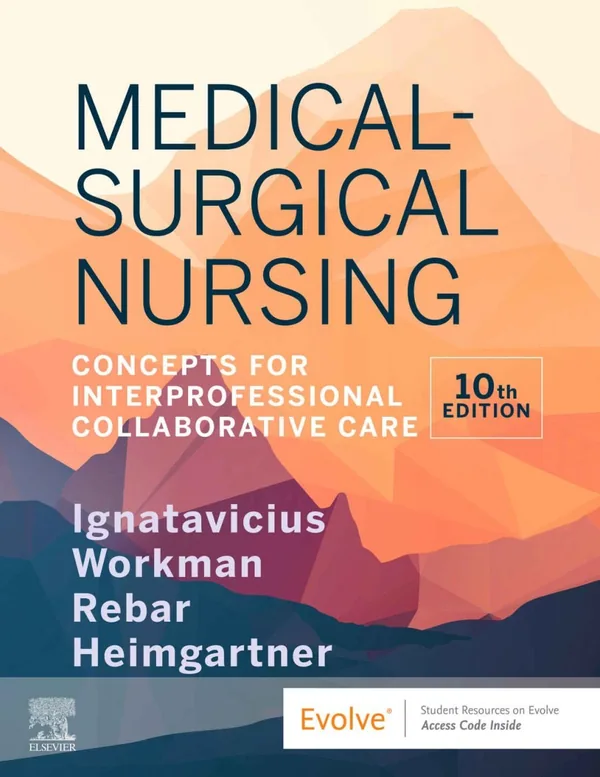
Medical-Surgical Nursing: Concepts for Interprofessional Collaborative Care, Tenth Edition, examines adult health nursing through clinical concepts and team-based care. Intended for nursing students and nurses reviewing medical-surgical subjects, it connects pathophysiology, pharmacology, assessment, patient safety, and clinical judgment across conditions, with cases illustrating the application of nursing knowledge.
Inside this title
Adult health conditions connected through recurring nursing concepts
Current listed price $44.99Regular price $132.00Digital ebook
Perfusion, oxygenation, mobility, nutrition, and elimination provide connections across the adult health conditions examined in this text. Disease mechanisms and medication considerations are integrated with assessment and nursing responsibilities, allowing readers to follow relationships between a patient's condition and the care being considered. The interprofessional focus examines how nursing work interacts with that of other healthcare disciplines.
Cases and clinical judgment questions invite students to identify relevant information, analyze findings, and consider priorities. Patient-centered care, cultural considerations, infection control, medication reconciliation, and other safety concerns recur throughout the discussion. The tenth edition supports associate degree and baccalaureate medical-surgical coursework and review of the conceptual foundations used to reason through adult nursing situations.
Study guide included
Inside Medical-Surgical Nursing: Concepts for Interprofessional Collaborative Care, 10th Edition.
This edition frames adult health nursing around recurring concepts and the six steps of clinical judgment, then shows how teams, systems, and safety routines determine whether good reasoning reaches the patient. Exemplar chapters, evidence boxes, and transition features turn theory into practice.
Professional concepts come first: clinical judgment, systems thinking, and the settings and roles that shape care delivery. The book then works through disaster and emergency response, fluids and acid-base regulation, defense against infection, and the perioperative period before settling into paired units. Each system receives an assessment chapter followed by condition chapters, so readers learn what to look for before studying what goes wrong. Clinical Judgment Challenges apply the NCSBN model to unfolding cases. Boxes summarizing research, quality improvement examples, safety alerts, and features on care coordination connect decisions to outcomes and to the next care setting.
Six skills of clinical judgment
The text maps the nursing process onto a six-step judgment sequence: recognize cues, analyze them, rank the likely explanations, devise responses, act, and evaluate. Cases start from findings rather than diagnoses, forcing learners to group related changes and state what information is still missing before committing to a response. Systems thinking then asks how routines and handoffs helped or hindered.
Group cues before naming a cause
State the missing information
Trace where responsibility moves
Chs. 1–3, professional and health concepts
Concepts organize, exemplars test them
Broad ideas such as perfusion, clotting, gas exchange, and mobility give students a shelf to place conditions on. Each exemplar shows how one concept behaves in a particular illness, while paired chapters supply the condition-specific detail. When two concepts overlap, readers weigh which findings back each explanation rather than letting one label drive the plan.
Start with the organizing concept
Add the exemplar's specific findings
Compare findings behind overlapping explanations
Ch. 3 and Units VI–VIII, health concepts and exemplars
Baselines, trends, and urgency
Chapters on fluids, electrolytes, acid-base regulation, emergencies, disasters, and infection share one demand: place each finding on a timeline. A measurement without a comparison point says little, and an urgent change needs both a clear description and a named recipient. Later checks reveal whether the concern settled or needs escalation.
Anchor findings to a baseline
Describe change, not just severity
Close the loop after escalation
Chs. 9–16 and 21, perioperative care through infection
Assessment chapters before care chapters
Most units open with normal function and systematic assessment, then move to disorders. That order matters: cues are learned first, so the disease chapter has something to attach to. Cardiovascular and respiratory units demonstrate the sequence clearly, and later units repeat the pattern across the nervous system, digestion, hormones, kidneys, and reproduction.
Learn normal before abnormal
Read assessment as a cue list
Combine systems when problems overlap
Units V–XV, system assessment and care
Evidence boxes and safety alerts
Research summaries, quality improvement stories, and alert features are treated as reasoning prompts rather than decoration. Readers are asked to check a study's context, outcome measures, and sample before borrowing its conclusion, and to turn each safety alert into a concrete observation to verify. The patient's wishes and personal circumstances belong in the final decision.
Check whether evidence fits the case
Convert alerts into checks
Weigh patient preference explicitly
Chs. 1–2 and exemplar chapter safety features
Transitions need clear owners
Care coordination features extend planning past discharge. The plan must state what the person and their family will do, what support exists, which barriers remain, and who follows up. Teach-back confirms understanding, and documentation should record both the unresolved issue and the person responsible for reviewing it, so the next setting is not left guessing.
Name the barrier, not just the plan
Confirm learning with teach-back
Assign every open issue
Care Coordination and Transition Management features
Chapter and section map
Clinical Judgment and Systems ThinkingCh. 2
Concepts of Fluid and Electrolyte BalanceCh. 13
Concepts of Care for Patients With InfectionCh. 21
Assessment of the Respiratory SystemCh. 24
Concepts of Care for Patients With DysrhythmiasCh. 31
Critical Care of Patients With ShockCh. 34
Concepts of Care for Patients With Diabetes MellitusCh. 59
Acute Kidney Injury and Chronic Kidney DiseaseCh. 63
Key takeaways
Group related cues under a concept, then let the exemplar supply condition-specific detail.
Pair each hypothesis with the observation that would confirm or weaken it.
Make every transition explicit: next action, owner, and how the result gets checked.
Nursing students in associate, baccalaureate, and accelerated programs, new graduates preparing for licensure, and practicing nurses who want a case-based review with team and safety emphasis.
Topics covered
medical-surgical nursing
interprofessional care
clinical judgment
concept-based learning
Ignatavicius text
nursing exemplars
care transitions
patient safety
Other editions of this title.
Compare editions, prices, and book details before you choose.
Edition, audience, and study-guide details at a glance.
What is Medical-Surgical Nursing: Concepts for Interprofessional Collaborative Care, 10th Edition about?
Medical-Surgical Nursing: Concepts for Interprofessional Collaborative Care, Tenth Edition, examines adult health nursing through clinical concepts and team-based care. Intended for nursing students and nurses reviewing medical-surgical subjects, it connects pathophysiology, pharmacology, assessment, patient safety, and clinical judgment across conditions, with cases illustrating the application of nursing knowledge.
Which edition of Medical-Surgical Nursing: Concepts for Interprofessional Collaborative Care, 10th Edition is this?
This listing is for the 10th edition. Check the title, ISBN, and book details above before ordering, especially if your course or reading list names a specific edition.
Who is Medical-Surgical Nursing: Concepts for Interprofessional Collaborative Care, 10th Edition for?
Nursing students in associate, baccalaureate, and accelerated programs, new graduates preparing for licensure, and practicing nurses who want a case-based review with team and safety emphasis.
Does this page include a study guide?
Yes. This page includes an original study guide with six thematic sections, key takeaways, and a chapter and section map for structured reading.