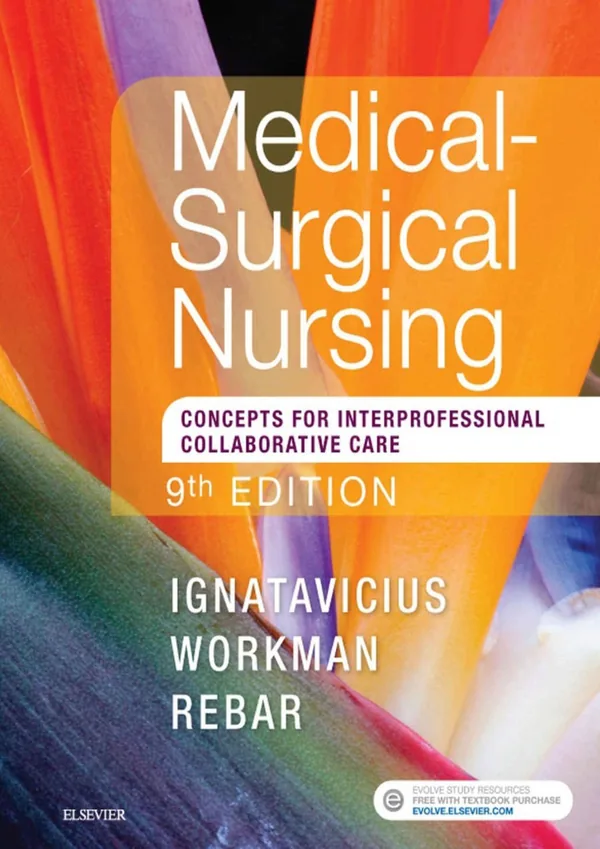
Medical-Surgical Nursing: Concepts for Interprofessional Collaborative Care, Ninth Edition, links adult health conditions through concepts such as oxygenation, perfusion, mobility, and cognition. Ignatavicius, Workman, and Rebar integrate assessment, pathophysiology, interventions, and collaborative roles for nursing students, using cases and clinical judgment discussions to examine priorities in patient care.
Inside this title
Adult health concepts connecting oxygenation, perfusion, mobility, and cognition
Current listed price $38.99Regular price $119.00Digital ebook
This adult health text uses recurring nursing concepts to relate conditions that may otherwise be studied separately. Assessment findings, disease processes, nursing diagnoses, and interventions are brought together within that framework. Collaborative care discussions consider how nurses coordinate responsibilities with physicians, pharmacists, respiratory therapists, social workers, and other team members.
Clinical judgment material and case studies encourage readers to interpret patient information and consider competing care priorities. The book also incorporates older adult needs, cultural considerations, end-of-life issues, and safety and quality concepts. Associate degree, baccalaureate, and accelerated nursing students can use the ninth edition to organize medical-surgical knowledge and examine the reasoning behind nursing actions across a variety of adult clinical situations.
Study guide included
Inside Medical-Surgical Nursing: Concepts for Interprofessional Collaborative Care, 9th Edition.
Adult health nursing becomes manageable when a small set of concepts carries across diseases. This edition pairs pathophysiology with bedside findings, then asks learners to justify priorities using a structured judgment model, interprofessional roles, and the patient's own baseline and goals.
Opening chapters lay out professional practice, comfort, aging, genomic variation, rehabilitation, and care at the end of life before moving into emergency and surgical care. The bulk of the volume then walks system by system: fluid and electrolyte balance, respiratory function, cardiac rhythm, hematology, immunity, neurology, movement, nutrition, kidney function, and endocrine regulation. Each unit pairs an assessment chapter with condition-specific ones. Case discussions, safety alerts, and evidence boxes keep returning to the same question: which finding matters most right now, and who needs to act on it.
Priority concepts guide the plan
Rather than memorizing each disorder separately, the opening chapters hand learners a handful of recurring ideas — oxygenation, circulation, mobility, comfort, tissue integrity — and show how they steer assessment. A concept earns its place only when it connects to something observable and to a result the care team can later verify. The patient's own preferences, plus their normal routine, shape how the outcome is phrased.
Tie each concept to a finding
Let patient goals set the target
Name what the team will recheck
Chs. 1–7
Reasoning moves through four phases
Tanner's model — notice, interpret, respond, reflect — is woven into the nursing-process headings so students can explain how a judgment formed. Noticing starts from the person's normal state; interpreting weighs context and competing explanations. Responding must fit the evidence and each professional's responsibilities, and reflection asks both how the patient reacted and how the decision itself was reached. The aim is a defensible trail, not a lucky guess.
Start from the usual state
Weigh competing explanations carefully
Ask how the call was made
Preface and clinical judgment features
Rapid change demands clear handoffs
Emergency, fluid, acid-base, and perioperative chapters share a common problem: information has to survive a change of setting or a sudden deterioration. Trends over time beat any single number, and a handoff works only when the receiving clinician knows the baseline, the shift, and the planned recheck. Treating preparation, the operation, and recovery as one chain exposes what must travel between them.
Compare readings across time
State baseline, change, recheck
Follow info between surgical phases
Chs. 8–16
Gas, flow, and blood overlap
Respiratory, cardiac, and hematologic units are separated for study but converge at the bedside. The assessment chapter for a system establishes what normal looks like; the chapters that follow apply it to pneumonia, dysrhythmia, anemia, and clotting disorders. Because fatigue or poor tolerance can stem from any of the three, learners compare findings rather than assign a cause from one symptom. Concept maps and reviews test whether the chosen priority fits the whole picture.
Read the assessment chapter first
Compare symptoms that overlap
Check the priority against the pattern
Chs. 27–40
Safety checks test your reasoning
Later units cover immunity, infection, skin, neurologic, musculoskeletal, nutritional, endocrine, and renal care — different content that shares worries about protection, daily function, and education. Evidence and quality boxes link clinical choices to current studies, while drug and safety features flag steps easy to skip. Learners should identify what makes a check critical in a given context and what a satisfactory response would look like, stated in terms the team can observe.
Find the pattern across units
Treat safety boxes as checks
Say what a good response looks like
Units V–VI and X–XVI
The next setting is part of care
Discharge planning is framed as clinical work, not paperwork. Coordinating with outside agencies and family caregivers requires knowing what the patient hopes to resume, which self-care tasks they grasp, and what practical help exists. Sensory, language, movement, and caregiver limits all change how teaching is delivered. A transition record should separate what has been explained from what is still open, then name who will follow the unresolved items.
Ask what the person wants next
Check understanding in their words
Assign an owner for open items
Care coordination and transition features
Chapter and section map
Overview of Professional Nursing ConceptsCh. 1
Rehabilitation ConceptsCh. 6
Problems of Fluid and Electrolyte BalanceCh. 11
Care of Postoperative PatientsCh. 16
Assessment of the Respiratory SystemCh. 27
Care of Patients With DysrhythmiasCh. 34
Care of Patients With Diabetes MellitusCh. 64
Acute Kidney Injury and Chronic Kidney DiseaseCh. 68
Key takeaways
Let the patient's baseline and stated goals decide which change earns attention first.
Carry one concept across conditions, but check what each disease adds to the reasoning.
Reflect afterward to strengthen whatever assessment, choice, or handover you face next.
Nursing students in adult health courses, newly licensed nurses, and instructors who want a concept-driven text with cases for practicing prioritization, interprofessional coordination, and transition planning.
Topics covered
medical-surgical nursing
concept-based learning
clinical judgment
interprofessional care
adult health
patient safety
care transitions
nursing education
Other editions of this title.
Compare editions, prices, and book details before you choose.
Edition, audience, and study-guide details at a glance.
What is Medical-Surgical Nursing: Concepts for Interprofessional Collaborative Care, 9th Edition about?
Medical-Surgical Nursing: Concepts for Interprofessional Collaborative Care, Ninth Edition, links adult health conditions through concepts such as oxygenation, perfusion, mobility, and cognition. Ignatavicius, Workman, and Rebar integrate assessment, pathophysiology, interventions, and collaborative roles for nursing students, using cases and clinical judgment discussions to examine priorities in patient care.
Which edition of Medical-Surgical Nursing: Concepts for Interprofessional Collaborative Care, 9th Edition is this?
This listing is for the 9th edition. Check the title, ISBN, and book details above before ordering, especially if your course or reading list names a specific edition.
Who is Medical-Surgical Nursing: Concepts for Interprofessional Collaborative Care, 9th Edition for?
Nursing students in adult health courses, newly licensed nurses, and instructors who want a concept-driven text with cases for practicing prioritization, interprofessional coordination, and transition planning.
Does this page include a study guide?
Yes. This page includes an original study guide with six thematic sections, key takeaways, and a chapter and section map for structured reading.